From a Wheat Field in Anhui to a Wider Question
For readers outside China, Xu Congxiang may not be a familiar name. According to public reports, he is a grain grower from Zhanghuai Village in Taihe County, Fuyang, Anhui Province, and has spent most of his life working with wheat and soybean fields. Local people have called the veteran farmer a living dictionary of farming because he kept notebooks, tested methods in the field, and explained difficult agronomic ideas in plain language that neighboring growers could use.
His story is useful for a smart agriculture audience not because it is a complete biography, but because it shows a practical shift many farms are now facing. Traditional experience did not disappear from the fields. It was written down, tested, compared with scientific advice, and gradually connected to Modern Farming Technology such as crop monitoring, farm monitoring, remote sensing, drones, and digital field data.
This article is based on facts described in public reporting about Xu Congxiang and his family. Wewin Smart Agri did not participate in the projects described here, and the examples are used only to discuss how Modern Farming Technology can turn field experience into more timely and measurable decisions.
Traditional Experience Was the First Field Database
The family’s farming knowledge began in a period when fieldwork depended heavily on labor, memory, and repeated observation. Public reports describe how, after leaving a short teaching job in the early 1970s, Xu returned to farming because he wanted local families to grow more grain. At that time, farmers still had few scientific tools, so a magnifying glass, a kettle, borrowed agricultural books, and notebooks became part of his working equipment.
Those notebooks mattered because they converted daily field experience into records. The veteran farmer observed crop growth during the day and studied by lamplight at night, looking for ways to raise wheat yields and manage soybeans under difficult conditions. He summarized practical rules about deep tillage, watering, fertilizer timing, strong seedlings, and crop recovery in simple rhymes that villagers could remember.
For a modern farm manager, this early stage looks surprisingly close to the first layer of Precision Agriculture. The data was not digital, but it had structure: crop stage, soil condition, weather stress, seedling strength, and the response after a management action. Modern Farming Technology does not replace that kind of observation; it gives experienced grain growers a faster and more consistent way to capture it.
Science Entered the Farm Through Experiments and People
The next step in the story was not an app or a dashboard. It was collaboration with agronomists and agricultural research institutions. Public reports say that in 2007, the farm invited experts from provincial and municipal agricultural science academies to the village, turning a family courtyard into a place where local farmers could learn from specialists.
That move changed the meaning of experience. Instead of relying only on what one farmer had seen in one season, the village began to compare varieties, test methods, and use expert guidance to decide what should be adopted more widely. Reports describe the screening of more than 20 wheat varieties and the breeding of a soybean variety known as Taifeng No. 6, as well as high-yield fields that refreshed yield records in Anhui. Similar wheat improvement research is also conducted by the International Maize and Wheat Improvement Center (CIMMYT), one of the world’s leading agricultural research organizations focused on improving wheat productivity and sustainable farming.
This is the bridge between traditional farming and Precision Farming. A farmer’s question becomes a trial. A trial becomes a repeatable method. A repeatable method becomes something that a cooperative, family farm, or service provider can scale across larger areas with less guesswork.
Weather Risk Turned Experience Into Planning
One of the strongest episodes in the public reports is the heavy rainfall in the Huang-Huai region in 2003. A large soybean demonstration field was flooded, and the family worked with local village cadres to drain water and protect seedlings. The farm also changed from root fertilization to foliar fertilization to help the soybean plants recover after flooding.
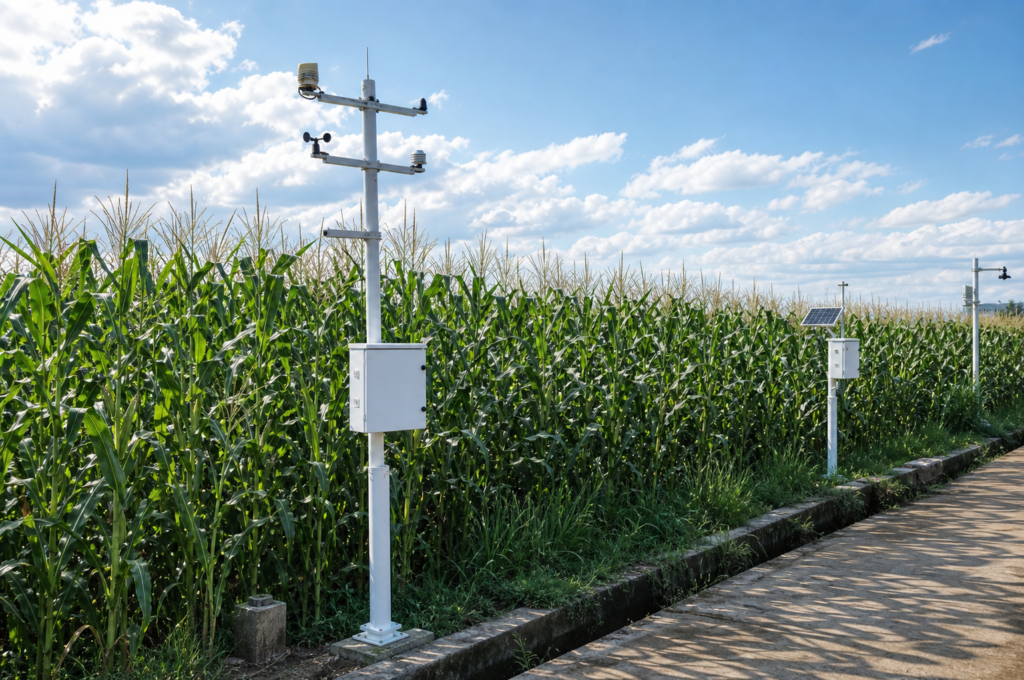
The lesson is not simply that a farmer worked hard in bad weather. This approach is consistent with the FAO Digital Agriculture initiative, which emphasizes using digital technologies and data to improve agricultural decision-making. It is that weather risk forced a change in management. In today’s smart agriculture, Weather Monitoring helps farms read rainfall, temperature, humidity, wind, and disease-conducive conditions earlier, so a team can prepare drainage, spraying, irrigation, or field access decisions before the damage becomes obvious.
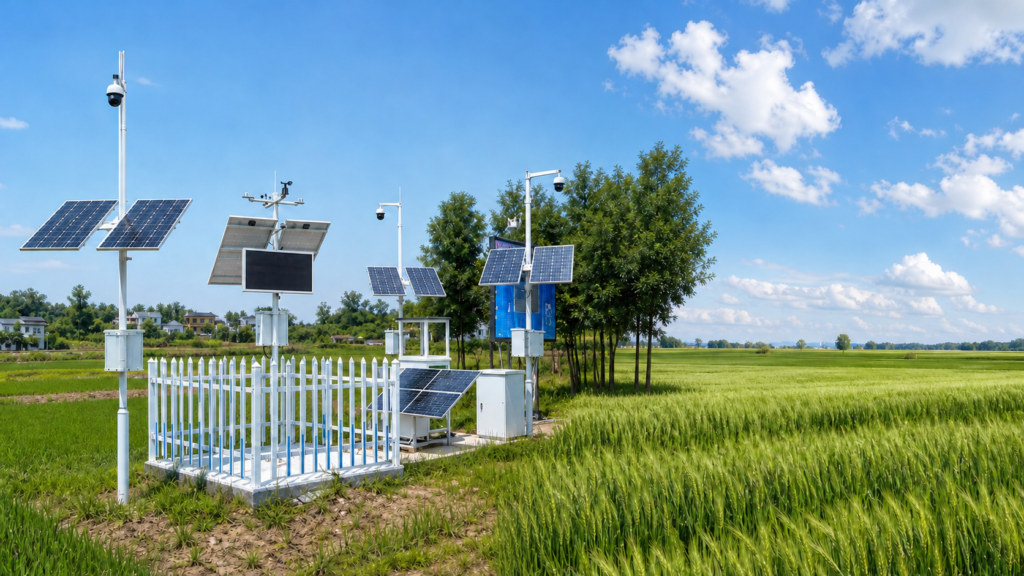
A practical Weather Monitoring System often starts with an Automatic Weather Station and Agricultural Sensors placed near the crop area. Temperature and Humidity Sensors, rainfall gauges, wind sensors, and other Environmental Sensors help modern farm managers predict disease outbreaks, schedule irrigation, reduce weather risks, and adjust crop management before stress is visible in the canopy. The value is not the data point itself; it is the decision it supports, such as delaying a spray in high wind or preparing irrigation after a dry, hot period.
Public reports say that the village’s soybean yield that year was later checked by agricultural experts and reached a high level for summer soybean planting in the Huang-Huai region. That fact should be cited carefully in any published article, but the operational point is clear: weather does not become manageable because a farm becomes digital. It becomes more manageable when observation, forecast, response, and follow-up measurement are connected.
Monitoring Pests Before They Become a Fieldwide Problem
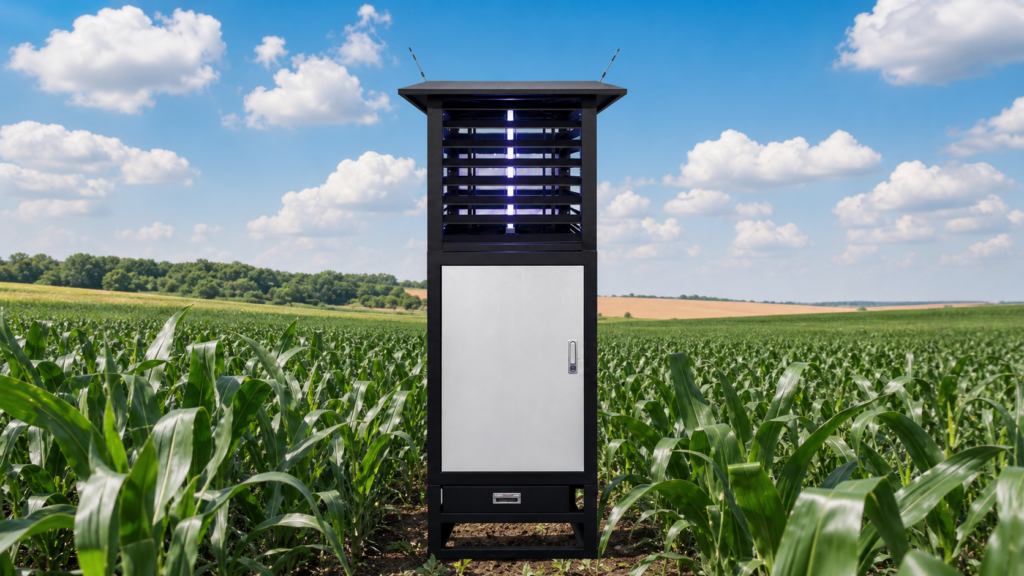
In the recent phase of the demonstration farm, public reporting describes the introduction of intelligent monitoring systems, including visible field monitoring stations for diseases and pests and an automatic monitoring and warning system for wheat scab. The reports also mention satellite remote sensing terminals that improved the accuracy of pest and disease warning, along with drone crop protection and Beidou-guided planting machinery.
For farms, a Pest Monitoring System is valuable because pest pressure is rarely uniform. Automatic pest monitoring can help identify insect activity, disease-conducive conditions, and field zones that need closer scouting. When the warning is early enough, a farm may avoid unnecessary pesticide spraying, protect beneficial field conditions, and improve crop quality by treating the right problem at the right time.
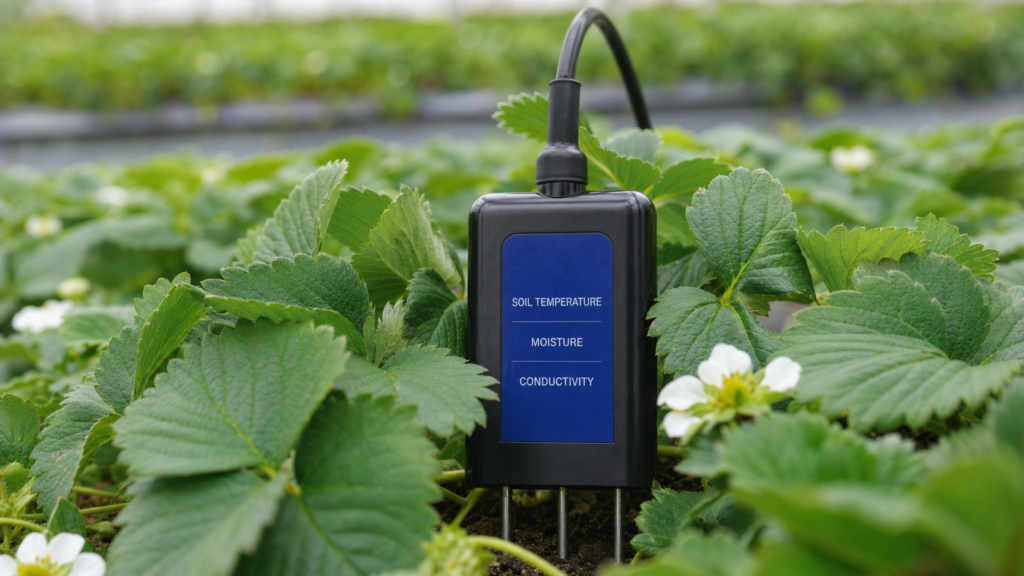
This is where Agricultural Sensors become more than devices placed in a field. Soil Moisture Sensors, Temperature and Humidity Sensors, leaf wetness sensors, light sensors, and other Environmental Sensors help explain why a crop is stressed and whether a pest or disease risk is linked to the field environment. In IoT Agriculture, sensor readings only become useful when they help a manager decide where to inspect, whether a threshold has been reached, and whether a drone crop protection operation should cover the whole area or a targeted zone.
Large farms, orchards, and remote agricultural areas often need a LoRa Sensor Network because Wi-Fi coverage is limited beyond buildings and yards. LoRa enables long-range communication between Agricultural Sensors and gateways while consuming very little power, which is useful when devices stay in the field for long periods. For Crop Monitoring and Farm Monitoring, that quiet connection keeps soil, weather, and pest data moving without asking every field to behave like an office network.
Remote Sensing Adds the View a Farmer Cannot See From the Ridge
A farmer walking a field can see leaf color, lodging, soil cracks, and waterlogged patches with a trained eye. What is harder to see from the ridge is variation across hundreds or thousands of mu, especially when land is managed through a cooperative or family farm. That is why satellite remote sensing has become important in the wider move toward Modern Farming Technology.
The public reports mention satellite remote sensing terminals in relation to disease and pest warning. In a broader Precision Agriculture workflow, satellite remote sensing can help identify crop growth differences, stress patterns, and areas that deserve closer ground inspection. It does not tell the whole truth by itself, but it can tell a farm manager where to look.
This matters for service providers as much as for growers. If a cooperative needs to schedule scouting, pesticide application, irrigation checks, or harvest planning, a map-based signal can reduce blind spots. The farmer’s experience still interprets the signal, but the signal shortens the time between a field problem and a management decision.
Drones, Navigation, and Irrigation Make Decisions Executable
Public reports describe Xu’s grandson Xu Xudong saying that his grandfather urged the family to buy drones and improve field infrastructure quickly. That detail is small, but it captures a real change in farming. Once monitoring identifies a risk, the farm still needs tools that can act at the right time and in the right place.
Drone crop protection is one way to close that gap. It can support timely spraying when field access is difficult, when labor is limited, or when a treatment window is narrow. In the same logic, Beidou-guided seeding machinery, mentioned in the public reporting, can reduce missed seeding and repeated seeding, turning a planting plan into straighter, more consistent field execution.
Smart Irrigation belongs in the same decision chain. Agricultural Sensors, Weather Monitoring, and Soil Moisture Sensors work together to show whether a crop needs water, whether rainfall is likely to cover the need, and whether irrigation could worsen disease pressure after humid weather. In Modern Farming Technology, irrigation is not only about delivering water; it is about matching water decisions to crop stage, soil condition, rainfall, and disease risk so water is used with more discipline.
A Three-Generation Story Without Turning It Into a Biography
The family story gives the article human weight, but the main lesson is agricultural change. Public reports describe Xu Congxiang as the first generation focused on raising grain output through experiments, demonstrations, and farmer education. His son Xu Jian later returned from an agricultural input business, joined the farming work, and helped build a cooperative in 2010.
The third generation, Xu Xudong, grew up around wheat fields but studied architecture before returning home. Reports say he helped digitize his grandfather’s handwritten materials while still in university, later came back to the village, and eventually became chairman of the cooperative after his father passed away in 2022. His own way of thinking is less about chasing the highest theoretical yield and more about planning for disasters, reducing risk, improving quality, and keeping output within a stable and reasonable range.
That generational change is relevant to project managers and farm owners because technology adoption is rarely a single purchase. One generation may collect experience by hand. Another may organize land, labor, and cooperative services. A younger generation may connect those foundations to Agricultural Sensors, Weather Monitoring Systems, Pest Monitoring Systems, Smart Irrigation, LoRa communication, branded products, and data-based management.
What This Means for Modern Farming Technology
The most useful reading of this case is not that every farm should copy the same equipment list. The useful reading is that each stage solved a specific problem. Notes solved the problem of forgotten experience, agronomic trials solved the problem of untested assumptions, a Pest Monitoring System addressed delayed warning, and satellite remote sensing helped make field variation visible.
For Wewin Smart Agri’s website audience, this is a grounded way to talk about Precision Agriculture. Agricultural Sensors should answer field questions, not just generate numbers. A Weather Monitoring System should support decisions about drainage, spraying, irrigation, and disease risk. Drone crop protection should be connected to thresholds, crop stage, and field access, rather than treated as a standalone service.
A project manager evaluating IoT Agriculture can ask practical questions from this story. What decisions are made too late? Which observations depend too much on one experienced person? Which risks repeat every season but are still handled by memory? Which data from Crop Monitoring, Farm Monitoring, or a LoRa Sensor Network would change the timing, location, or method of a field operation?
Experience Still Leads, Data Makes It Actionable
The reported experience behind this story shows that Modern Farming Technology is not a clean break from traditional agriculture. The oldest layer is still field knowledge: when seedlings are strong, when water becomes harmful, when fertilizer timing should change, and how a crop looks after stress. The newer layer is that those judgments can now be supported by Agricultural Sensors, weather data, satellite images, pest monitoring, drone operations, Smart Irrigation, and precision machinery.
That is the practical future of smart agriculture. It is not about replacing farmers’ experience with machines. It is about turning experience into decisions that are faster, more measurable, and more consistent, so knowledge built over decades can guide larger fields, younger teams, and uncertain growing seasons without losing the judgment that made it valuable.
Modern Farming Solutions
Looking to modernize your farm with reliable monitoring and automation technologies?
We provide Agricultural Sensors, Weather Monitoring Systems, Pest Monitoring Systems, Smart Irrigation Solutions, LoRa-based Farm Monitoring, and Smart Data Collection Cabinets.
Contact us to discuss your agricultural project.