Mushroom Farming Equipment
Mushroom Farming Equipment & Complete Growing Solutions
Mushroom farming does not have to depend on weather, season, or large land area. With a properly designed controlled environment system, mushrooms can be grown efficiently in different spaces such as rooms, greenhouses, or container farms.
We help mushroom growers get started with equipment that actually works in the real world. Whether you have a greenhouse, a spare room, or a shipping container, we can put together a system that fits your space and budget.
Set your parameters once. The system handles the rest. One person can manage an entire farm, no daily manual labor to save money. And because the environment is fully controlled, you grow year-round, not just when the weather allows.
Why Mushroom Farming
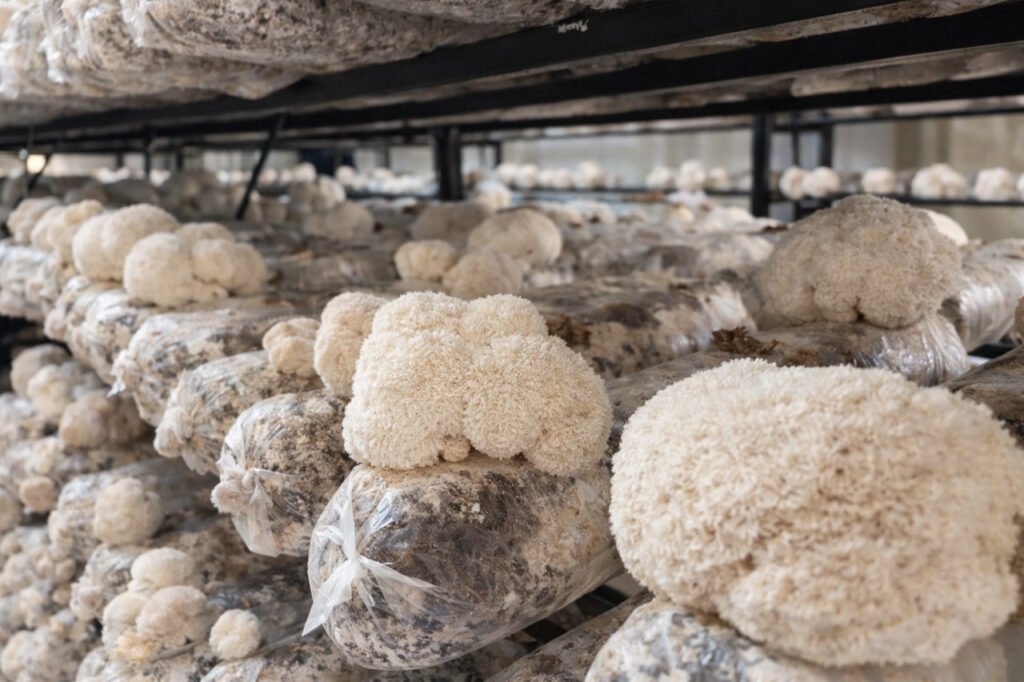
Mushroom farming is one of the most practical and flexible agricultural businesses today. Unlike traditional crops, mushrooms do not rely on sunlight, which means production can take place in a wide range of environments, including indoor rooms, greenhouses, or fully controlled container farms.
The growing cycle is relatively short — typically 6 to 8 weeks from setup to first harvest — and each batch can produce multiple flushes, allowing for continuous production. With multi-layer rack systems, growers can achieve high output even in limited space.
At the same time, controlled environmental systems make it possible to manage temperature, humidity, airflow, and CO₂ more precisely, reducing risks caused by climate and improving consistency. Compared to many other crops, mushroom farming requires lower initial investment, offers faster returns, and is easier to scale as the business grows. We have customers who have already recovered their investment within just six months.
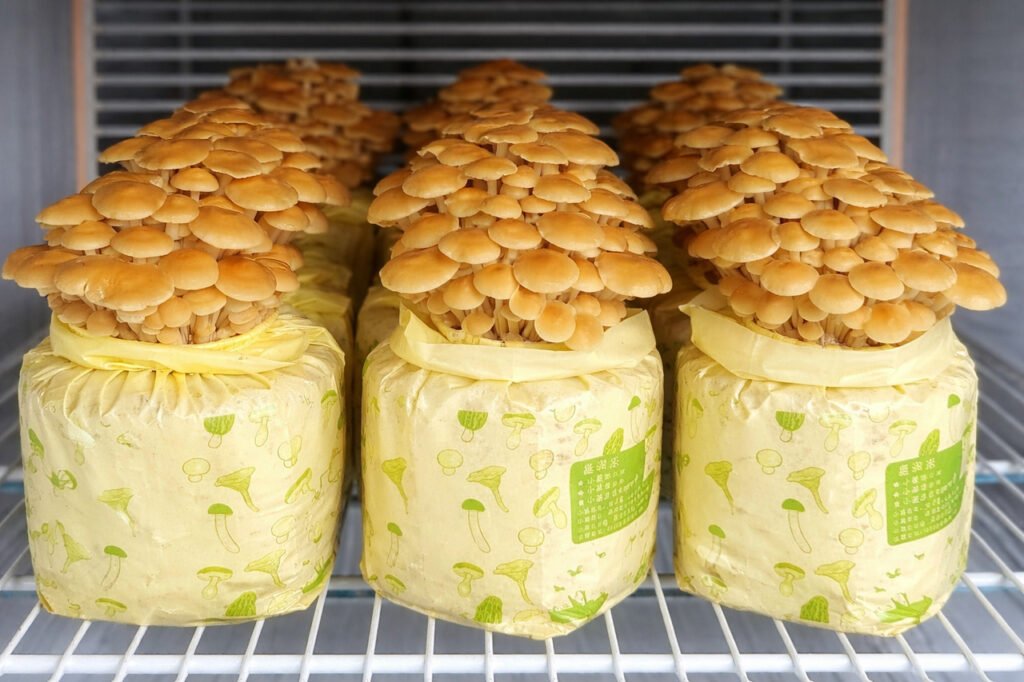
Core Equipment & System Design At the core of the system is a combination of essential equipment working together to create a consistent growing environment. Multi-layer rack systems are used to maximize space utilization and increase yield per square meter. A humidity control system, typically using ultrasonic fogging or misting, maintains the high moisture levels required for proper mushroom development. Ventilation plays a critical role in regulating air quality and controlling CO₂ levels, while temperature management ensures that the growing conditions remain stable across different seasons and climates. These components are not provided as isolated equipment, but as a complete and coordinated system designed to work efficiently as a whole.
Advanced & Optional Systems
As your operation grows, additional systems can improve stability and efficiency:
- CO₂ monitoring and control systems
- Low-intensity LED lighting (for specific varieties)
- IoT remote monitoring (temperature, humidity, CO₂ via mobile)
- Solar-ready power systems (for container farms)
- Full insulation packages for extreme climates
How the System Works
- Prepare your growing space (room, greenhouse, or container)
- Install racks and environmental control systems
- Load mushroom bags or substrate
- Control humidity, airflow, and temperature
- Harvest in continuous cycles
Customer Story: Container Mushroom Farm in China
Why they chose a container
This customer originally made environmental control equipment. They realized their own technology could solve real farming problems — so they built a container plant factory. Not a concept demo. A working farm that ships product consistently. They considered greenhouses and dedicated mushroom houses. Both had the same problem: environment control is hard. When it‘s 30°C outside, a greenhouse can hit 35°C. When it rains, humidity spikes. Crop quality ends up depending on weather. A container is different. It’s fully enclosed. Temperature, humidity, light, CO₂ — everything can be set manually. Whether it‘s 40°C in summer or below freezing in winter, the inside stays exactly where mushrooms need it to be. Another advantage: containers are movable. You can put one on the edge of a city, then move it somewhere else. For growers testing different markets or following demand, that’s a real option.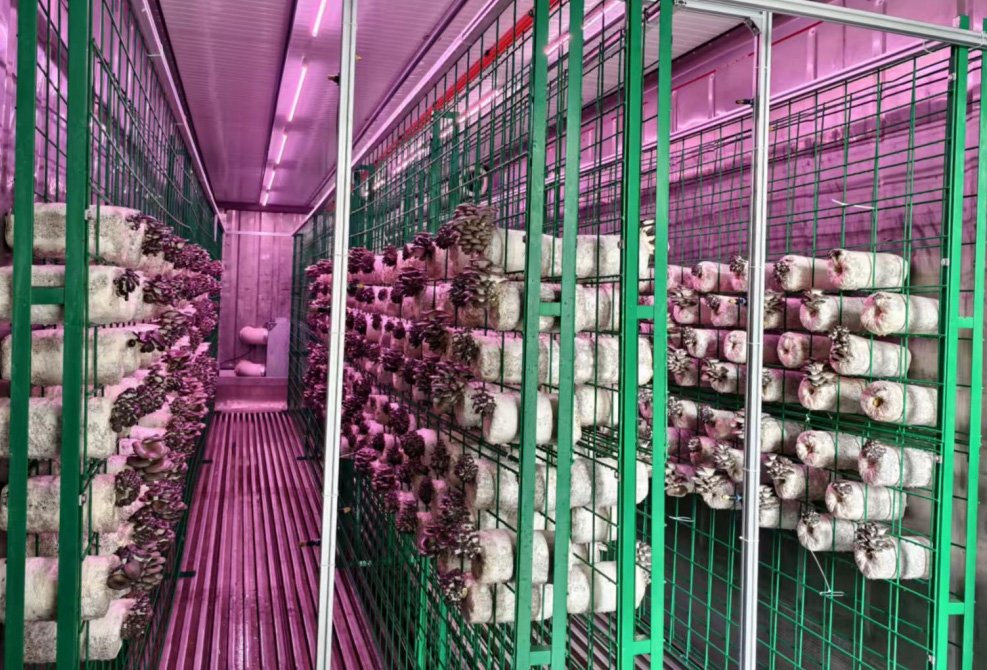
How they laid it out
We have customers who have already recovered their investment within just six months. The control room sits near the entrance. It has a panel showing all environmental data — temperature, humidity, CO₂, light status. You set everything from here: temperature range, fresh air exchange, humidity level, cleaning cycles. One person can run the entire farm from this room.
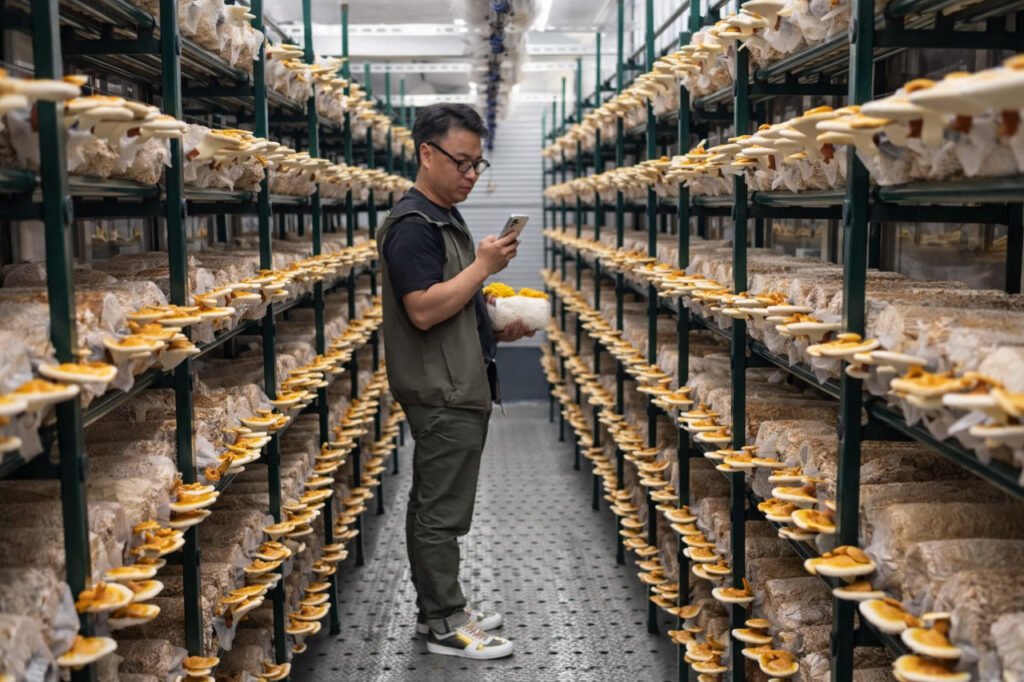
The growing area takes up most of the container. Inside, multi-layer growing racks are made from galvanized steel and alloy vacuum-formed beds — both sterile and contamination-free. Mushrooms grow on stacked shelves, so the same footprint produces significantly higher yields than ground-level growing. CO₂ sensors and temperature/humidity sensors send real-time data back to the control room, so you always know exactly what’s happening inside.
The power and utility room sits at the opposite end. Air conditioning, EC controller, pH controller, nutrient tanks, everything that keeps the system running.
What equipment did they used
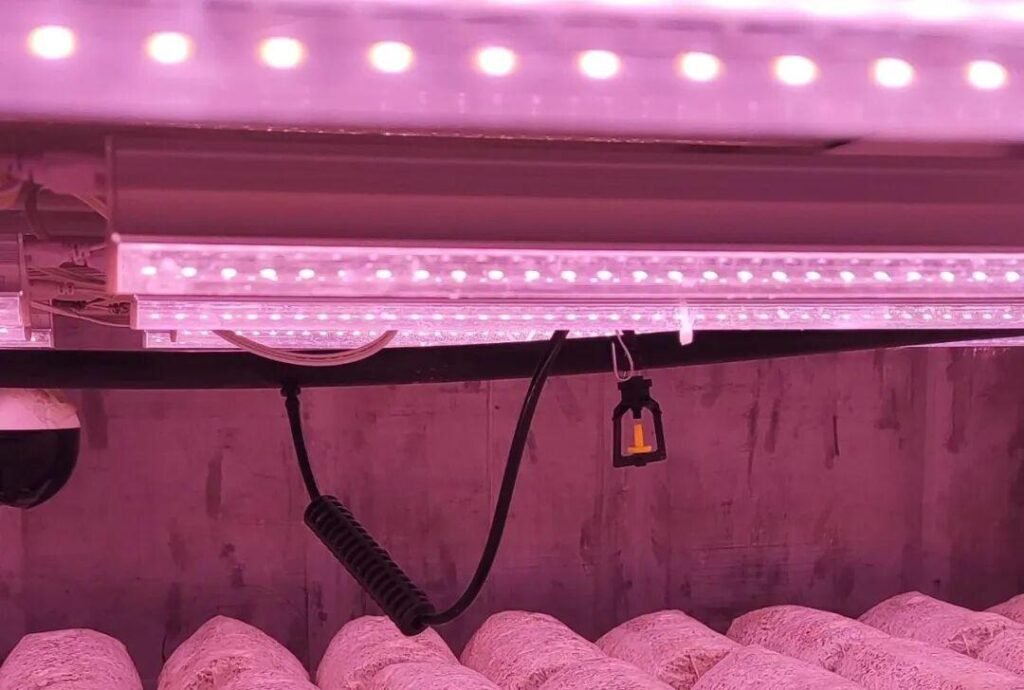
An intelligent environmental control unit connects everything as the core system.- The four-season temperature control system keeps the container at optimal mushroom temperature year-round, regardless of outside weather.
- The fresh air system exchanges air while keeping insects out. Vents open and close automatically. The whole unit can be removed for cleaning.
- The smart lighting system provides supplemental light when needed. Mushrooms don‘t need much light, but the right amount at the right stage improves growth speed and appearance.
- The ozone generator handles several jobs at once — sterilization, odor removal, air purification. In a sealed container where air doesn’t move as freely as open spaces, this makes a real difference.
- The humidification system and misting system keep moisture levels stable. The humidifier maintains ambient humidity. The misting system delivers water directly when needed. One thing they emphasized: don‘t over-mist. Water frequency depends on the mushrooms’ actual needs, not a fixed schedule.
- The CO₂ generation system maintains stable CO₂ levels. Mushrooms consume oxygen and release CO₂, but too much CO₂ is a problem. This system keeps the balance right.
- One more detail: they installed smart cameras. Not for security — to document growth. The camera automatically takes time-lapse photos and generates a short video of the entire growing cycle. Customers can scan a QR code and see exactly how their mushrooms were grown: planting date, environmental data, harvest conditions. Full traceability. For consumers, that‘s a powerful trust signal.
What this case show
This project was not started by a traditional farmer, but by a customer with experience in environmental control systems. They identified a clear opportunity: applying controlled environment technology to solve common challenges in mushroom cultivation, such as temperature fluctuations, inefficient space usage, dependence on weather, and unstable yields.
The choice of a container-based system was not based on trends, but on practicality. A fully enclosed structure provides a stable and controllable environment, making production more predictable and easier to manage.
Across our mushroom farming solutions, two key advantages stand out. First, the system significantly reduces labor requirements by simplifying daily operations through integrated control and automation. Second, it enables reliable year-round production, independent of local climate conditions. Together, these advantages help growers achieve more consistent output with lower operational effort.
join the success
Start Your Vertical
Farming Project
Planning to build a container farm or indoor growing system?
Tell us your project requirements — we will deliver a customized solution within 24 hours.