
Selecting soil moisture sensors for irrigation starts with the decision the readings must support. A probe that tracks wetting and drying may be useful for monitoring, yet still need additional validation before its readings trigger valves automatically. For distributors, irrigation installers and system integrators, the practical question is whether the measurement, interface and installation will fit the customer’s project.
A useful specification goes beyond a moisture range and an accuracy figure. It identifies the growing medium, calibration conditions, output format, installation requirements and evidence needed to accept the delivered equipment. This guide explains how to compare those details and turn a sensor quotation into a workable project specification.
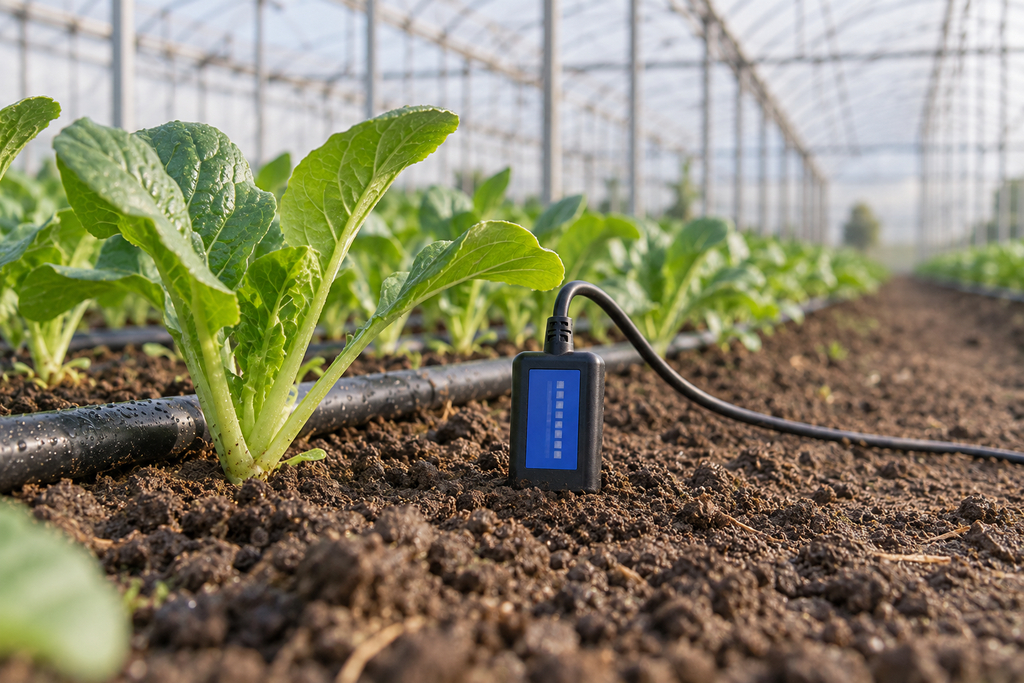
Choose the Sensor Around the Project Decision
For a distributor building a product range, the first question is which customer applications the model can support with documented limitations. For an installer or integrator, it is whether the probe can deliver usable data through the existing controller. For commercial growers, it is whether those measurements represent the managed root zone. These are different acceptance questions, even when the same sensor appears in each quotation.
- Monitoring only: define the medium, measurement units and reporting platform; confirm repeatable trends under the proposed installation.
- Irrigation scheduling: add representative root-zone locations and a method for interpreting readings for the crop and soil.
- Automatic control: add validated controller integration, thresholds, stale-data handling and tested fault responses.
- Repeat supply: require configuration records, documentation revisions and a process for communicating model or firmware changes.
In This Guide
- Choose the measurement and sensor type
- Compare accuracy, calibration and environmental specifications
- Check controller and logger compatibility
- Plan representative installation locations
- Validate samples and troubleshoot readings
- Prepare an RFQ and handover checklist
What Should Soil Moisture Sensors for Irrigation Measure?
Start by writing down the task: observe root-zone drying, check irrigation penetration, compare management zones, or provide an input for automatic control. Those tasks do not necessarily require the same instrument. Specify whether the project needs absolute water-content estimates, repeatable trends, or a measurement of how tightly the soil holds water.
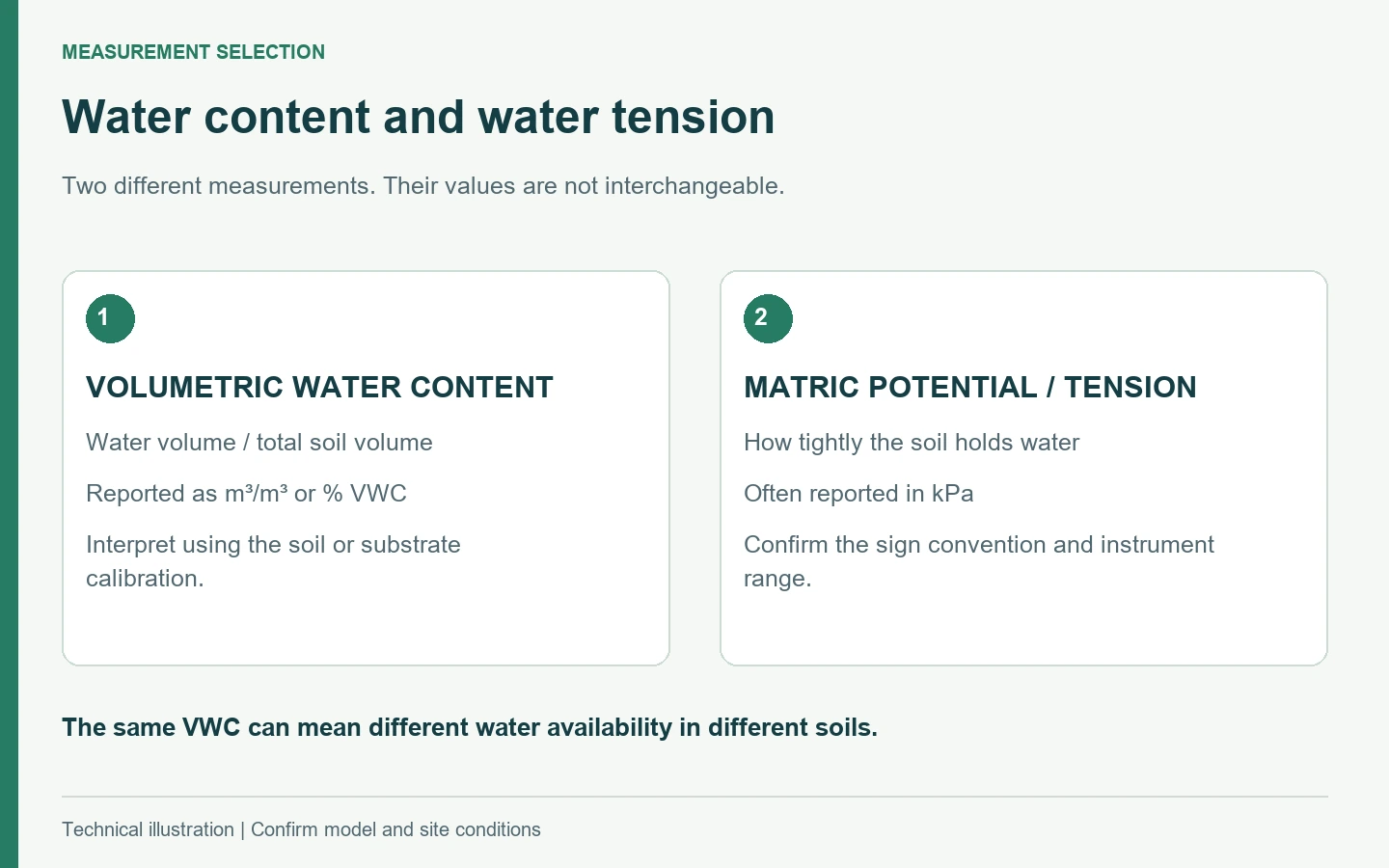
Water content and water potential are different quantities
Volumetric water content, or VWC, describes water volume relative to total soil volume and is commonly reported as m³/m³ or a percentage. Soil water potential describes the water’s energy state; field instruments often measure matric potential or report soil water tension in kPa. Matric potential does not include every component affecting water availability, such as the osmotic effects of salinity.
These readings are not interchangeable. The same VWC can have a different meaning in a sandy soil and a clay soil. Relating water content to potential requires information about the medium’s water-retention behavior. Virginia Tech’s overview of agricultural sensor types explains the main measurement approaches and their practical limitations.
| Sensor approach | Useful project role | Conditions to check |
|---|---|---|
| Capacitance / frequency-domain methods | Continuous VWC trends and multi-point monitoring | Calibration, soil contact, texture, temperature and conductivity limits. |
| Time-domain methods, including TDR | VWC monitoring where documented measurement performance is important | Model-specific accuracy, calibration, conductivity limits and logger requirements. |
| Tensiometers | Matric-potential measurements within the instrument’s working range | Maintenance, cavitation, freezing conditions and suitability for the intended irrigation regime. |
| Granular-matrix sensors | Tension-based monitoring where response characteristics fit the task | Wetting/drying response, soil conditions, temperature compensation and manufacturer instructions. |
Do not choose by the technology acronym alone. Different products using related measurement principles can have very different designs and limitations. Basic conductive hobby probes are also different from engineered granular-matrix instruments; treating both as one “resistive sensor” category can lead to a poor comparison.
Which approach is unsuitable?
A slow-equilibrating instrument may be a poor match for rapid irrigation pulses. A device supplied only with a mineral-soil calibration should not be assumed accurate in coco coir or another substrate. A sensor that provides only an undefined “wetness percentage” is difficult to specify for an application requiring traceable VWC estimates. Ask what the displayed value actually represents before evaluating the price.
How Can Buyers Compare Sensor Accuracy and Calibration?
A quotation should allow the buyer to reproduce the supplier’s claim under stated conditions. If the datasheet lists an accuracy without explaining units, calibration and test conditions, request clarification. A finer display resolution does not establish better accuracy.
Accuracy, resolution and repeatability
- Accuracy: closeness to an accepted reference under defined conditions.
- Resolution: the smallest output increment the device reports.
- Repeatability: how consistently it responds when the measurement conditions are repeated.
For illustration only, an uncertainty of three percentage points at 30% VWC would describe a different interval from an uncertainty of 3% of the reading. This is a calculation example, not a product specification. Ask whether a quoted percentage means percentage points of VWC, percentage of reading, or percentage of full scale.
Also distinguish repeatable behavior from correct absolute readings. Several probes can agree with each other while sharing a calibration bias. Conversely, differences between field probes may reflect real spatial variation. A comparison is meaningful only when the reference method and installation conditions are controlled.
Calibration and salinity conditions
Ask which calibration is supplied, which media it covers and whether site-specific calibration is available or required. Calibration needs depend on the device and the decision being made. Agriculture Victoria’s device-selection guidance highlights soil type, salinity, calibration and irrigation method as factors in selection.
For a multi-parameter probe, confirm the definition of each output separately. Bulk-soil EC, pore-water EC and an extraction measurement are different quantities. An EC reading is not a direct measurement of individual nutrient concentrations. Extra pH or NPK outputs should be assessed using the relevant method, reference and validation evidence rather than assumed trustworthy because they share the same housing.
Housing, cable and power
Check whether the stated environmental rating applies to the complete probe, cable entry and connector arrangement. An IP rating does not by itself establish chemical resistance, permanent-burial suitability or a particular service life. Request the specified test conditions and installation limitations.
Confirm supply voltage, measurement and standby current, startup behavior, cable length and connector pinout. For battery or solar installations, evaluate the complete station, including logger and communications duty cycle. A low-power sensor does not guarantee a particular battery life for the assembled system.
Will the Sensor Work with Your Irrigation Controller?
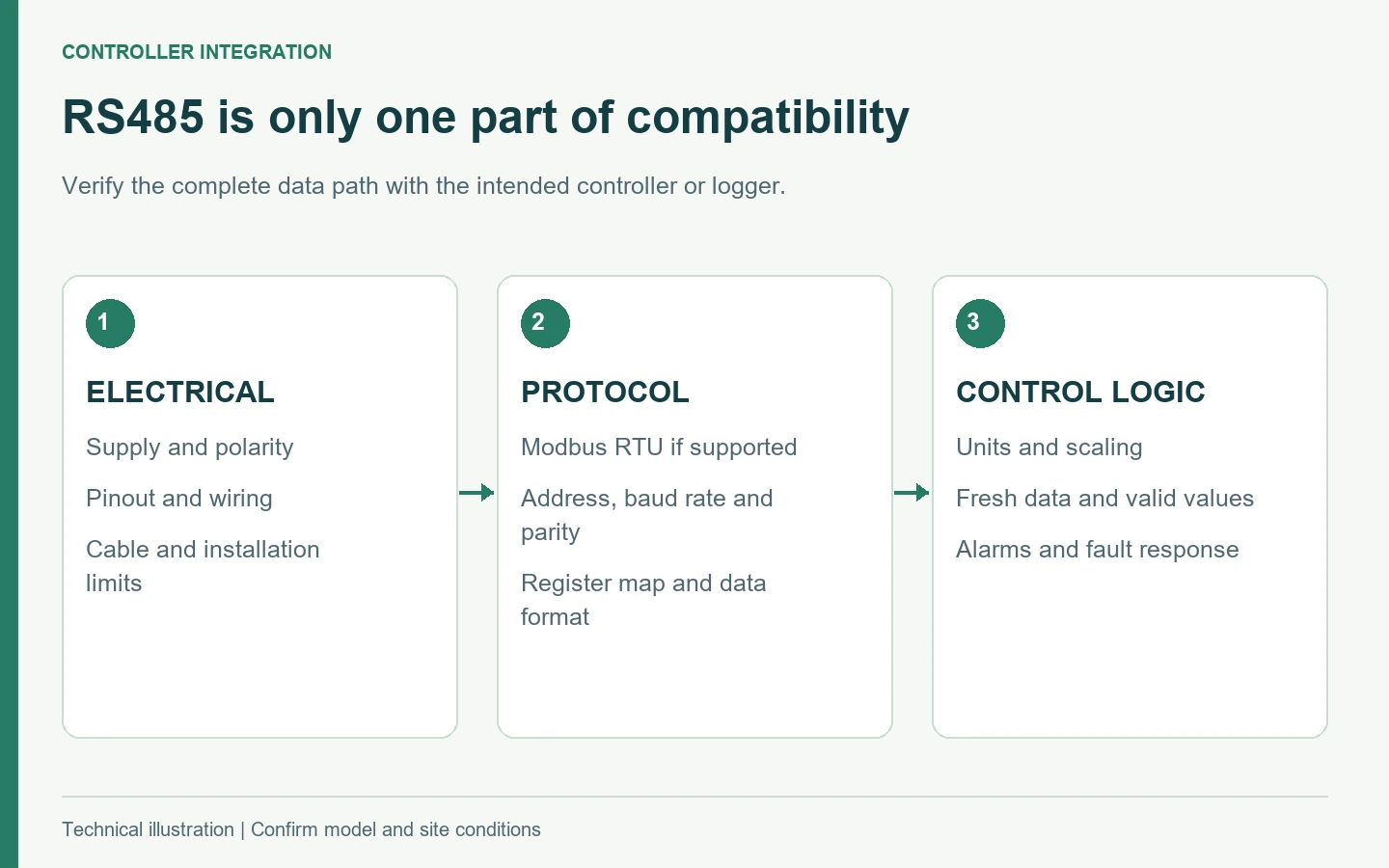
“RS485 output” is not a complete integration specification. RS485 describes an electrical interface; Modbus RTU defines a communication protocol commonly used over it. The controller must support the actual commands and data format used by the selected probe. Matching a connector or reading a familiar acronym is insufficient.
| Check | Information to request | Acceptance evidence |
|---|---|---|
| Electrical connection | Voltage, current, polarity, pinout and cable requirements | A wiring diagram matching the supplied model. |
| Communication settings | Protocol, address, baud rate, parity and supported functions | Successful polling with the intended controller or logger. |
| Data interpretation | Register map, address convention, units, scaling and byte order | Displayed and recorded values match the agreed interpretation. |
| Fault response | Disconnected-probe behavior, invalid-value codes and recovery | An agreed alarm or control response during a deliberate fault test. |
SDI-12 and analog outputs require their own compatibility checks. For analog devices, verify the input type and scaling; a voltage input and a current-loop input are not interchangeable. Wireless connectivity is another layer: a wired probe may connect to a gateway that sends data over a radio or cellular network.
Keep measurement principles separate from communications. Campbell Scientific’s water-content reflectometer documentation describes how dielectric behavior affects signal travel time and water-content estimation. That measurement process does not establish compatibility with a particular controller.
Include a handover package in the order: the datasheet revision, wiring drawing, configuration settings, protocol documentation and an agreed procedure for replacing a probe. For repeat purchases, confirm whether a component or firmware change requires renewed testing.
Can the Cable Be Extended or the Probe Made Wireless?
Request approval for the proposed cable distance and installation arrangement rather than assuming a universal maximum. Supply-voltage drop, electrical interference, interface limits, topology and connector sealing all matter. For RS485, follow the equipment documentation for grounding, shielding, termination and addressing. For analog signals, check the complete input circuit and scaling. Test the intended cable run with the actual controller before committing to a batch.
A wireless system also needs a compatible gateway or network, adequate coverage, a power plan and access to the data. Ask who owns the account, whether data can be exported, what subscription costs apply and what happens when connectivity fails. A radio range advertised under favorable conditions is not a site coverage guarantee.
How Many Sensors Are Needed, and Where Should They Go?
Determine the management zones before choosing a sensor quantity. Different soils, slopes, crop conditions and water-distribution patterns may need separate monitoring. Oregon State’s irrigation-monitoring guide explains representative zones and monitoring at relevant root-zone depths.
Depth should follow the crop’s effective rooting zone and the question being asked. A shallower measurement can help observe wetting and drying, while a deeper measurement can help assess penetration or drainage. There is no universal depth or sensor-per-hectare rule suitable for every farm.
For drip irrigation, define the intended relationship to the emitter. Monitoring directly in the wettest area answers a different question from monitoring a representative part of the root zone. University of Minnesota’s installation guidance emphasizes representative locations, good soil contact and limited disturbance.
Record location, depth, orientation, soil conditions and installation date. Follow the selected model’s instructions for insertion and backfilling. Do not force the probe into stones, leave air gaps around its sensing area, or introduce a preferential water path along the installation hole. Protect the cable from machinery and identify each probe clearly.
What Should You Test Before a Bulk Order?
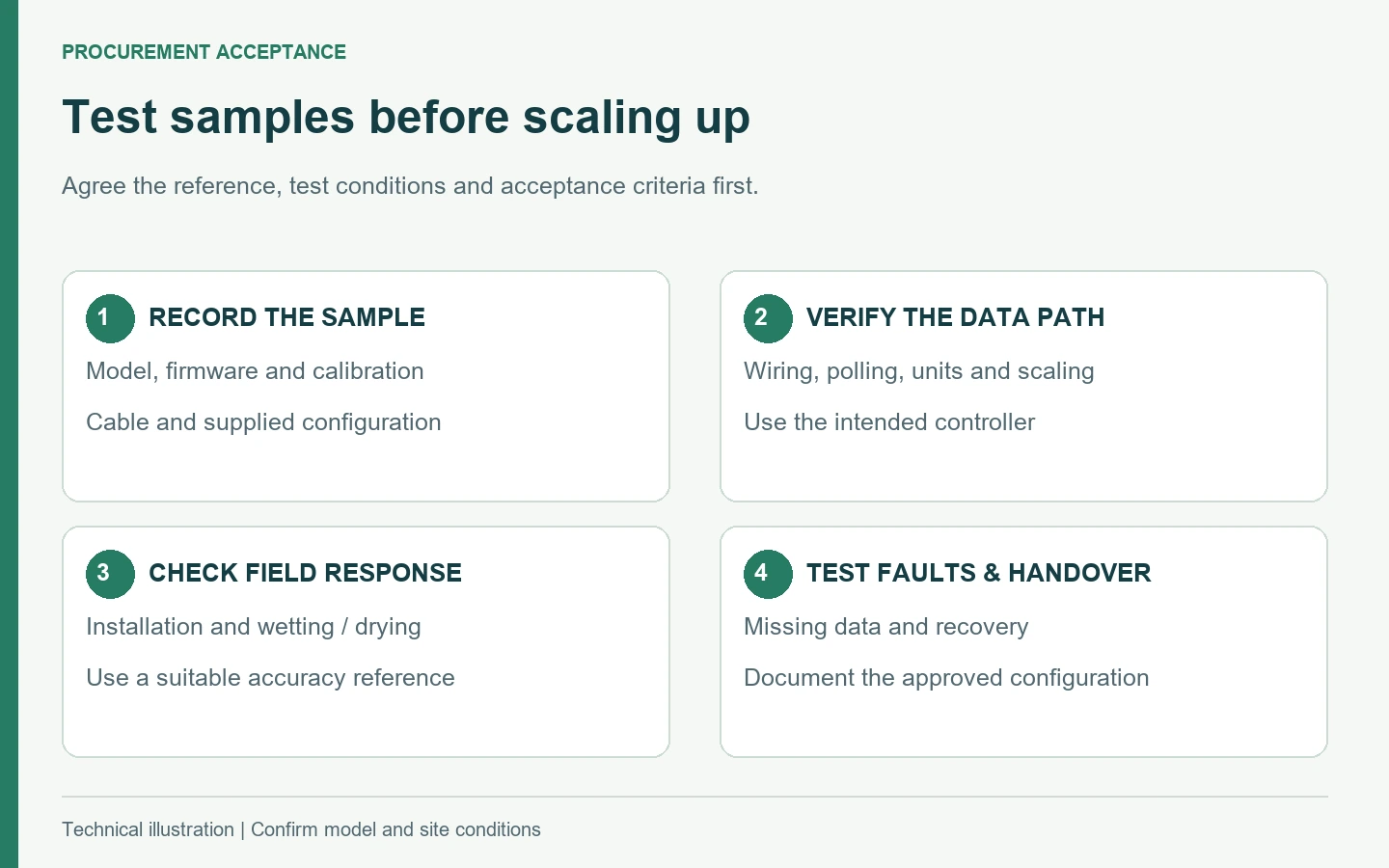
Agree the test objective before asking for samples. An installation contractor may prioritize dependable communication and field trends. A project requiring quantitative water accounting may need a more demanding reference comparison. The sample plan should test the risks of that application, rather than simply demonstrate that the probe outputs a number.
- Document the sample. Record model, serial number where available, firmware, cable length, calibration and supplied settings.
- Check the data path. Verify wiring, communication, units and scaling through the intended logger or controller.
- Evaluate measurement behavior. Use repeatable conditions and an appropriate independent reference where absolute accuracy is required.
- Observe the field response. Record wetting and drying alongside soil observations and irrigation events.
- Test faults and recovery. Check the agreed response to a disconnected probe or interrupted power.
- Approve a configuration. Keep the results and list unresolved exceptions before confirming the production order.
Where gravimetric sampling is used as a reference, the sampling procedure and bulk-density information matter when converting mass-based water content to VWC. A wet/dry demonstration or an air-and-water check may reveal gross faults, but it is not a substitute for a soil-specific accuracy test.
Set acceptance criteria jointly with the supplier and project team. Define the reference, environmental conditions, acceptable deviation, data continuity and fault behavior. Choose sample numbers and test duration according to project risk; a short trial does not prove long-term durability or a guaranteed service life.
Common Problems and What to Check First
| Observed issue | First checks | Avoid this shortcut |
|---|---|---|
| Implausibly low or unstable readings | Air gaps, insertion, wiring, supply and suitability for the medium | Changing calibration before checking installation. |
| An unchanged value after irrigation | Fresh timestamps, live communication, installation depth and wetting pattern | Assuming the sensor is faulty because one location stayed dry. |
| Differences between nearby probes | Actual spatial variation, depth, calibration and output scaling | Averaging every reading without identifying the cause. |
| Changes during fertigation | Conductivity limits, temperature, wetting and calibration conditions | Interpreting every change as additional water or a nutrient concentration. |
| Unexpected valve operation | Threshold logic, stale data, fault codes and control interlocks | Allowing one unchecked value to command irrigation. |
For automatic control, agree how the system handles missing, stale or implausible readings. Test alarms, run-time limits, manual override and any required flow confirmation. Soil sensors should contribute to a control strategy that also considers crop conditions and the irrigation system’s actual delivery.
How Should an Installer Investigate Incorrect Readings?
- Confirm that the data is current. Inspect timestamps and communication status before treating a repeated number as a live measurement.
- Check the data interpretation. Confirm units, scaling, register address and byte order against the exact model documentation.
- Inspect installation and delivery. Check soil contact, depth, emitter operation and wetting pattern; a dry location may indicate distribution rather than sensor failure.
- Review the measurement conditions. Check whether substrate, salinity or temperature falls outside the calibration or operating limits.
- Compare against an appropriate reference. Record the method and conditions before changing calibration or replacing equipment.
For supplier support, send the model and firmware, wiring drawing, controller settings, installation photos and a time series covering irrigation events. Include changes made during troubleshooting. This gives the supplier evidence to distinguish a probe fault from integration or installation problems; an isolated screenshot rarely establishes the cause.
What Information Makes Sensor Quotations Comparable?
“Please quote a soil moisture sensor” leaves too many assumptions unresolved. A useful RFQ gives suppliers the same application information and asks them to identify any conditions their proposed model cannot meet.
- Application: crop, commercial growing setting, soil or substrate, and irrigation method.
- Measurement objective: trend monitoring, water-content estimates, tension measurement, alerts or automatic control.
- Site conditions: expected salinity, temperature, exposure and installation period.
- Layout: management zones, proposed monitoring locations, depths and cable distances.
- Integration: controller or logger model, supported protocol, input type, available power and platform requirements.
- Acceptance: required accuracy basis, reference method, sample-test expectations and documentation.
- Commercial requirements: sample quantity, initial order, expected repeat demand, destination and required delivery date.
- Handover: labeling, packaging, language, replacement configuration, warranty terms and support responsibilities.
Compare the scope of supply as well as unit price. Identify whether cables, connectors, gateways, software fees, configuration, commissioning and support are included. A lower probe price can describe a different package. Oklahoma State’s sensing-system guide also treats data access and the move from readings to irrigation decisions as part of system selection.
For broader sourcing decisions, see our soil monitoring supplier evaluation guide. This article focuses on specifying the sensor; supplier qualification and commercial terms remain separate checks.
Frequently Asked Questions
Is the sensor with the highest advertised accuracy always the right choice?
No. Accuracy must be interpreted alongside calibration conditions, installation, interface support and the intended decision. A well-documented device that fits the project can be more useful than a higher headline figure whose conditions are unclear.
Can a soil sensor be used in coco coir or other substrates?
Only after confirming that the model and calibration are suitable for that medium. Do not assume that a mineral-soil calibration transfers directly. Validate performance under the customer’s actual substrate and irrigation conditions.
Will every RS485 sensor work with an irrigation controller?
No. Check the protocol, electrical requirements, register map and data interpretation, then test the complete connection. Some controllers accept only specified devices or do not expose configurable sensor inputs.
Does a combined moisture, temperature and EC probe replace water-quality sensors?
Not necessarily. Soil measurements and irrigation-water measurements have different locations, methods and roles. Our greenhouse sensor guide explains how several sensor types can contribute to an irrigation monitoring system.
How many samples should a distributor test?
There is no universal quantity. Base the sample plan on model variation, expected order size, application consequences and the available test method. Agree how approved samples relate to later batches and how changes will be communicated.
Can monitoring begin before automatic irrigation control?
Yes. An observation phase can help verify placement, data interpretation and field response. Enable automatic actions only after the project team has checked the control logic and fault handling.
Specify the Project, Then Compare the Sensor
Soil moisture sensors for irrigation should be compared as part of a measurement and control system. Establish the measurement objective, clarify accuracy conditions, check compatibility and record sample acceptance before expanding deployment. Those steps make quotations easier to compare and reduce uncertainty during installation.
Wewin Smart Agri can help coordinate product matching, sample-test requirements and quotations for sensor and irrigation projects. Browse our multi-parameter soil sensor page for a starting point, then request the selected configuration’s current documentation. Additional measurement outputs should be confirmed individually.
To discuss a project, send Wewin your application and procurement requirements: crop and growing medium, irrigation method, monitoring depths, controller model, interface, power supply, expected salinity, current problem, destination and estimated order quantity. Include any existing wiring diagram or datasheet so the quotation can address the actual integration requirements.