An Ancient Warning and the Water Taps of 600 Million People
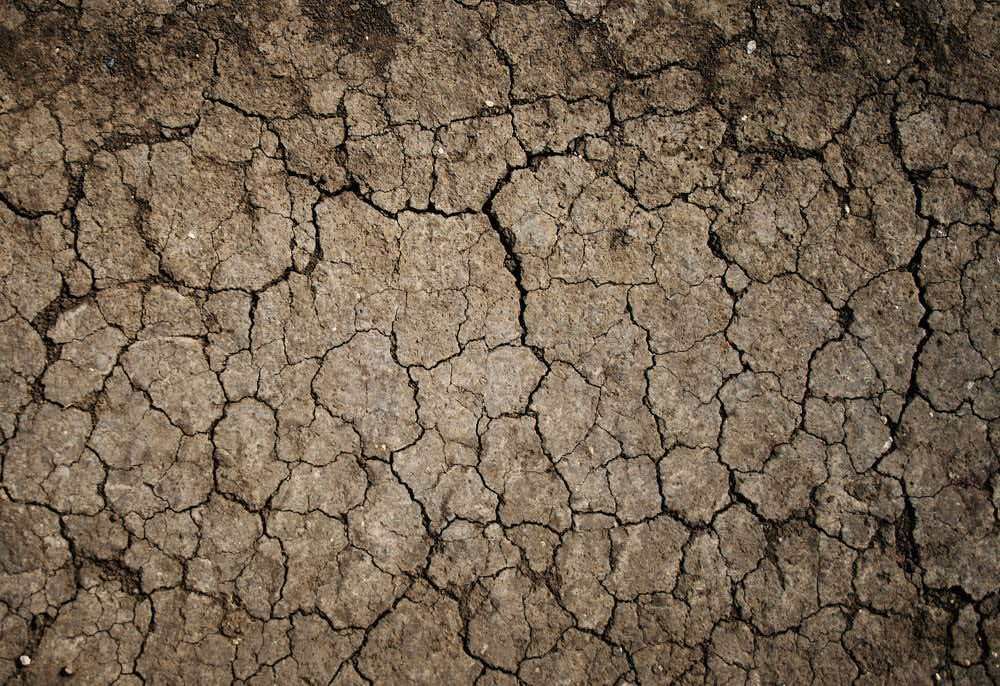
At 3:30 in the morning, an Indian woman named Radhika left home. She carried three empty plastic buckets, followed by her eight-year-old daughter. They had to walk seven kilometers to a place called Puzhal — a place that was once a reservoir. Today, it has become a vast area of cracked dry land.
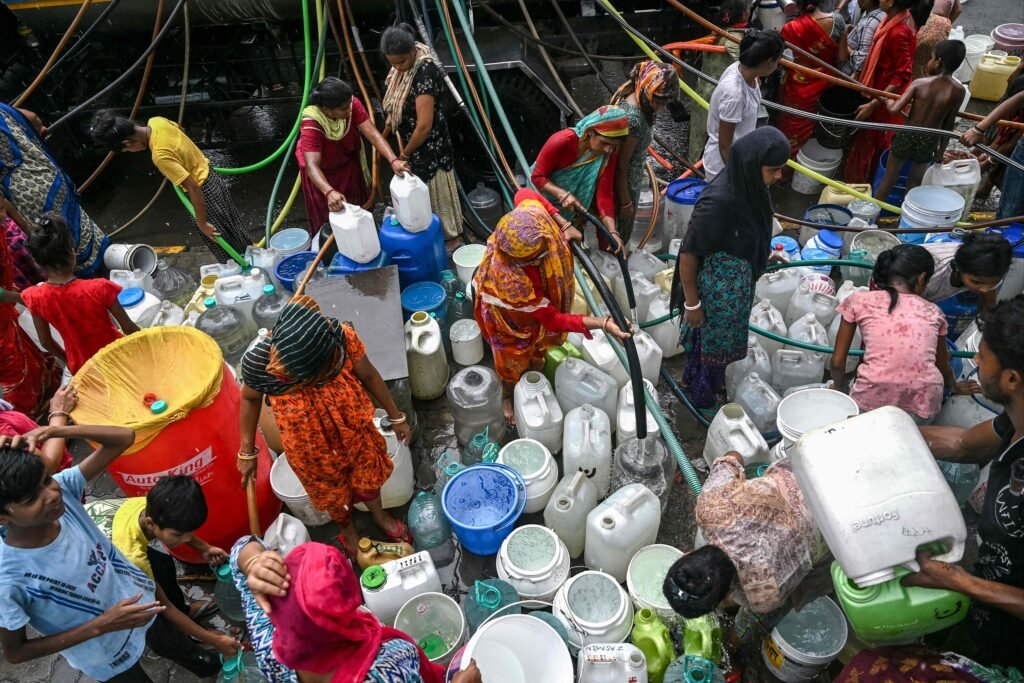
They stood in line, waiting and waiting for the water truck to arrive. If it came, Radhika could carry back 40 liters of water, enough for a family of five to drink for one day, cook one meal, and barely wash their faces. If it did not come, they would have to return tomorrow. Last week, someone from a nearby village was beaten to death for cutting in line. Here, a bucket of water is worth more than a human life.
This is not a movie. This is Chennai, India, in 2026 — an industrial city with a population of nine million people. And it is just one example of why the world urgently needs precision irrigation.
The 2026 India Water Crisis by the Numbers
On May 29, 2026, Xinhua News Agency reported that New Delhi had suffered severe water shortages for more than 25 consecutive days. A local council member described the situation in four words: “completely out of control.” Previous data from People’s Daily was more specific — 43 communities in New Delhi, affecting around 2 million people, experienced water supply interruptions.
What is even more concerning is that India’s official institution NITI Aayog had already warned in 2018 that groundwater in 21 major cities, including Delhi, was expected to be exhausted around 2020. That countdown has passed. According to the institution’s latest data in 2026, around 600 million people across India are now facing this water supply crisis. Six hundred million people — that’s more than the population of the United States and Mexico combined, or more than half of Europe.
These numbers are staggering. But behind them is a deeper story about how India uses water, especially in agriculture. And that story points directly to why precision irrigation is no longer a luxury — it is a necessity.
What Are the “Three Shortages”?
More than 3,000 years ago, the Chinese classic I Ching (The Book of Changes) described a crisis known as the “Three Shortages”: when water shortage, food shortage, and soil shortage happen at the same time, a society can no longer sustain itself. Ancient people considered it a sign from nature, but in reality, it was an observation of cause and effect.
Today, this situation is becoming a reality in India. Let me walk you through each of the three shortages and show you how they connect to precision irrigation.
First, water shortage. India is the world’s largest groundwater user, with 60% of the country’s irrigated agriculture relying on groundwater. That’s not sustainable by any measure. And because the government subsidizes rice production and provides free electricity to farmers, there is no incentive to save water. So they pump, and pump, until the water runs out.
Second, food shortage. What do Indian farmers grow with all that water? Rice. One kilogram of rice requires 2,500 to 3,000 liters of water. In a water-scarce country, farmers have been growing one of the most water-intensive crops for decades. The result is predictable: in May 2026, water levels in multiple reservoirs across India dropped below warning levels, some completely drying up. Farmers stood on cracked land. Their crops withered.
Third, soil shortage. When you pump too much groundwater, the land itself begins to die. As water tables drop, deep salts rise to the surface. The soil becomes too salty to grow anything. The ground sinks. The soil hardens into a crust. Rain can no longer penetrate to recharge the groundwater. Scientists call this “groundwater overdraft” — you are taking out water faster than nature can put it back. Sooner or later, your account hits zero.
India is standing at that edge. And this is exactly where precision irrigation steps in.
Groundwater Depletion in India: A Self-Inflicted Crisis
So where did all the water go? The answer lies in a policy from more than half a century ago.
In the 1960s, after India suffered severe food shortages, the government introduced the Minimum Support Price system — if farmers lost money growing food, the government would cover the loss. At the same time, agricultural electricity was made free. The result was simple: pump as much as you want. It costs nothing. So farmers drilled more wells and grew more rice — because rice got the most government support. The system was designed to encourage pumping until the last drop was gone.
Can groundwater recover? In theory, rain can recharge it. But in reality: cities are covered in concrete, so rainwater runs off instead of soaking in; rural soil is compacted and can’t absorb much; and El Niño is making monsoons less reliable. In 2026, monsoon rainfall is expected to be only 90% of normal. Recharge is far behind consumption.
The Indian government knows the problem. A 2018 NITI Aayog report clearly stated that if nothing changed, 40% of India’s population would have no access to safe drinking water by 2030. The same report admitted that more than 200,000 people already die each year from water shortages or contaminated water.
But knowing is one thing. Changing is another. Agricultural policies can’t be easily touched. Water prices can’t be easily raised. Groundwater use can’t be easily restricted — because behind all of this are hundreds of millions of farmers and their votes. So the problem is delayed, again and again, until nature gives no more time.
This is where IoT irrigation solutions come into play. Technology can break this cycle without waiting for policy changes.
How Extreme Heat Makes Water Scarcity Worse
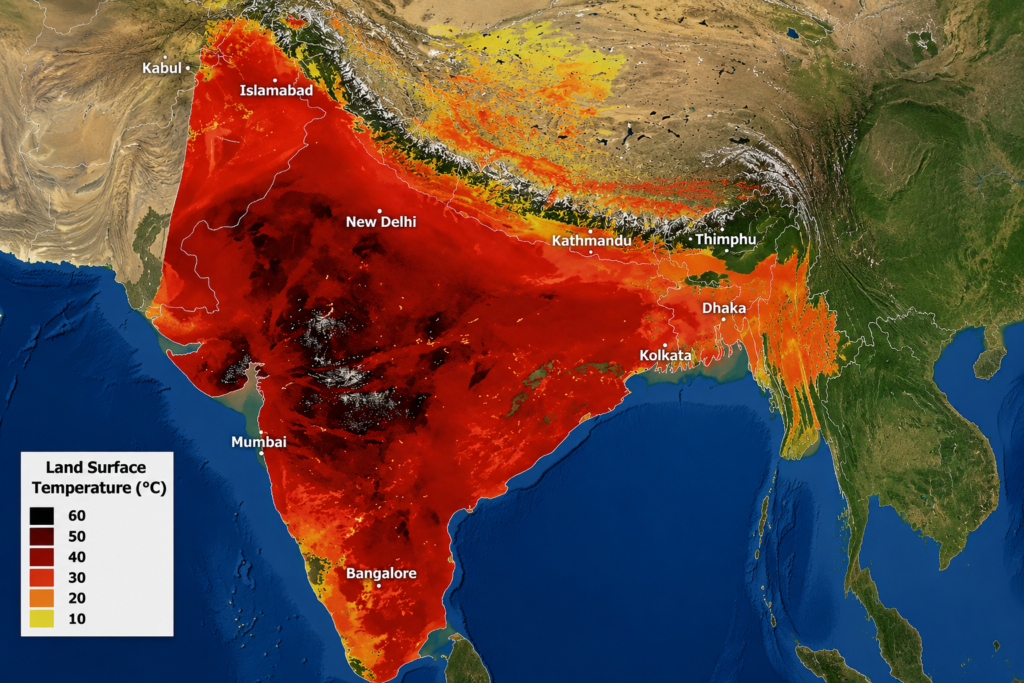
In May 2026, temperatures in northern India approached 50°C (122°F). New Delhi hit 45°C (113°F). In Banda, Uttar Pradesh, the temperature reached 48.2°C (118.8°F) — the highest in 75 years.
To understand how hot that is: the water in a hot shower is about 45°C. People in India are now standing in air that is even hotter than that. Monkeys on the streets of Delhi are collapsing from heatstroke. Dead fish float on lakes. The heat dries up reservoirs, evaporates groundwater, and forces everyone to turn on air conditioners — which crashes the power grid. In May 2026, India had more power outages than in any month in the previous five years.
No electricity means no water pumps. No water pumps means more suffering. More heat means more demand for electricity. A vicious cycle.
Chennai is the perfect example of how bad this can get. Four major reservoirs went completely dry in the same season. Tech companies and factories asked employees to work from home — not for digital transformation, but because there wasn’t enough water to flush the toilets.
Every morning at 4 a.m., endless lines form near the reservoirs. People wait four or five hours in the sun, hoping a water truck will arrive. If it comes, the family survives another day. If not, they return tomorrow. In rural areas, violent fights over water are daily news. People have been killed over a single bucket.
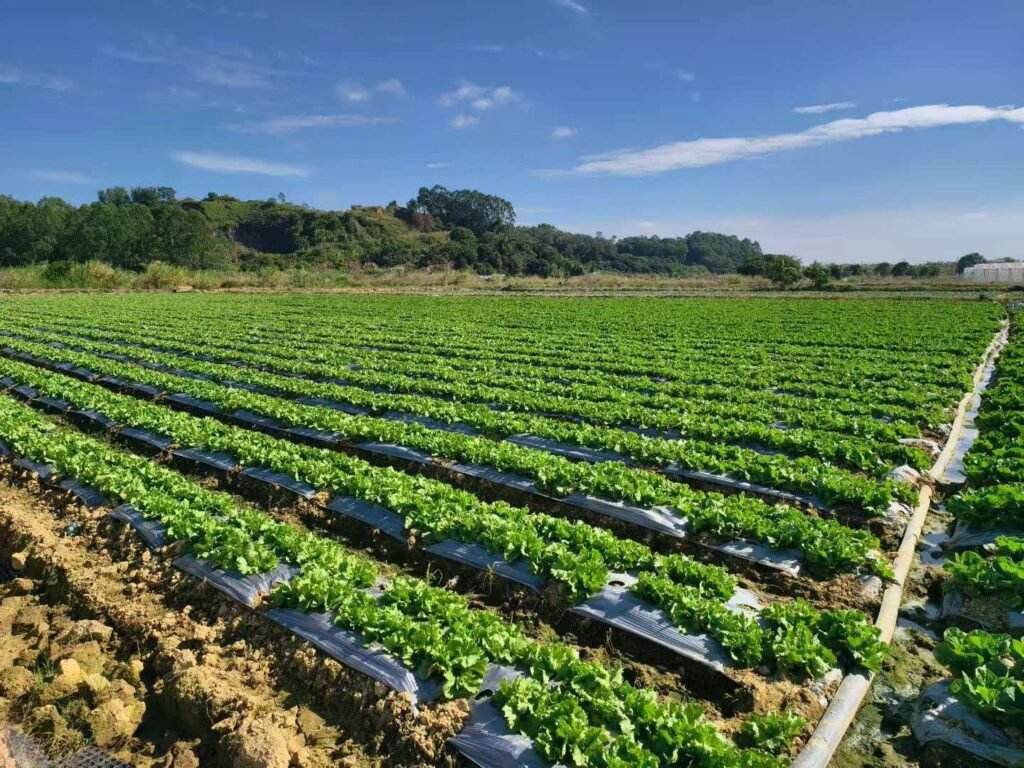
But here’s the thing: agriculture uses about 80-90% of India’s available water. That means even small improvements on farms can have an enormous impact. And that’s exactly what precision irrigation can deliver.
How a Smart Irrigation System Works
There is another saying in the I Ching: “When things reach their limit, change becomes necessary. Through change, a solution can be found.”
The crisis of water, food, and soil shortages means agriculture can no longer depend only on nature. It must adapt through technology. Precision irrigation is that adaptation — and at its core is the smart irrigation system.
A smart irrigation system is not mysterious. Here is how it works:
- Sensors are placed in the soil to monitor moisture, pH, and nutrient levels in real time
- The data is transmitted to a cloud platform
- The platform analyzes the data and decides when to water and how much
- Smart valves and fertigation machines automatically execute the plan
This is IoT irrigation solutions in action. The farmer doesn’t need to guess when to water. The system tells them — or better yet, does it for them.
Let me show you the comparison. Traditional flood irrigation produces one kilogram of rice using 2,500 to 3,000 liters of water. Fertilizer efficiency remains only around 30% to 40%. And soil conditions become worse year after year due to salt buildup.
A precision irrigation system, on the other hand, can:
- Reduce water consumption by more than half (to under 1,500 liters per kilogram of rice)
- Increase fertilizer efficiency to 70% to 80%
- Gradually restore soil health by preventing over-watering and salt accumulation
This is not about conquering nature. It’s about following nature’s rhythm — watering when needed, stopping when not. That perfectly reflects the ancient wisdom of “following the right timing of nature,” which the I Ching taught 3,000 years ago.
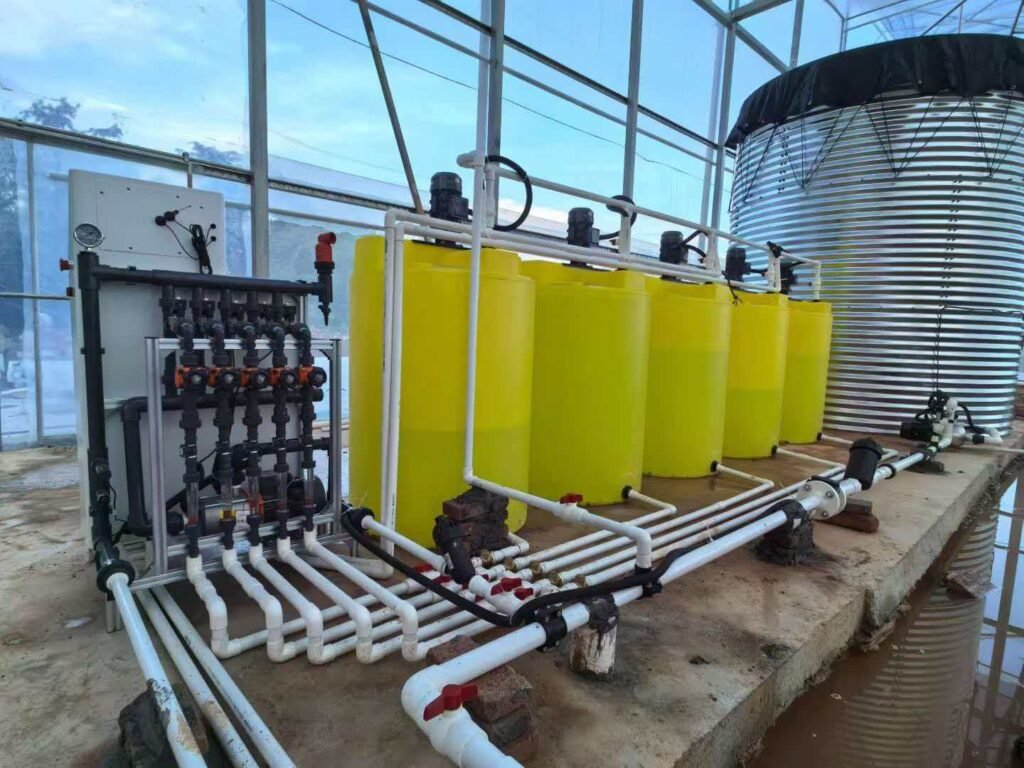
Precision Irrigation in Practice: Real Equipment That Works
This is not theoretical. The equipment exists today. Let me give you a few examples from real products on the market.
A smart fertigation machine connects directly to your irrigation system. It injects fertilizer into the water at precisely the right ratio, based on real-time EC and pH readings. You can control it from your phone, from a touch screen on the device, or from a computer in your office.
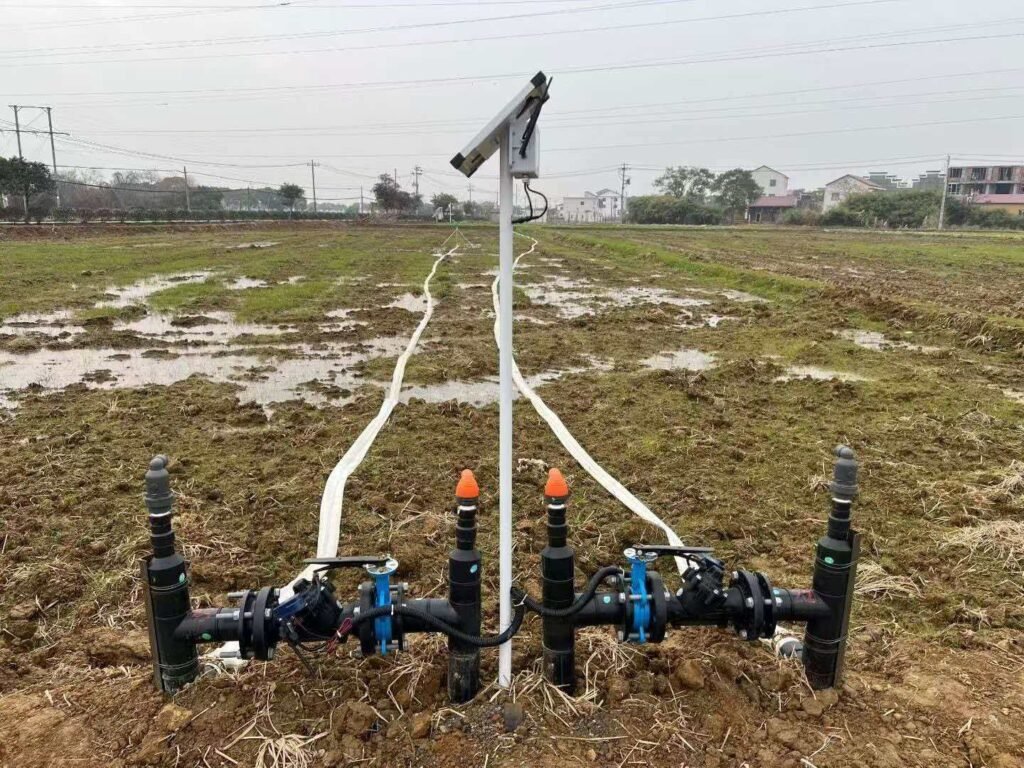
Smart ball valves replace manual valves. They open and close automatically, powered by a small solar panel and battery. They can be set to open 30%, 50%, or 100% — not just on or off. And if the network goes down, you can still operate them with a magnetic tool or a manual lever.
Soil sensors measure temperature, moisture, EC (electrical conductivity), pH, and even NPK (nitrogen, phosphorus, potassium) levels. These sensors send data every few minutes to the cloud. Some use wireless transmission, so you don’t need to run cables across your farm.
A cloud platform pulls all this data together. You can see every sensor, every valve, every pump on a single dashboard. You can set up automatic rules: for example, “when soil moisture drops below 40%, open valve A1 for 10 minutes.” The system handles it from there.
These components work together as a complete precision irrigation system. They are already being used on farms across Asia, Africa, and even in developed markets like Australia and Germany. The technology is proven, reliable, and cost-effective.
The Economics of Precision Irrigation
You might be thinking: this sounds expensive. Let me walk you through the real economics.
A typical precision irrigation system costs anywhere from a few hundred to a few thousand dollars, depending on the size of the farm and the number of sensors and valves. That is real money, especially for a small farmer. But here is what you get in return:
- 50-70% reduction in water costs. In regions where water is metered or trucked in, this alone can pay for the system in one or two seasons.
- 20-30% increase in crop yield, because plants receive exactly the water and nutrients they need at the right time.
- 30-40% reduction in fertilizer costs, because the system applies fertilizer only when and where it is needed, not everywhere all the time.
- Lower labor costs. One person can manage a precision irrigation system across hundreds of acres from a phone or computer. No more hiring people to walk through fields opening and closing valves.
When you add these savings together, the payback period for a precision irrigation system is often less than one growing season. For larger farms, it can be just a few months.
Now consider the alternative. Without precision irrigation, farmers in water-stressed regions face:
- Crop failure due to drought or over-watering
- Rising water costs as supplies dwindle
- Falling yields as soil degrades
- Eventually, losing the farm entirely
In this light, precision irrigation is not an expense. It is an investment in survival.
Why India’s Water Crisis Is the World’s Warning
World Bank data makes the reality clear: India has only about 4% of the world’s water resources but needs to support 18% of the global population. In this equation, improving the efficiency of every drop of water is not a choice — it is a matter of survival.
But India is not alone. The Middle East, North Africa, Australia, the western United States, and many agricultural regions around the world are facing similar challenges. Climate change is making rainfall patterns less predictable. Populations are growing. Demand for food is rising. But water is not.
Every country that depends on agriculture will eventually face some version of India’s water crisis. The only question is whether they will prepare for it or wait until it’s too late.
Precision irrigation is the preparation. It is the set of tools and methods that allow farmers to produce more food with less water. And unlike building new dams or desalination plants — which take years and billions of dollars — smart irrigation systems can be deployed in weeks, on any budget, at any scale.
The Future of Farming: More Food with Less Water
From the I Ching to modern precision irrigation, the principle remains the same: produce more with less.
The ancient Chinese saw that when water, food, and soil run out at the same time, collapse follows. Today, we have the technology to prevent that collapse. We have sensors that measure what the soil needs. We have cloud platforms that make decisions in real time. We have valves and pumps that execute those decisions automatically.
What we need now is adoption. More farmers need to know that these tools exist. More governments need to subsidize water efficiency instead of water waste. More buyers need to ask where their food comes from and how much water was used to grow it.
If you are a farmer, a farm manager, or someone who works with farmers, here is what you can do right now:
- Learn more about precision irrigation — there are many resources online, including free guides and case studies.
- Start small. You don’t need to automate 1,000 acres overnight. Start with a single field, a single crop, a single sensor. See the results for yourself.
- Ask for help. Companies that make these systems (including ours) offer training, support, and sometimes financing. You don’t have to figure it out alone.
The future of farming must produce more food with less water. Whoever finds this path first will stand at the entrance of the next era. And in that future, every drop of water will do its full work — no more, no less.
Conclusion
When Radhika walks to the dry reservoir at 3:30 in the morning, she is not thinking about precision irrigation or IoT solutions. She is thinking about water for her children. But the reason she has to make that walk is, ultimately, a failure of technology and policy. Too much water was wasted for too long. Too few people saw the crisis coming.
We cannot change the past. But we can change the future. Every farm that switches to precision irrigation saves water. Every saved drop means one less family standing in line at 3:30 in the morning.
The warning was written 3,000 years ago. The technology is here today. The only question left is: what are you going to do about it?
If you are interested in learning more about precision irrigation systems — including fertigation machines, smart valves, soil sensors, and cloud platforms — feel free to reach out. We work with farmers, distributors, and partners around the world to bring water efficient farming to everyone who needs it.