Commercial farms and greenhouse projects are under pressure from two directions: tighter water availability and tighter margins. That’s why buyers are searching for fertigation system manufacturers that can deliver repeatable dosing, dependable automation, and real-world service support—not just hardware.
A fertigation system injects fertilizer (and often acid for pH adjustment) into irrigation water so nutrients are delivered with every irrigation event. In practical terms, it helps operators control nutrient timing, reduce waste, and keep crop growth more uniform across zones.
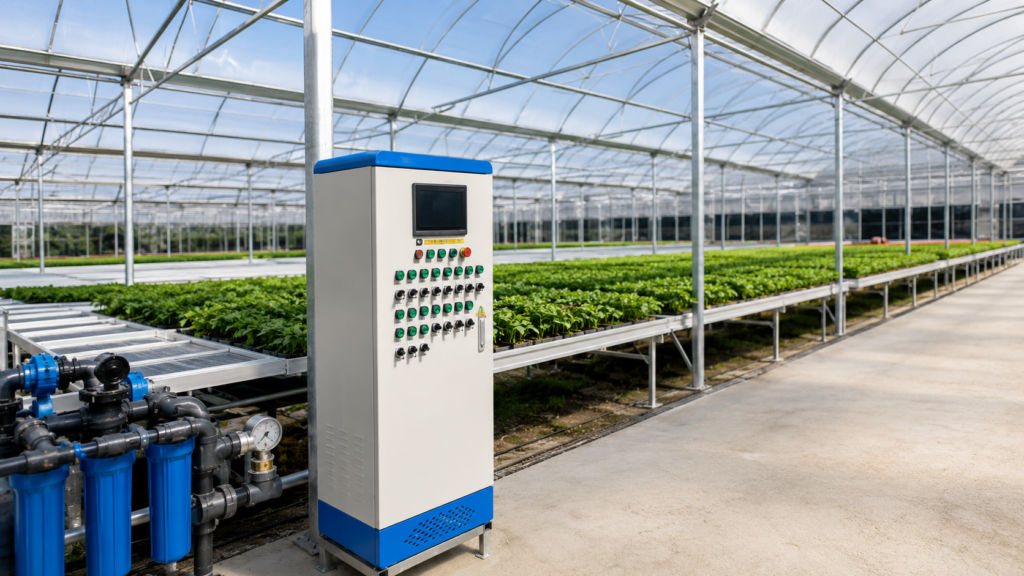
As precision agriculture expands, the buying conversation is shifting from “Can it inject fertilizer?” to “Can it run reliably across multiple zones, with remote oversight, and integrate into smart irrigation systems?” If your projects span open-field blocks, greenhouses, and remote sites, that integration matters.
If you’re building a connected farm stack (controllers, valves, sensors, monitoring, and fertigation working together), start with WeWin Smart Agriculture’s Smart Irrigation Solution.
How to choose a fertigation system manufacturer
The right fertigation system depends on your crop type, irrigation method, farm scale, and automation requirements. A greenhouse tomato project, for example, usually requires tighter EC/pH stability and higher irrigation frequency than an open-field orchard.
Before comparing fertigation system manufacturers, commercial buyers should evaluate how well the system integrates with irrigation controllers, valves, sensors, and remote management platforms — not just fertilizer injection performance alone.
Automation capability
A commercial-grade automatic fertigation system should support:
- Scheduled or sensor-triggered dosing
- Alarm logic (out-of-range EC/pH, low tank, no-flow, pump faults)
- Audit logs for troubleshooting and compliance
EC and pH control
If you’re running high-value horticulture or tight greenhouse recipes, you’ll want:
- Closed-loop EC control with stable setpoints
- Closed-loop pH control (acid dosing) with safe limits
- A clear calibration workflow (who does it, how often, what parts wear)
⚠️ Warning: Many smart fertigation systems fail for non-obvious reasons—probe drift, inconsistent water pressure, poor filtration, or missing fail-safes. Ask every vendor to explain what happens when an EC/pH sensor fails mid-cycle.
Remote app control and remote monitoring
For multi-site operations and contractors managing multiple clients, remote access should include:
- Mobile/PC dashboard
- Permission controls for teams and subcontractors
- Real-time alerts (not just on-site alarms)
- Historical trends for EC/pH/flow/irrigation volume
Multi-zone irrigation support
Most commercial projects need more than one “recipe.” Look for:
- Multi-zone scheduling
- Zone-by-zone recipes (or at least recipe groups)
- Expandability when the farm adds new blocks, greenhouses, or varieties
IoT integration and interoperability
Smart fertigation is more valuable when it connects to:
- Soil moisture sensors and weather stations
- Flow and pressure sensors
- Valve manifolds and irrigation controllers
- Farm IoT platforms (data export, API/protocol support where available)
Technical support and parts availability
Strong commercial fertigation equipment is only half the deal. Validate:
- Installation and commissioning support
- Training for on-farm operators
- Lead time for EC/pH probes and consumables
- Warranty terms and the practical service process
Scalability for commercial farms
Ask what changes as you scale:
- More zones
- Higher flow rates
- More dosing channels (multi-fertilizer + acid)
- More data points (multiple sensors per zone)
Greenhouse compatibility
For a greenhouse fertigation system, the bar is higher:
- Short irrigation cycles and fast stabilization
- Repeatability across many irrigation events per day
- Compatibility with climate/irrigation control strategies
What are the best fertigation systems manufacturers
The list below focuses on vendors commonly considered in commercial irrigation and controlled-environment projects. “Best” depends on your crop, water quality, required automation, and the support footprint in your region.
1) Netafim

Netafim is a major global player in micro-irrigation and precision agriculture, with solutions spanning open-field and protected cultivation.
Main products: Drip irrigation components plus advanced fertigation/dosing systems. In a 2026 announcement, Netafim describes its AI-powered Dosing 5G range as including multi-configuration dosing options and systems positioned around EC/pH stabilization and digital integration.
Smart irrigation capability: Strong emphasis on precision control, connected operations, and integration with digital farm management.
Key strengths: Broad global footprint, proven micro-irrigation ecosystem, and high-end fertigation options for demanding crops.
Best applications: High-value horticulture, orchards, large commercial drip projects, and greenhouse/CEA setups needing stable EC/pH control.
2) Rivulis
Company overview: Rivulis is a large micro-irrigation manufacturer known for drip systems used in commercial agriculture.
Main products: Drip tape/driplines and irrigation distribution components; often selected for field-proven irrigation hardware.
Smart irrigation capability: Typically implemented as part of a broader control stack (controllers, sensors, valves) depending on the integrator and project scope.
Key strengths: Scale, availability, and practical irrigation products used across many crops.
Best applications: Open-field commercial farms, large blocks with long runs of drip tape, and irrigation projects where robust distribution is a priority.
3) Jain Irrigation
Company overview: Jain Irrigation is widely associated with accessible micro-irrigation solutions in water-stressed markets.
Main products: Drip irrigation and related water management components; often packaged into cost-effective project designs.
Smart irrigation capability: Usually depends on pairing with controllers/sensors and integrator design. Best fit when the goal is reliable irrigation infrastructure with a sensible automation layer.
Key strengths: Value-oriented positioning, water efficiency focus, and broad adoption in many regions.
Best applications: Open-field farms scaling drip irrigation, orchards, and projects where cost-to-coverage matters.
4) Priva

Main products: Water-powered proportional dosing pumps.
Dosatron specializes in dosing/injection rather than complete irrigation systems.
Smart irrigation capability: Dosatron’s core advantage is simplicity and proportional injection. It’s not a full “brains + sensors + cloud” platform on its own.
Key strengths: No electricity required, straightforward installation, and consistent proportional dosing. Dosatron explains its non-electric dosing principle in How does a dosing pump work?.
Best applications: Greenhouses, nurseries, and practical commercial setups where you want reliable dosing without complex automation.
5) Autogrow

Autogrow provides precision fertigation and greenhouse automation solutions for commercial growers.
Main products: Fertigation controllers, irrigation automation systems, and remote monitoring platforms.
Smart irrigation capability: Strong cloud-based monitoring and automated nutrient dosing functions.
Key strengths: User-friendly automation and flexible greenhouse integration.
Best applications: Greenhouses, hydroponics, and indoor farming projects.
6) WeWin Smart Agriculture
WeWin Smart Agriculture is an integrated smart agriculture provider focused on irrigation, fertigation, monitoring, and greenhouse automation.
Main products: Smart irrigation controllers, fertigation systems, irrigation valves, weather stations, and soil moisture sensors.
Smart irrigation capability: Supports remote irrigation control, automatic fertigation, EC/pH monitoring, and integrated control of sensors, valves, and irrigation equipment.
Key strengths: Integrated system architecture, remote monitoring, and flexible deployment for commercial agriculture projects.
Best applications: Commercial farms, greenhouse projects, smart agriculture parks, and multi-zone irrigation systems.
7) Argus Control Systems

Argus Control Systems provides greenhouse automation and integrated irrigation control solutions for commercial horticulture and controlled-environment agriculture.
Main products: Greenhouse climate control systems, fertigation controllers, irrigation automation platforms, and environmental monitoring systems.
Smart irrigation capability: Integrated irrigation scheduling, fertigation management, remote monitoring, and greenhouse environmental control.
Key strengths: Advanced greenhouse automation, reliable system integration, and strong support for precision horticulture operations.
Best applications: Commercial greenhouses, hydroponic farms, indoor growing facilities, and controlled-environment agriculture projects.
8) Ridder
Ridder provides greenhouse automation and fertigation management solutions for commercial horticulture and controlled-environment agriculture.
Main products: Fertigation systems, irrigation controllers, greenhouse climate control systems, and horticulture automation platforms.
Smart irrigation capability: Integrated irrigation scheduling, nutrient dosing, climate management, and remote greenhouse monitoring.
Key strengths: Reliable greenhouse automation, precision fertigation control, and strong horticulture integration capability.
Best applications: Commercial greenhouses, hydroponic farms, indoor growing facilities, and controlled-environment agriculture projects.
9) Climate Control Systems(CCS)
Climate Control Systems (CCS) provides greenhouse automation and environmental control solutions for commercial horticulture and controlled-environment agriculture.
Main products: Greenhouse climate control systems, fertigation controllers, irrigation automation systems, and environmental monitoring equipment.
Smart irrigation capability: Integrated irrigation automation, fertigation management, and climate control with remote monitoring support.
Key strengths: Strong greenhouse automation expertise, reliable environmental control, and practical fertigation integration.
Best applications: Commercial greenhouses, hydroponic systems, indoor farming, and controlled-environment agriculture projects.
10) Irritec
Irritec is an irrigation equipment supplier with a broad catalog used across open-field and protected agriculture.
Main products: Irrigation distribution components and system parts used in drip irrigation projects; fertigation is typically part of the system design rather than a single standalone product line.
Smart irrigation capability: Commonly integrated with third-party controllers, sensors, and fertigation control depending on the project.
Key strengths: Breadth of components, availability, and flexibility across use cases.
Best applications: Vineyards, orchards, horticulture, mixed systems with both open-field and greenhouse blocks.
Markets served: Global, strong in Europe and Mediterranean regions.
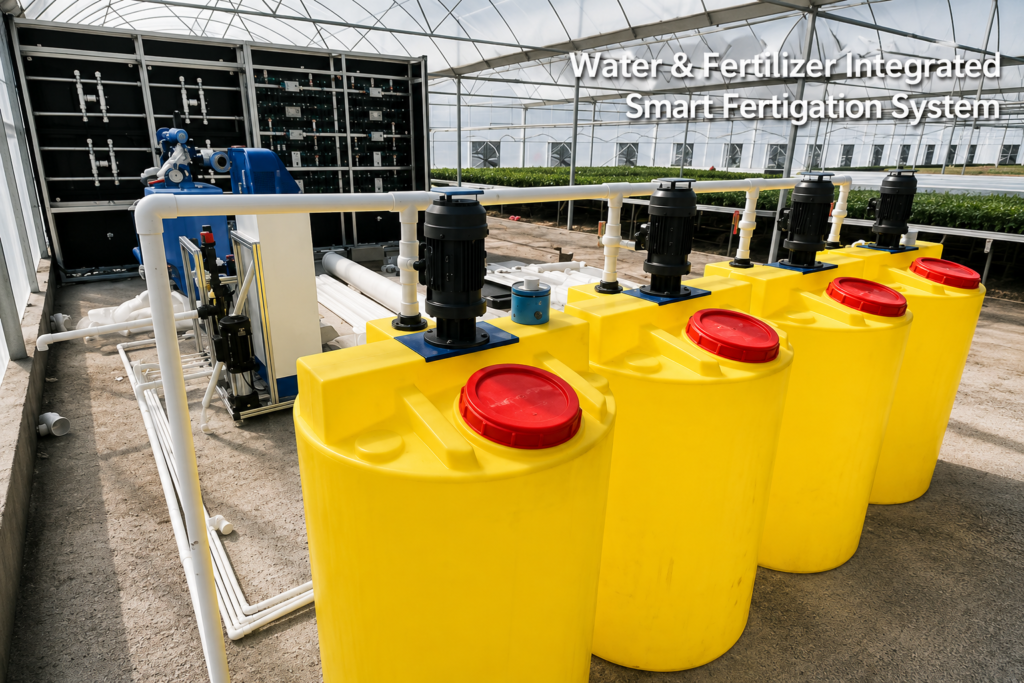
Technology trends in fertigation systems (what buyers are asking for in 2026)
AI-assisted irrigation and dosing
AI in fertigation isn’t magic. In practice, it’s about improving stability and reducing operator workload—especially where short irrigation cycles make manual tuning difficult.
IoT monitoring that actually reduces labor
The trend is shifting from “more sensors” to “fewer alarms that matter.” Commercial buyers are prioritizing:
- Actionable alerts
- Zone-level visibility
- Reliable data pipelines (not dashboards no one checks)
Solar-powered irrigation and edge control
Solar-powered valve control and field edge devices keep spreading in remote blocks where wiring is expensive and grid power is unreliable. For integrators, this changes system design: you need controllers/valves/sensors that can operate with constrained power and intermittent connectivity.
Remote farm management as a standard requirement
Remote app control has moved from “nice to have” to baseline, especially for:
- Contractor-managed irrigation
- Multi-site farm groups
- Greenhouse portfolios managed by a small central team
Data-driven precision agriculture
Precision irrigation and fertigation are becoming less about one controller and more about a system:
- soil moisture sensors
- weather stations
- flow/pressure monitoring
- EC/pH dosing control
- multi-zone automation
Why smart fertigation matters for commercial farms
Labor reduction and fewer emergency visits
Remote monitoring + alarms can reduce late-night “guess-and-check” site visits. But it only works if alarms are configured for real failure modes (no-flow, dosing faults, tank low, out-of-range EC/pH).
Water savings without sacrificing crop quality
Smart irrigation systems can adjust irrigation volume based on conditions rather than fixed calendars—helping operations protect yield quality while staying inside water budgets.
Better fertilizer efficiency and less runoff risk
Consistent dosing helps reduce nutrient over-application. For some regions and crops, better control also supports compliance expectations around nutrient runoff.
Yield stability across zones
Multi-zone control matters when blocks differ by:
- soil type
- slope
- crop variety
- greenhouse bay microclimates
Greenhouse automation advantages
In greenhouses, fertigation is closely tied to crop consistency. Tight control of EC and pH, repeatable recipes, and reliable logging help teams standardize outcomes across bays and sites.
If you’re evaluating irrigation by crop type and production model, the WeWin Smart Agriculture Applications page shows examples across greenhouse, open-field, and indoor/container setups.
Conclusion: shortlist vendors, then validate the system design
A good shortlist is only step one. When you evaluate fertigation equipment suppliers, prioritize what makes or breaks commercial deployments:
- stable EC/pH control (and a realistic calibration plan)
- multi-zone support that matches how your farm is actually managed
- remote monitoring with clear alarms and logs
- interoperability with controllers, valves, and sensors
- service response, spares, and commissioning support
If you want to sanity-check an architecture for a greenhouse or multi-site farm—controllers, valves, sensors, and fertigation working as one system—start with WeWin Smart Agriculture’s Smart Irrigation Solution and share your zone count, water source, and crop plan.
For more practical engineering notes and field examples, browse WeWin Smart Agriculture’s Knowledge hub.
FAQ
What is a fertigation system?
A fertigation system injects fertilizer (and often acid for pH adjustment) into irrigation water so crops receive nutrients through the irrigation network in controlled doses.
How does automatic fertigation work?
Automatic fertigation uses dosing hardware and control logic to inject nutrients according to a schedule or triggers, often with feedback from EC and pH sensors to keep the nutrient solution within target ranges.
What is the difference between irrigation and fertigation?
Irrigation delivers water to crops. Fertigation delivers water plus dissolved nutrients (and sometimes pH adjustment) through the same irrigation lines.
What are the benefits of smart fertigation systems?
Smart fertigation systems can reduce labor, improve water and fertilizer efficiency, stabilize crop growth across zones, and enable remote monitoring and control through an app or web dashboard.
Can fertigation systems be used in greenhouses?
Yes. Greenhouse fertigation systems are widely used because greenhouses often require repeatable nutrient recipes, tight EC/pH control, and consistent irrigation events across multiple zones or bays.
Build a Smarter Irrigation System for Your Farm
Looking for fertigation systems, irrigation controllers, smart valves, or greenhouse automation solutions?
WeWin Smart Agriculture helps commercial farms and greenhouse projects reduce labor, save water, and improve irrigation efficiency through integrated smart agriculture systems.
✔ Remote irrigation control
✔ Automatic fertigation
✔ EC/pH monitoring
✔ Multi-zone irrigation management
✔ IoT-based monitoring systems
👉 Request a Solution
👉 Contact Us on WhatsApp