
Sensor applications in smart farming are becoming more useful in some very ordinary moments: noticing that an irrigation zone stayed dry, recognizing a change in pump vibration, or finding that a shaded nursery remained humid long after sunrise. These are small observations with practical consequences. The value comes from turning them into a check or an action someone can take.
Consider a coffee nursery during a humid morning in Southeast Asia. The plants look healthy, yet the operator wants to know whether the growing medium is drying evenly and whether the air beneath the shade net is remaining unusually humid. A few well-positioned measurements can help decide where to inspect first. They cannot make that decision meaningful without knowledge of the plants, irrigation and site.
The same principle travels well: from date palms in the Middle East to maize fields and commercial horticulture in Africa. The crops and conditions change, but buyers still need to connect a measurement to an operational question.
Agricultural Sensor Series · Part 3
Part 1 examines adoption barriers; Part 2 explains four technology developments. This installment focuses on practical applications. The regional examples below are illustrative scenarios, not reported Wewin customer projects.
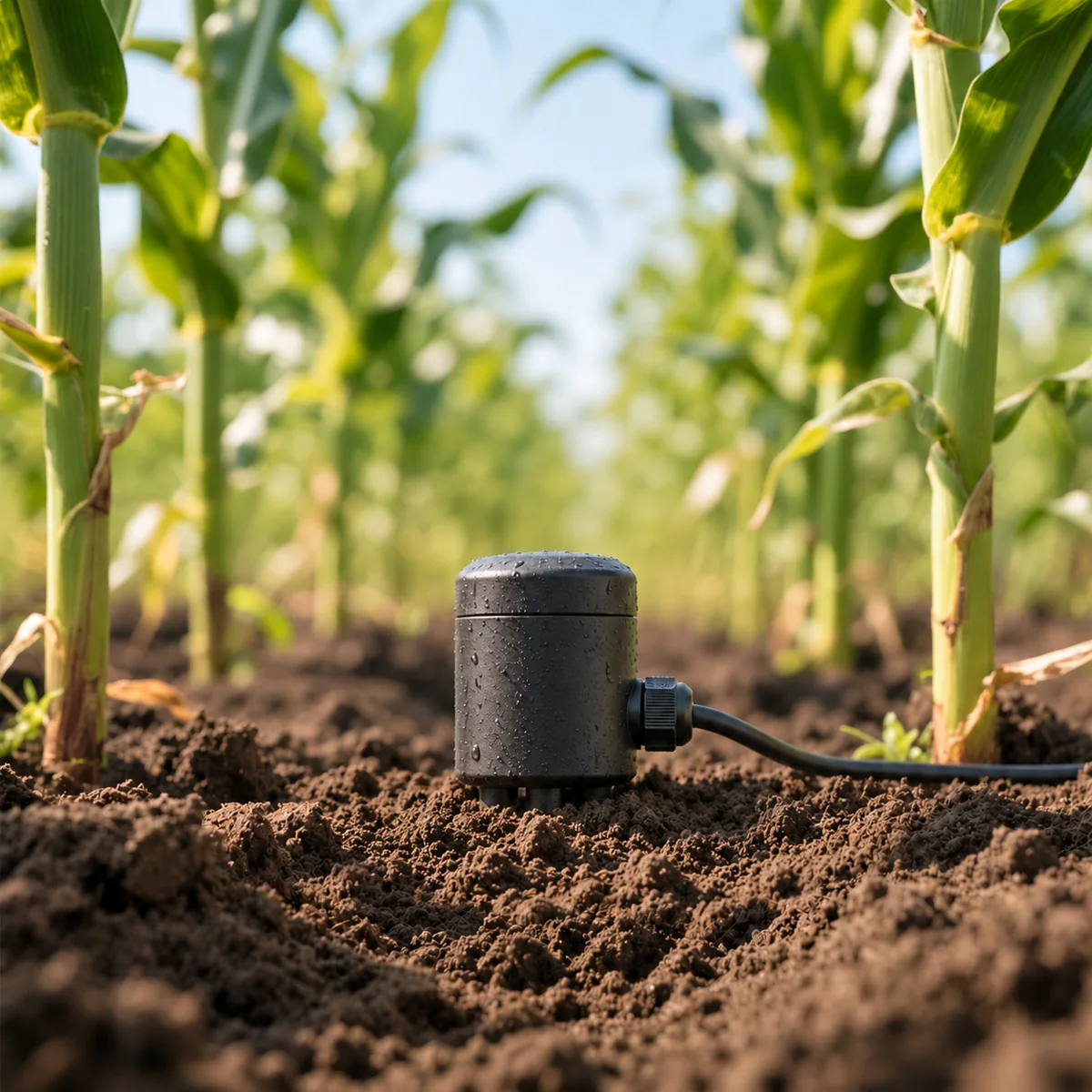
1. Root-Zone Monitoring: See What the Surface Does Not Show
A field can look wet at the surface while the active root zone remains unevenly supplied. Conversely, a dry-looking surface does not necessarily mean that roots need another irrigation. Soil moisture measurements help make these differences visible, provided the measurement method and location are appropriate.
Date palms: combine moisture information with irrigation context
In a Middle Eastern date palm orchard, representative soil moisture measurements can help an operator examine the response to irrigation. Readings near a wetted zone may change differently from those farther from an emitter. Differences between soil types or irrigation zones also matter.
Use trends to ask practical questions: Did water reach the intended depth? Does a monitored zone dry faster than expected? Is a reading unusually stable despite irrigation? Then inspect the emitter, installation and surrounding soil before changing the schedule.
FAO’s date palm irrigation guidance identifies soil salinity and climatic conditions among the factors affecting water management. A moisture reading should therefore support a wider irrigation assessment, not become a universal target applied to every orchard.
Maize and horticulture: monitor representative locations
For an irrigated maize field or a commercial vegetable block in Africa, start by identifying management zones and active rooting depths. Do not assume that one probe represents the whole field or that all sensors measure the same volume of soil.
Poor contact, air gaps, disturbed soil and placement outside the relevant wetted zone can produce misleading trends. Protect cables from machinery and mark locations for maintenance. Select the reporting interval around the management task and available power, rather than copying a fixed interval from another installation.
Le University of Minnesota’s soil moisture guidance explains representative placement and installation considerations. Those principles need adapting to the local crop, soil and irrigation arrangement. Our soil moisture sensor selection guide covers equipment choices in more detail.
2. Nutrient Monitoring: Separate Useful Signals from Unsupported Claims
The idea of seeing nutrient changes around roots is appealing. However, a product labeled “NPK” should not automatically be treated as a direct replacement for a suitable soil laboratory test. Measurement principles, sample preparation, calibration and the meaning of the reported value differ between instruments.
Ask what is actually measured: a particular ion, an optical response, conductivity or an estimated quantity derived from a model. Establish the units, soil or solution conditions and reference method used for validation. Do not accept a claimed sensing radius or a precise nutrient concentration simply because it appears in a dashboard.
A review of rapid in-field nutrient and pH analysis discusses the importance of calibration and validation across different sensing approaches. The buying question is whether the proposed measurement is fit for the intended decision under local conditions.
EC, for example, indicates electrical conductivity; it does not separately identify nitrogen, phosphorus and potassium. For fertigation, EC and pH can support management of the mixed solution, while fertilizer composition, source-water chemistry and suitable reference testing remain relevant. Soil EC and irrigation-water EC should also be interpreted according to their measurement methods.
For distributors, this distinction is commercially useful. A clear specification and an agreed sample test are more persuasive than promising that a probe can tell every grower exactly which fertilizer to add.
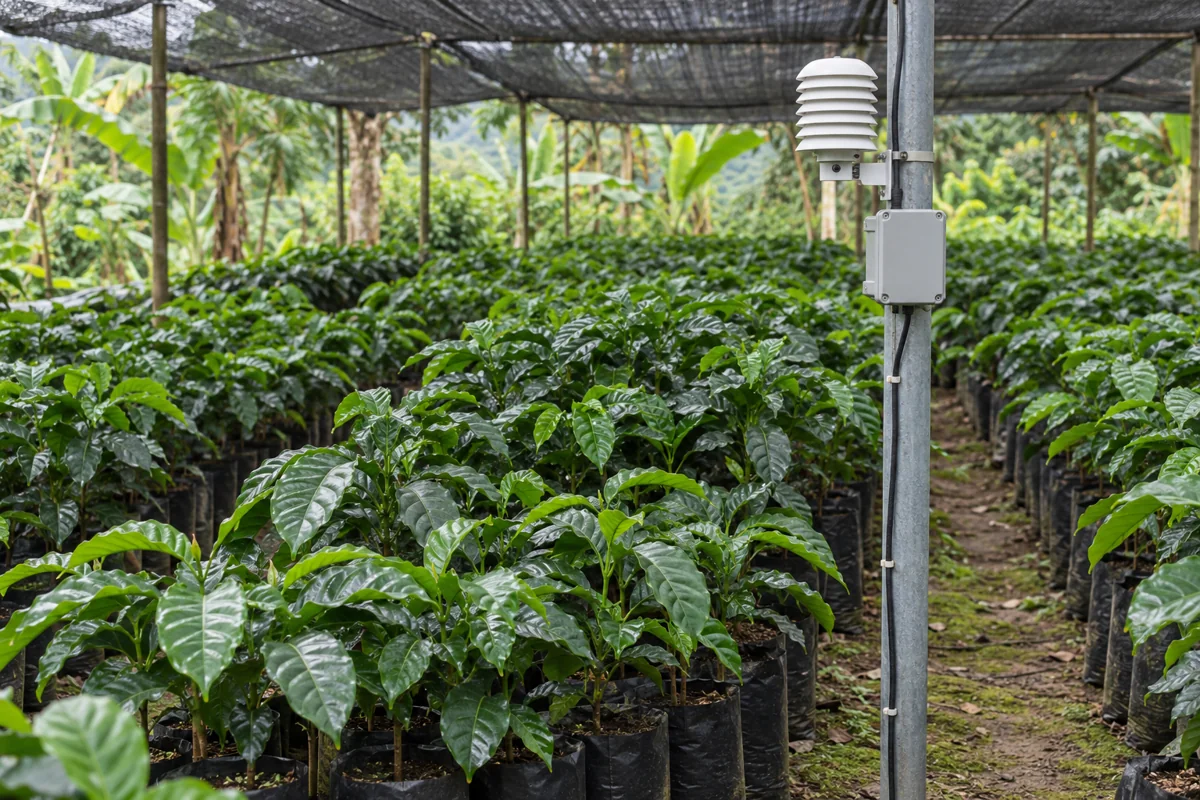
3. Greenhouse and Nursery Monitoring: From a Reading to Controlled Action
Small sensors can contribute to the control of a large growing space, but the sensing element does not directly operate the whole facility. A working system also needs a controller, suitable outputs, correctly rated switching equipment and connected fans, vents or shading equipment.
Coffee seedlings under shade: measure the conditions plants experience
A coffee nursery under shade netting is different from a sealed greenhouse. Temperature and relative humidity can help staff understand conditions around the seedlings, while growing-medium moisture can support irrigation checks. Measurements should be located where they answer those questions, rather than where installation is simply convenient.
Avoid mounting an air sensor against a hot surface, in direct sunlight without suitable shielding or where irrigation repeatedly wets it. In a ventilated greenhouse, also consider whether the sensor sits in an unrepresentative draft. Compare representative points before deciding that one location is adequate.
Use thresholds that suit the application
An automatic response needs more than a small change in temperature. Setpoints should reflect the crop, growth stage, sensor accuracy and the response of the equipment. Hysteresis and suitable delays can prevent repeated switching around a threshold.
Ventilation, shading and evaporative cooling have different functions and interact with outside conditions. The UMass Extension greenhouse ventilation guide provides useful background on those relationships. A dashboard alarm should lead to an agreed response, and automatic actions should include manual intervention and suitable failure behavior.
Commission the complete chain: create a test condition, verify the reading and alarm, confirm the correct output and observe the physical equipment. A working notification alone does not prove that a vent opened or that water reached the plants.
4. Pump and Fan Monitoring: Bring Industrial Maintenance Lessons onto the Farm
The original idea of “hearing a machine’s language” is especially relevant to irrigation pumps, greenhouse fans and other rotating equipment. Vibration, temperature, pressure and flow can provide complementary evidence that operating conditions have changed.
A change is a reason to investigate, not a guaranteed diagnosis
A vibration trend may indicate a need to check bearings, alignment, mounting or operating conditions. It does not establish a universal number of days before failure. Interpretation depends on the machine, mounting method, speed, load and the type of measurement available.
Le U.S. Department of Energy’s pumping-system sourcebook describes condition monitoring as part of effective maintenance. Apply that principle to farm equipment with an appropriate baseline and a plan for investigating changes.
For an irrigation installation, compare pump-condition information with hydraulic measurements. If a pump runs but flow falls, inspect the water supply, valves, filters and pipework as well as the machine. A pressure change by itself can have several causes. Record which irrigation zones were active when the event occurred.
Keep protection functions distinct from general monitoring
A general-purpose sensor and a cloud alarm should not be assumed to provide certified machine protection. Where rapid shutdown is necessary, the complete protection arrangement must be selected for that duty. Agree on the response to power loss, a disconnected probe and a failed communication link.
For an initial deployment, one critical pump or fan with a clear maintenance owner can be a useful trial. Establish normal operation, review anomalies with the responsible technician and document what was found. Predictive models become more useful when the underlying records are trustworthy.
5. Robotics: Better Sensing Can Improve Handling, but the System Matters
Force, torque, tactile and vision sensing can help robots respond to contact and changing conditions. In agricultural handling, a relevant application might involve gripping delicate produce or placing nursery trays. That does not mean every agricultural buyer needs a robotic system to benefit from sensing.
Force measurements can inform a controller that contact or load has changed. Performance depends on sensor range, installation, control software, tooling and the object being handled. A published sampling rate or a successful demonstration is not enough to establish performance on different crops.
NIST’s work on benchmarking robot force control emphasizes the role of metrics and test methods. For a produce-handling trial, use representative crop size, firmness and surface conditions, and assess both successful handling and damage.
A tactile element should not be described as a complete safety system. Equipment intended to work around people needs an appropriate system-level safety assessment. Similarly, underwater flow sensing remains a specialized application: interesting developments should not be presented as standard capabilities of ordinary farm water-quality probes.
6. Beyond Growing: Follow Produce into the Packhouse
Sensing also supports the stages after harvest. Temperature logging, suitable humidity measurements and equipment-status signals can help staff investigate interruptions in handling or storage. For export-oriented horticulture, this extends monitoring from the field to the point where product condition is being preserved.
Select storage conditions for the actual commodity. Do not apply one temperature or humidity target to every fruit or vegetable. Sensor placement should also distinguish the air being monitored from the product itself; a reading beside a cooling outlet does not necessarily represent a packed pallet.
A useful alarm identifies the location, time, threshold and responsible person. The response might involve checking a door, refrigeration equipment or loading procedure. Keep records that make the event understandable later, rather than collecting numbers without an investigation process.
7. Match Each Sensor Application to a Practical Question
| Application | Question to answer | Measurements to consider | Check before expanding |
|---|---|---|---|
| Date palm irrigation | Did the intended root-zone locations respond to watering? | Soil moisture at suitable depths; irrigation flow and pressure where required | Placement, soil conditions and irrigation-zone context |
| Coffee nursery | Are seedlings experiencing uneven moisture or persistent humid conditions? | Growing-medium moisture; air temperature and relative humidity | Representative positions, shielding and irrigation exposure |
| Irrigated maize or vegetables | Which management zones need closer inspection? | Root-zone moisture and local weather information | Soil variability, crop stage and data continuity |
| Pump or greenhouse fan | Has operation changed from an established baseline? | Appropriate vibration and temperature; flow or pressure for pumps | Mounting, operating load and maintenance responsibility |
| Packhouse or cold room | When and where did storage conditions depart from the plan? | Temperature and other commodity-specific measurements | Location, reference checks and alarm response |
These are example configurations, not fixed packages. Choose the smallest set of measurements that answers the operational question reliably. Additional parameters are worthwhile when they change a decision or help explain a fault.
A practical sample-evaluation sequence
First, define the task and select a representative installation point. Then verify the reading against an appropriate reference and check how it responds during normal operation. Test communication interruptions, power recovery and alarms. Finally, confirm that the person responsible can interpret the information and perform the required maintenance.
Compare results under similar conditions and retain the raw readings, installation notes and reference checks. If the sample does not answer the agreed question, investigate placement and configuration before treating a larger deployment as the solution.
Foire aux questions
Can one multi-parameter probe replace several specialist instruments?
Sometimes it can simplify installation, but only when its measurement principles, ranges, positioning and validation suit the application. A device measuring several parameters is not automatically suitable for every measurement decision.
Do useful sensor applications in smart farming require AI?
No. A reliable measurement, a clear trend and a well-designed alarm can already improve an operating routine. AI may help with particular analysis tasks, but should be evaluated against a defined problem and representative data.
What should an importer or installer ask for before ordering samples?
Request the exact measurement definition, stated performance conditions, power requirements, interface documentation, calibration procedure and maintenance instructions. Agree on the application test and what will count as acceptance. Confirm that the gateway and controller can interpret the sample’s output.
Turn a Small Signal into a Useful Conversation
Return to the coffee nursery. A changed reading does not have to announce a dramatic failure to be useful. It may simply prompt someone to inspect a dry row, move a poorly positioned sensor or check an irrigation line. That is a practical form of progress: noticing the detail early enough to do something sensible about it.
For Wewin Smart Agri, the starting point is the application. Share your crop, country and site conditions, the question you want to answer, required measurements, installation depth or location, available power, gateway or controller, preferred communication method and expected quantity. We can help review sensor matching and sample-evaluation requirements.
Send Wewin your monitoring application and sample requirements. Begin with one clear question, test the complete measurement-to-action process, and expand once it works in practice.