When a farm starts a smart agriculture project, cameras are often the first purchase: open an app and see the field. That is useful—but a clear picture cannot tell you how much water remains around the roots.
IoT sensors for agriculture add measurements that support irrigation, environmental monitoring and equipment decisions. The useful question is not how many devices you can connect. It is which measurements will change a decision, where they should be taken and who will respond.
This guide covers four monitoring groups, the specifications to check, connectivity choices and an illustrative layout for a small commercial plot. It is written for distributors, irrigation and greenhouse installers, agricultural IoT integrators and growers planning a practical first installation.
1. Cameras or Sensors: Start with the Decision
Cameras and sensors answer different questions. Cameras support security, remote inspection and crop observation; specialist imaging can also detect crop changes. Contact probes and weather instruments provide measurements that ordinary video cannot reliably supply. Neither is universally an early-warning system.
| Management question | Useful measurements or observations | Important limit |
|---|---|---|
| Should this irrigation zone receive water? | Root-zone moisture trends, irrigation records and weather | Surface appearance alone may not represent water at root depth. |
| Is the crop experiencing a disease-risk period? | Relevant weather or leaf-wetness data, crop inspection and a validated model | There is no universal three-to-seven-day warning from a sensor. |
| Is salinity increasing? | A defined soil or water EC measurement plus appropriate testing | EC does not identify individual nutrients or prove that fertilizer is sufficient. |
| Are insects entering the crop? | Species-appropriate traps, scouting and, where validated, images | Trap catches and AI classifications need interpretation. |
| Is there an intruder or visible equipment problem? | Camera footage, with equipment-status sensing where relevant | A camera does not replace a soil, flow or pressure measurement. |
Begin with a decision you can act on. If irrigation timing is the main problem, a small root-zone monitoring pilot may be more useful than another general-view camera. If security is the immediate issue, cameras may come first.
2. Four Agricultural Monitoring Groups and When to Use Them
| Group | What to measure | When it earns its place |
|---|---|---|
| Soil and root zone | Moisture or water tension, temperature and, where needed, EC or pH | Irrigated fields, orchards, nurseries and protected crops with a defined irrigation or salinity question. |
| Weather and microclimate | Air temperature and humidity, rainfall, wind and appropriate radiation measurements | Field operations, local weather tracking and crop-specific climate or disease-risk decisions. |
| Water quality and delivery | EC, pH and water temperature; dissolved oxygen for relevant applications; flow and pressure for delivery | Nutrient solution, variable irrigation water, aquaculture or confirmation that irrigation actually reached a zone. |
| Pest monitoring | Trap catches, target-species observations and optional imaging or counting | A crop with an identified pest-monitoring need and a workable scouting programme. |
These are planning groups, not a requirement to buy all four. A greenhouse may need temperature, humidity and CO₂ monitoring before an outdoor weather station. An aquaculture operator may prioritise dissolved oxygen. Avoid a universal purchase order for every crop.
For a broader introduction to individual devices, see our agricultural sensor types guide. The rest of this article concentrates on configuration and layout.
3. IoT Sensors for Agriculture: Specifications That Matter in the Field
| Vérifier | Soil probes | Weather instruments | Water probes | Pest equipment |
|---|---|---|---|---|
| Measurement basis | Water content or tension; EC method and units | Which weather variables are actually measured | Correct medium, range and measurement method | Target pest, attractant, trapping method and counting method |
| Accuracy evidence | Test conditions, soil calibration and sample variation | Accuracy across the stated operating range | Calibration standards and operating conditions | Validated identification/counting performance for the target pest |
| Installation | Representative zone, root depth and soil contact | Exposure and siting for each weather variable | Representative sampling position and service access | Crop- and species-specific placement |
| Protection | Probe, connector and logger ratings separately | Exposure, mounting and cable protection | Immersion conditions, connector protection and fouling | Outdoor enclosure, drainage and consumable protection |
| Maintenance | Reference checks, cables and physical condition | Clean and inspect sensors and mounting hardware | Cleaning, calibration and consumables according to the manual | Inspect traps and replace lures or liners as specified |
| Integration | Power, pinout, protocol and data scaling | Logger inputs, timestamps and units | Probe/controller compatibility and analog scaling | Image/data access, power and supported software |
A range is not an accuracy claim. An output resolution is not proof of accuracy, either. Ask what a percentage means: percentage of reading, full scale or percentage points of volumetric water content.
Also avoid one maintenance interval for every instrument. Fouling, salinity, weather exposure and the measurement method affect what needs checking and when. Build the schedule from the selected model’s instructions and pilot observations.
For example, the documented 3-in-1 soil moisture, temperature and EC probe has its own power, measurement and output specification. Those values do not apply to every multi-parameter soil sensor configuration.
4. RS485, LoRa, NB-IoT or 4G: Match the Whole Data Path
A useful distinction is the connection between the probe and the logger versus the connection from the site to the user. An RS485 probe can connect to a LoRa node or a cellular gateway. These choices are not necessarily alternatives at the same layer.
| Option | Typical role | What to verify |
|---|---|---|
| RS485 | Wired link from a probe to a logger or controller | Supply, pinout, baud rate, register map, units, cable layout and protection. |
| LoRa / LoRaWAN | Low-data radio link between field devices and receiving equipment | Private LoRa versus LoRaWAN, destination frequency version, site coverage, gateway power and backhaul. |
| NB-IoT | Cellular connection for a compatible low-data device | Operator deployment, actual site coverage, bands, SIM and platform support; ordinary phone reception is not sufficient evidence. |
| 4G | Cellular backhaul for loggers, gateways or suitable image equipment | Bands, local coverage, data plan, transmitting current and the selected device’s data capabilities. |
Do not choose a network from acreage alone. Test the most difficult monitoring point, then size the power system using the sensors, logger, radio transmissions and reporting schedule. Battery life and range depend on the configuration; multi-year operation is not a standard promise.
A private radio link may avoid a SIM in each field node, but a gateway can still need internet backhaul, electricity, hosting or software subscriptions. Compare the complete system, not just the radio fee.
Le LoRa Alliance technical overview explains LoRaWAN architecture. For Wewin’s documented matched hardware, see the LoRa sensor node and RS485 gateway; do not assume a private LoRa product joins an existing LoRaWAN network.
5. A Small-Plot Layout: Start with Zones, Not a Fixed Sensor Count
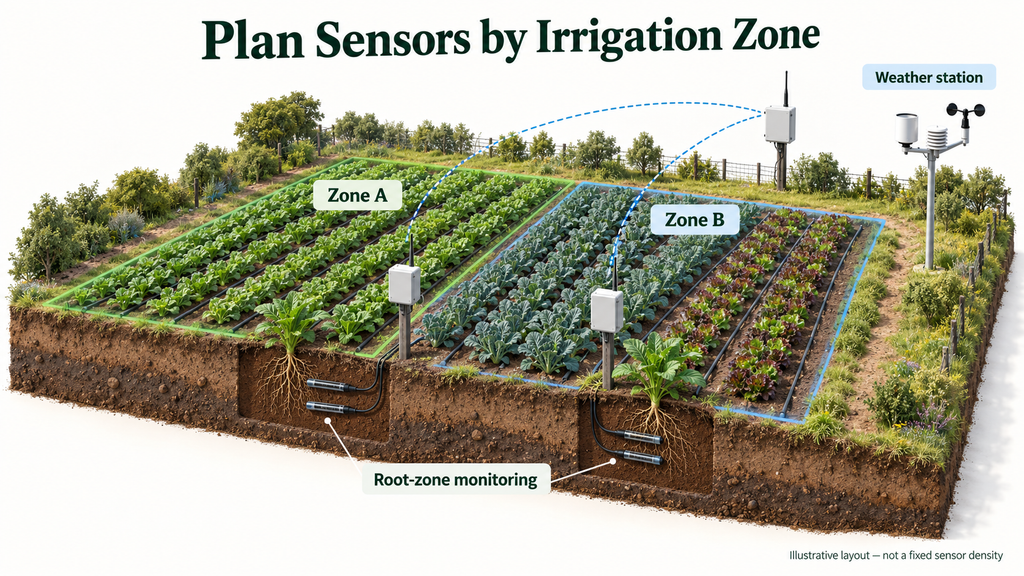
Consider an illustrative 0.7-hectare commercial vegetable plot—about 7,000 m²—with two irrigation zones and one water source. The following is a pilot concept, not an acreage-based industry standard or a completed customer case.
| Monitoring point | Illustrative starting arrangement | Reason to add or change it |
|---|---|---|
| Root-zone stations | One representative location in each of the two irrigation zones | Add locations where soil, slope, crop or irrigation behaviour differs. |
| Measurement depth | Select depth for the active roots; consider a second depth if drainage below the root zone is part of the decision | A station can contain more than one probe; station count and probe count are different. |
| Weather station | One suitable local station if the required weather measurements are representative | Separate microclimates or greenhouse conditions can require additional measurements. |
| Water source | Select EC/pH, level or other measurements only for a defined water-management need | A storage tank does not automatically need every water-quality probe. |
| Pest monitoring | Add a target-specific trap programme where scouting identifies a need | Do not set trap number or spacing from farm area alone. |
A visibly dry corner is worth investigating, but it should not automatically become the control point for an otherwise uniform zone. Check whether it represents that zone or a separate irrigation fault. Install moisture probes with good soil contact rather than leaving air gaps.
Le University of Minnesota Extension placement guide discusses representative monitoring and root-zone installation. Agriculture Victoria also recommends interpreting sensor readings alongside weather and field observations.
For weather instruments, an open position alone is not the complete siting specification. Wind, rainfall, solar radiation and canopy climate have different exposure requirements. Do not prescribe one mounting height for every sensor. Use the selected station’s instructions and keep a record of the installation.
See the University of Florida farm weather station installation and maintenance guidance and our agricultural weather station selection guide.
6. Adapt the Layout to the Crop and Region
- Middle Eastern date-palm orchard: map irrigation zones and the wetted root area before selecting soil monitoring positions. Include salinity measurements where they address a documented concern, and plan radio, enclosure and power protection for the site.
- Southeast Asian greenhouse: monitor the crop environment where it is representative, check condensation exposure and confirm connectivity through the structure. Outdoor weather and indoor crop-zone measurements serve different purposes.
- East African coffee farm: separate monitoring areas where slope, altitude, shade or soil creates different conditions. Validate the radio link in the actual terrain rather than relying on a brochure distance.
These are configuration examples, not fixed prescriptions or claims of Wewin deployments. Local crop management and a site survey determine the final layout.
For pest monitoring, choose the target species before the camera specification. A high megapixel count or one lamp wavelength does not establish useful identification. Lure selection, trap placement, collection condition and counting validation matter.
Le Penn State orchard IPM guide explains why trap type and placement are species-specific. Automated identification should support a monitoring programme, with an agreed way to review uncertain detections.

7. Compare Equipment Supply and Platform Packages
Public prices for isolated domestic products are a poor budget for an overseas project. Request an itemised quotation against the same equipment list, destination and support scope. Compare the costs below without assuming that a platform includes every service.
- Hardware: probes, logger or gateway, antenna, mounting, cables and connectors.
- Power: adapter or solar equipment, battery and the expected operating conditions.
- Connectivity and software: SIM/data, account fees, hosting, storage and export/API access where applicable.
- Delivery and maintenance: packing, freight, installation responsibility, consumables, calibration support and replacement arrangements.
| Procurement route | Useful when | Clarify before ordering |
|---|---|---|
| Components integrated by the buyer | The buyer has technical staff and an existing controller or platform | Who validates the protocol, powers the devices and diagnoses faults? |
| Coordinated monitoring package | The buyer wants a matched list and one point of coordination | Which devices, platform functions, configuration work and documents are included? |
| Monitoring plus automation | The application has already been validated and control is required | Who sets thresholds, handles missing data and confirms safe pump or valve behaviour? |
One dashboard does not automatically mean compatible devices, calibrated measurements or agronomic advice. Ask for a demonstration using the exact proposed equipment and agree on the handover documents.
8. Validate the First Installation Before Expanding
- Write one decision for each measurement: what reading or trend will trigger a check or action?
- Agree on model, firmware, units, calibration basis, reporting interval and acceptance limits.
- Test representative wetting/drying or operating cycles against an appropriate reference method.
- Check power cycling, missing readings, local storage and data recovery where supported.
- Verify dashboard units, timestamps, export and account access.
- Approve the pilot before adding automatic control or duplicating the package across sites.
Our soil monitoring procurement checklist covers the supplier and sample evaluation in more detail.
Plan a Monitoring Package with Wewin Smart Agri
Start with the crop and the decision, then select the equipment. Wewin Smart Agri can help review sensor and weather monitoring configurations for distributors, installers, integrators and commercial growers.
To request a configuration review and sample quotation, send your country, crop, site layout, irrigation zones, required measurements, existing equipment, power and connectivity. Model matching, sample supply, delivery documentation and online guidance are confirmed in the quotation; local installation, crop-management decisions and ongoing support responsibilities should be agreed separately.
A useful first system is not the one with the most devices. It is the one that measures the right conditions, at representative points, and gives someone a clear reason to act.