The Middle East is not simply adopting smart agriculture. The region is being forced to reinvent its farming model under extreme pressure — water scarcity, rising temperatures, food import dependence, and national security concerns.
For decades, Middle Eastern agriculture relied on abundant groundwater and government subsidies. Those days are ending. Groundwater reserves are depleting at alarming rates. Desalination is expensive. Climate change is making summers hotter and more unpredictable.
In response, governments across the Gulf have launched ambitious agricultural technology programs. Saudi Arabia’s Vision 2030, the UAE’s food security strategy, and Qatar’s National Food Security Program are not policy documents — they are funded mandates with procurement budgets, subsidy mechanisms, and measurable targets.
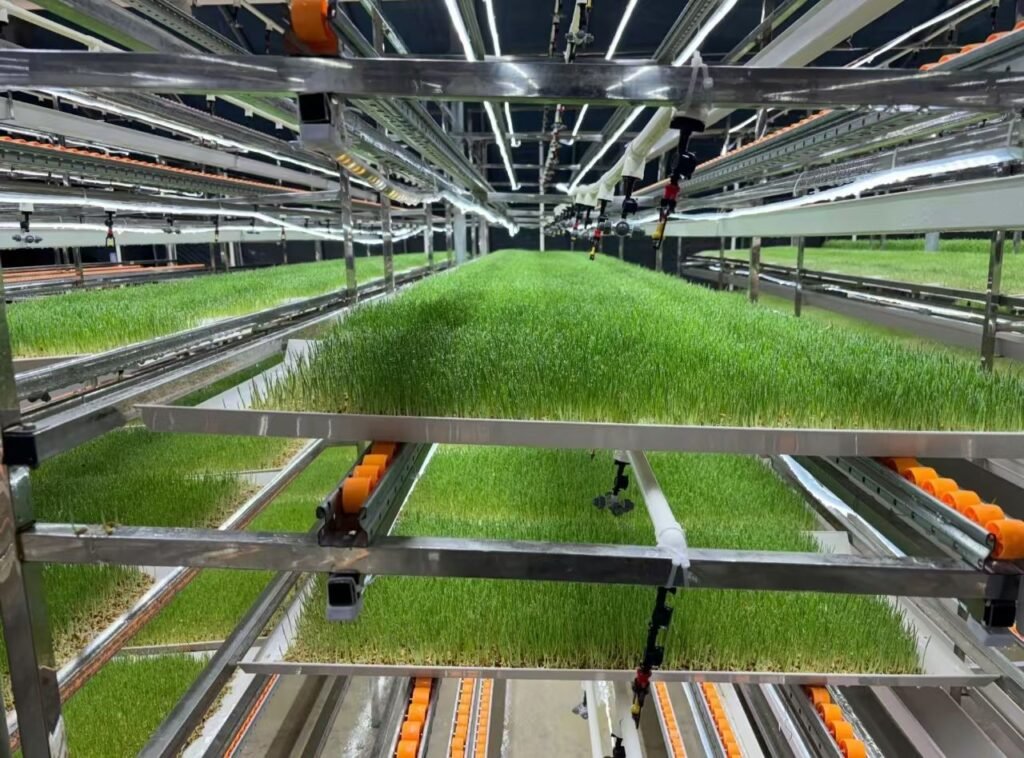
But here is the reality that few industry reports openly discuss: most of the hardware making this transition possible — the sensors, irrigation controllers, weather stations, and automation systems — comes from China. Not because Middle Eastern buyers prefer Chinese suppliers. Because the global agricultural technology supply chain has shifted. China now manufactures a substantial share of the world’s agricultural sensors and smart irrigation equipment. European and American brands still lead in premium segments, but typically at 2-3x the price point.
This article examines the technologies that matter most for Middle Eastern agriculture, the real-world results from regional projects, and the practical considerations for farms evaluating technology partners — including the advantages and limitations of Chinese equipment.
Part One: The Middle East’s Agricultural Crisis
The scale of the challenge is often understated.
According to the Food and Agriculture Organization (FAO), the Near East and North Africa (NENA) region holds just 1-2% of the world’s renewable freshwater resources but supports more than 6% of its population. Agriculture consumes approximately 80-90% of all freshwater withdrawals in most Middle Eastern countries — far above the global average of roughly 70%.
The efficiency problem is equally severe. Traditional irrigation methods — flood irrigation, open canals, and center pivots without scheduling optimization — typically achieve water use efficiency of only 50-60%. The remaining 40-50% is lost to evaporation, runoff, and deep percolation.
In real terms: for every 100 liters of water pumped or desalinated for agriculture, roughly 40-50 liters never reach the plant roots.
Climate projections make this situation worse. The Intergovernmental Panel on Climate Change (IPCC) projects temperature increases of 2-4°C across the region by 2050, with reduced and more erratic rainfall. Without significant efficiency improvements, agricultural water demand will continue to outpace supply. This is not a future problem. This is the operating reality for farms across the region today.
Part Two: The Hardware Revolution — What Chinese Technology Actually Delivers
Smart agriculture is often discussed in abstract terms — AI, big data, digital transformation. But for a farm manager in Saudi Arabia or the UAE, the question is concrete: what equipment do I install, what does it cost, and what results will I see?
The following technologies currently offer the strongest return on investment for Middle Eastern conditions.
Smart Irrigation and Fertigation Systems
This is the highest-priority investment for most Middle Eastern farms. Not because it is the most advanced technology — because it addresses the single largest operational cost: water.
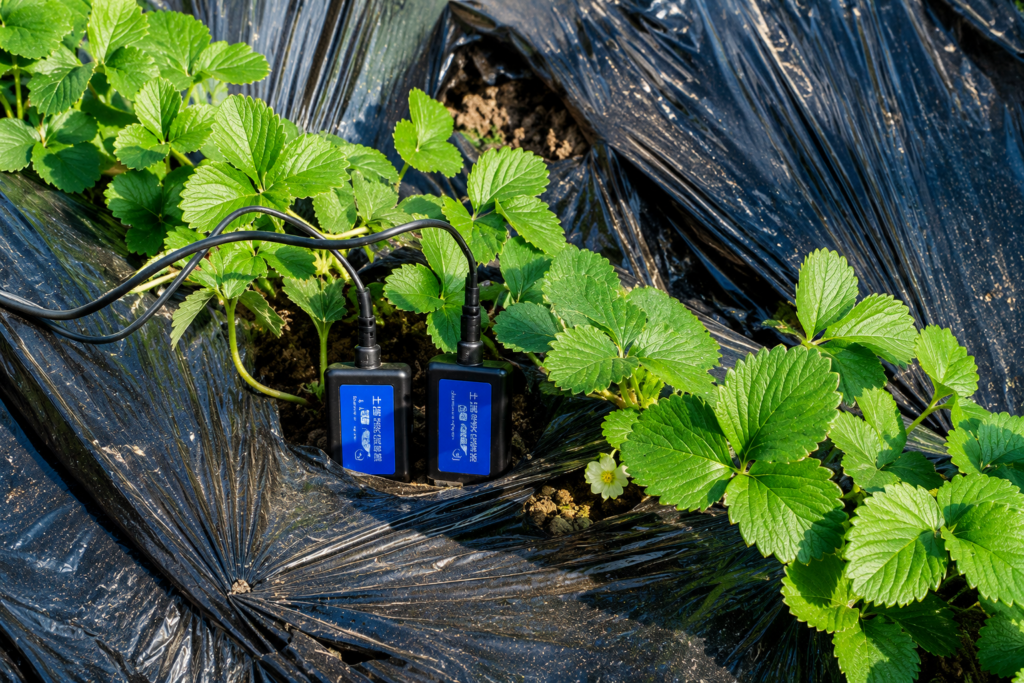
Smart irrigation combines soil moisture sensors, localized weather data, automated valve controllers, and fertigation injectors that deliver nutrients with irrigation water.
The results from multiple field studies across the region are consistent:
- Water consumption: typically reduced by 30-50%
- Fertilizer use: typically reduced by 20-30%
- Energy for pumping: typically reduced by 15-25%
- Crop yield consistency: typically improved by 10-20%
Source: FAO regional irrigation efficiency studies; field trials in Jordan, Iraq, and Saudi Arabia (2022-2025).
Why Chinese equipment is relevant here:
Chinese manufacturers produce the full range of smart irrigation components — sensors, controllers, solenoids, fertigation injectors, and connectivity modules — at price points typically 40-60% lower than equivalent European or US brands. The trade-off is not quality (most leading Chinese suppliers hold CE, RoHS, and ISO certifications). The trade-off is primarily brand reputation and documentation quality.
For a mid-sized Middle Eastern farm, choosing Chinese equipment can reduce the upfront system cost from approximately $35,000-45,000 (European system) to roughly $15,000-25,000 (Chinese system) — a difference large enough to fund local installation, staff training, and two years of on-call support.
Environmental Sensor Networks
Sensors are the foundation of precision farming. Without reliable field data, AI models are useless — the “garbage in, garbage out” problem is particularly acute in agriculture, where data quality is often poor.
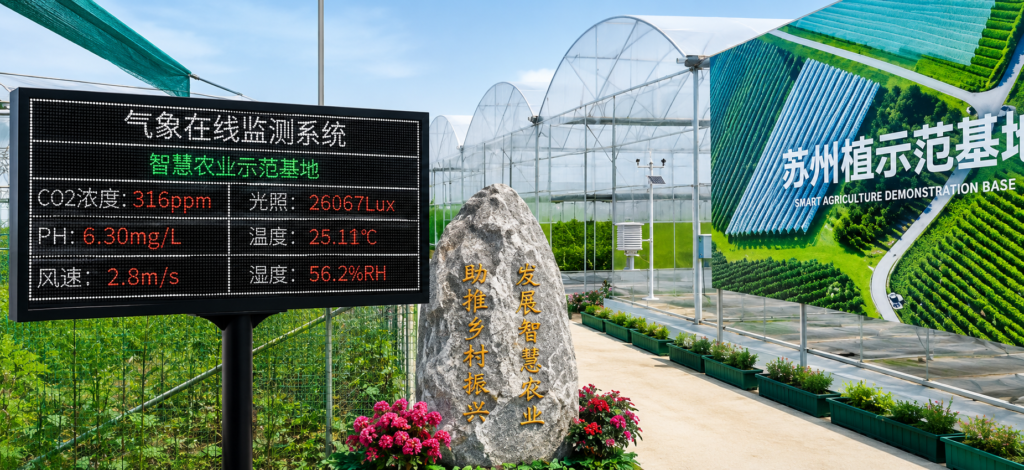
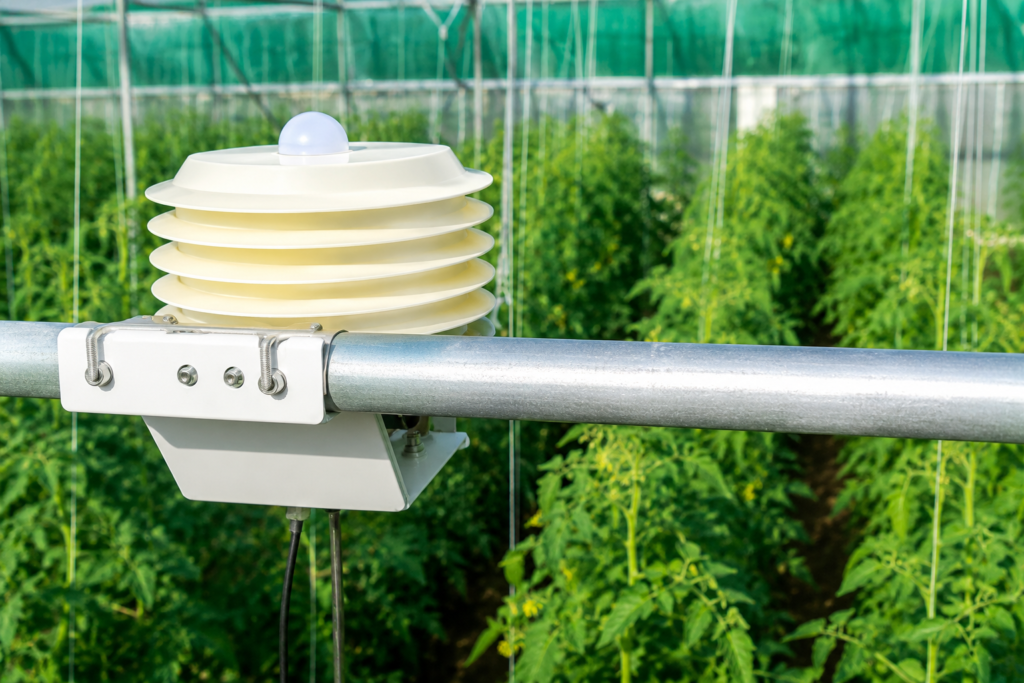
For Middle Eastern conditions, the most valuable sensors include soil moisture sensors (for irrigation scheduling and root zone monitoring), soil EC sensors (for salinity monitoring, which is critical in the Gulf), temperature and humidity sensors (for crop stress detection and greenhouse control), light intensity sensors, CO₂ sensors for greenhouses, and wind speed and rainfall sensors for spraying decisions and frost protection.
Sensor prices have declined significantly over the past three years, while accuracy and durability have improved. A basic sensor network that might have cost $8,000-10,000 a few years ago can now be sourced from Chinese suppliers at approximately $5,000-7,000, with similar or better specifications.
For many farms, the payback period for sensor investment is roughly 2-3 growing seasons based on water savings alone. When fertilizer and labor savings are included, payback often falls below 24 months.
Agricultural Weather Stations
Microclimate variability across the Middle East is extreme. Temperature differences between day and night can exceed 20°C. Weather patterns can differ significantly across distances of only a few kilometers.
Regional weather forecasts are not sufficient for precision agriculture. Localized weather stations provide data that directly affects operational decisions — irrigation adjustment, spray timing, frost protection, and disease prevention.
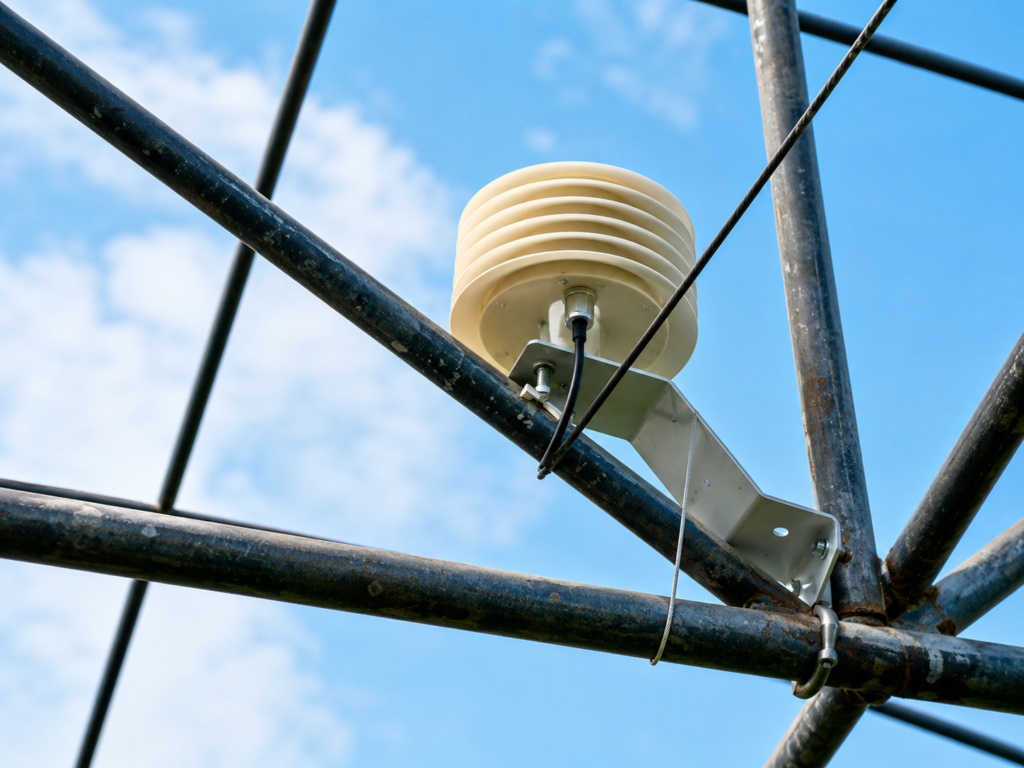
Chinese agricultural weather stations — typically priced at roughly $1,500-3,500 for a complete system with solar power and cellular transmission — have become widely adopted across the Middle East in recent years. Similar stations from European suppliers generally cost $5,000-10,000.
Greenhouse Environmental Control
Protected agriculture is expanding rapidly across the Gulf. High-value crops — tomatoes, cucumbers, peppers, strawberries, herbs, and cut flowers — are increasingly grown in climate-controlled greenhouses to maintain year-round production despite summer heat.
Automated greenhouse control systems manage temperature and humidity, shading and screening, CO₂ enrichment, irrigation and fertigation, and supplemental lighting.
The cost gap is largest in this category. A complete greenhouse automation system from a European supplier typically starts at $50,000-80,000 for a 1-hectare greenhouse. Chinese systems with comparable specifications are generally available at $25,000-40,000 — roughly 50% lower.
But this is also the category where vendor support matters most. Greenhouse automation is complex; integration between climate control, irrigation, and lighting requires careful configuration. Farms purchasing Chinese greenhouse systems should verify that the supplier provides clear documentation, remote support, and preferably on-site training.
Part Three: Two Case Studies of Smart Agriculture in the Middle East What Actually Works in the Region
The following projects demonstrate that commercial-scale smart agriculture is already functioning in the Middle East. Both provide replicable models for farms considering technology adoption.
Case Study 1: NEOM Topian Greenhouse — Saudi Arabia
In 2024, Topian (NEOM’s food company) inaugurated its first high-tech greenhouse in Oxagon, northwest Saudi Arabia.
The facility covers approximately 4 hectares and is designed to produce roughly 4,000 tons of fresh fruits and vegetables annually. The project reports water savings of approximately 93% compared to traditional agriculture. The greenhouse integrates AI-driven predictive models, robotics, and renewable energy systems, developed in partnership with Van der Hoeven, a Dutch horticultural technology leader.
Why this project matters for farms across the region: the greenhouse was designed for replicability. The system is intended to be scalable to other arid regions facing similar climate conditions. For farms across the Gulf, this serves as a proof point: controlled-environment agriculture with smart monitoring and AI-driven decision support works at commercial scale in desert conditions.
Like most large-scale Gulf agricultural projects, NEOM’s greenhouse integrates European design expertise with hardware sourced from multiple global suppliers — including, in many cases, Chinese sensors, actuators, and control modules.
Source: NEOM/Topian announcements (2024-2025); industry reporting.
Case Study 2: UNS Vertical Farms — UAE
In April 2026, UNS Vertical Farms launched a new 10,000-square-meter controlled-environment tomato facility in Al Ain, UAE.
The facility produces approximately 150,000 kilograms of fresh tomatoes annually, including premium cherry and cluster tomato varieties. It achieves up to 90% water savings compared to traditional agriculture through a combination of hydroponics, IoT sensors, AI analytics, and centralized control systems. The farm operates without pesticides and delivers produce to consumers within 24-48 hours of harvest.
The facility operates year-round, independent of seasonal and weather constraints. Sensors continuously monitor temperature, humidity, CO₂, lighting, and nutrient delivery in real time, while an integrated platform coordinates climate control, irrigation, airflow, and cooling.
As Mehlam Murtaza, Director of UNS Vertical Farms, noted: “Food security today goes beyond availability; it is about building a resilient, sustainable, and future-ready UAE food ecosystem.”
The facility’s core automation and control systems are supplied through a technology partnership model, with hardware sourced from both European and Asian manufacturers — representing the practical supply chain integration that characterizes most large-scale Gulf ag-tech projects.
Source: Gulf News (April 2026); UNS Vertical Farms official announcements; TahawulTech.
Part Four: What You Should Know About Chinese Agricultural Equipment — Advantages and Limitations
This section addresses the question that Middle Eastern buyers often ask but industry articles rarely answer directly: what is it actually like to buy and use Chinese agricultural equipment?
Advantages
Price competitiveness. The most obvious advantage. Price differentials of roughly 40-60% compared to European and US equivalents are real and sustainable, driven by China’s scale of manufacturing, integrated supply chains, and lower labor costs.
Breadth of product range. Chinese manufacturers produce the full stack — sensors, controllers, valves, cables, weather stations, and software platforms. Farms can source an entire system from a single supplier, reducing integration complexity.
Rapid iteration. Chinese hardware manufacturers typically release product updates every 6-12 months, compared to 24-36 months for many European brands. This means newer features are available sooner, though it also means product lifecycles are shorter.
Compatibility with third-party systems. Most Chinese sensors now support standard communication protocols (RS485, Modbus, 4-20mA, SDI-12), allowing integration with non-Chinese controllers and platforms.
Limitations
Documentation and training materials. English documentation is often available but varies widely in quality. Arabic documentation is rare. Farms should verify that the supplier provides clear, accurate, and complete documentation before purchasing.
Remote technical support. Time zone differences — roughly 5-6 hours between Saudi Arabia and China — can affect support response times. Farms should establish clear service level agreements with suppliers, including response time commitments and escalation procedures.
Durability in extreme conditions. Not all Chinese equipment is designed for 45°C+ temperatures and sandstorms. Buyers should verify that products have been tested for high-temperature operation and dust ingress protection (IP65 or higher). Ask for test reports, not just marketing claims.
Brand reputation and bankability. Large projects sometimes require equipment from “approved brands” to qualify for government subsidies or bank financing. Chinese brands are increasingly accepted, but pre-approval should be verified with the relevant agency before procurement.
Software and cloud platform differences. Chinese management platforms often provide excellent functionality but may have different data privacy regimes, language options, and integration capabilities than Western equivalents. Farms should verify where data is stored, what data export options exist, and whether the platform can integrate with existing farm management systems.
Part Five: The Service Shift — Why Middle Eastern Farms Are Moving from Buying to Subscribing
One of the most important trends in agricultural technology — and one with particular relevance to the Middle East — is the shift from equipment sales to technology services.
For farms with limited capital, the challenge has always been the same: advanced technology is proven to work, but the upfront investment is often too large to justify.
The service model solves this problem by converting capital expenditure (CapEx) into operating expenditure (OpEx).
Instead of purchasing an irrigation controller, sensor network, weather station, and management software outright — which together might cost $20,000-40,000 — farms can subscribe to per-hectare irrigation management, monthly sensor data analysis, drone spraying services, or equipment-as-a-service. The first payment is typically $1,000-3,000 rather than $20,000-40,000.
This changes the adoption decision significantly. The farmer no longer bears full equipment risk; the service provider does. Technical expertise requirements are lower because the supplier handles complexity. Upgrades are included. And the payback evaluation becomes simple: does the monthly fee exceed the monthly savings?
For mid-sized farms that cannot justify large capital expenditures, the service model makes advanced technology accessible.
Part Six: What to Do Next — A Three-Step Approach for Middle Eastern Farms
Based on regional experience and technology maturity, farms considering smart agriculture investment should consider a phased approach.
Step 1: Start with Monitoring (Months 1-6)
Install soil moisture sensors and a basic weather station. Collect data for one full growing season. Establish baseline water and fertilizer consumption. Cost typically ranges from $5,000-10,000 depending on farm size.
Monitoring provides the data needed to justify further investment. Without baseline data, ROI calculations are guesswork. This also builds staff familiarity with digital tools at minimal risk.
Step 2: Automate Irrigation (Months 7-12)
Connect sensor data to automatic irrigation controllers. Implement precision irrigation based on real-time soil moisture and weather data. Compare water consumption against baseline. Cost typically ranges from $10,000-25,000 depending on system size.
Irrigation is the largest variable cost for most Middle Eastern farms. If monitoring shows 30-40% water waste is occurring — which it almost always does — irrigation automation becomes the logical next investment. This is the most reliable source of measurable ROI.
Step 3: Expand to Integrated Platform (Months 13-24)
Add digital farm management software to centralize all data. Integrate irrigation, weather, crop records, and labor tracking. Consider greenhouse automation if applicable. Cost for larger farms typically ranges from $20,000-50,000, though phased implementation is possible.
An integrated platform amplifies the value of individual technologies by connecting them. But the platform is only useful if the underlying data streams — sensors, irrigation, weather — are already reliable. Build the foundation first; add the “brain” after the “senses” are working.
Conclusion: The Opportunity and the Reality
Smart agriculture in the Middle East is not an experiment. It is a response to real, intensifying pressures: water scarcity, climate change, food import dependence, and operating cost inflation.
The technology works. The case studies from Saudi Arabia and the UAE demonstrate that commercial-scale smart agriculture is viable in the region’s extreme conditions.
What is still uncertain for many farms is not the technology — it is the route to adoption. Should you purchase from a European premium brand or a Chinese value brand? Should you buy equipment outright or subscribe to a service? Should you automate the entire farm at once or phase in technology?
There is no universal answer. The correct path depends on your farm size, crop type, operating capital, staff capabilities, and strategic objectives.
But for most mid-sized Middle Eastern farms, the following is true:
- The cost gap between Chinese and European equipment — typically 40-60% — is too large to ignore for anything but the most capital-rich operations.
- Chinese equipment is not automatically better or worse — it is different, with distinct trade-offs in price, documentation, support, and durability.
- The smartest adoption strategy is almost always phased — monitor first, automate irrigation second, expand to integrated platforms third.
- The service model makes technology accessible to farms that would otherwise be excluded by capital constraints.
- The farms that start now — with monitoring, with a small pilot, with a single hectare of automation — will have 2-3 years of operational data and experience advantage over farms that wait.
Interested in exploring smart farming solutions for your operation?
We supply agricultural sensors, irrigation controllers, weather stations, and integrated monitoring systems designed for Middle Eastern conditions. Our equipment is sourced from leading Chinese manufacturers and selected for reliability in high-temperature, low-humidity environments.
📩 Contact us for product specifications, pricing, or a free consultation.