
An agricultural weather station should be selected around the measurements your customer needs, the installation site and the way the data will be used. Sensor count alone is a poor purchasing specification. A station can display many values yet still be unsuitable because its records cannot be exported, its interfaces do not match the existing system, or its sensors cannot be positioned correctly.
For equipment distributors, irrigation installers and system integrators, a useful selection process ends with a defined configuration and a testable sample. This guide explains how to compare station designs, check data access and prepare a quotation request without paying for functions the application does not need.
Agricultural Weather Station Selection: The Short Answer
Choose in this order: define the operating decision, select the necessary measurements, check sensor performance, plan placement, confirm the complete data path, size the power system and agree on sample acceptance. Compare quotations only after the included sensors, logger, mounting, software and support are listed on the same basis.
Start with a practical question: who will read the data, how often, and what will they do differently because of it? A distributor supplying replacement instruments has different requirements from an installer adding weather data to an irrigation controller. Neither automatically needs a large, fully managed monitoring project.
This guide covers measurement selection, station construction, specifications, placement, communications, power, sample testing, ownership costs and an RFQ checklist.
1. Define the Application Before Choosing Sensors
Turn the customer’s request into a short measurement brief. Identify the crop environment, the person responsible for the station and the existing equipment. Then separate essential measurements from useful additions. A clear brief also prevents a familiar problem: comparing a sensor head quotation with the price of a complete installed system.
| Customer task | Measurements to consider | Procurement boundary |
|---|---|---|
| Field weather records | Air temperature, humidity, wind and rainfall | Define record intervals, storage and export |
| Irrigation planning | Weather inputs required by the chosen method, plus rainfall and relevant soil information | Confirm the calculation method and who interprets the results |
| Orchard microclimate monitoring | Temperature and humidity at representative locations; other sensors as required | Determine whether one location represents the managed blocks |
| Existing system integration | Only the measurements the controller or platform can use | Obtain the interface documentation before buying |
| Distributor sample evaluation | A defined sensor and logger package | Record the exact configuration for repeat orders |
Do not assume that a station automatically predicts disease, calculates irrigation demand or operates valves. Those functions require appropriate software, models, inputs and control hardware. Ask which functions are included, licensed separately or outside the supply scope.
For irrigation calculations, reference evapotranspiration is different from the actual water requirement of a particular crop. FAO describes radiation, air temperature, humidity and wind as principal weather inputs; crop and management factors must also be considered. See FAO’s explanation of evapotranspiration.
2. Compare Modular and All-in-One Stations
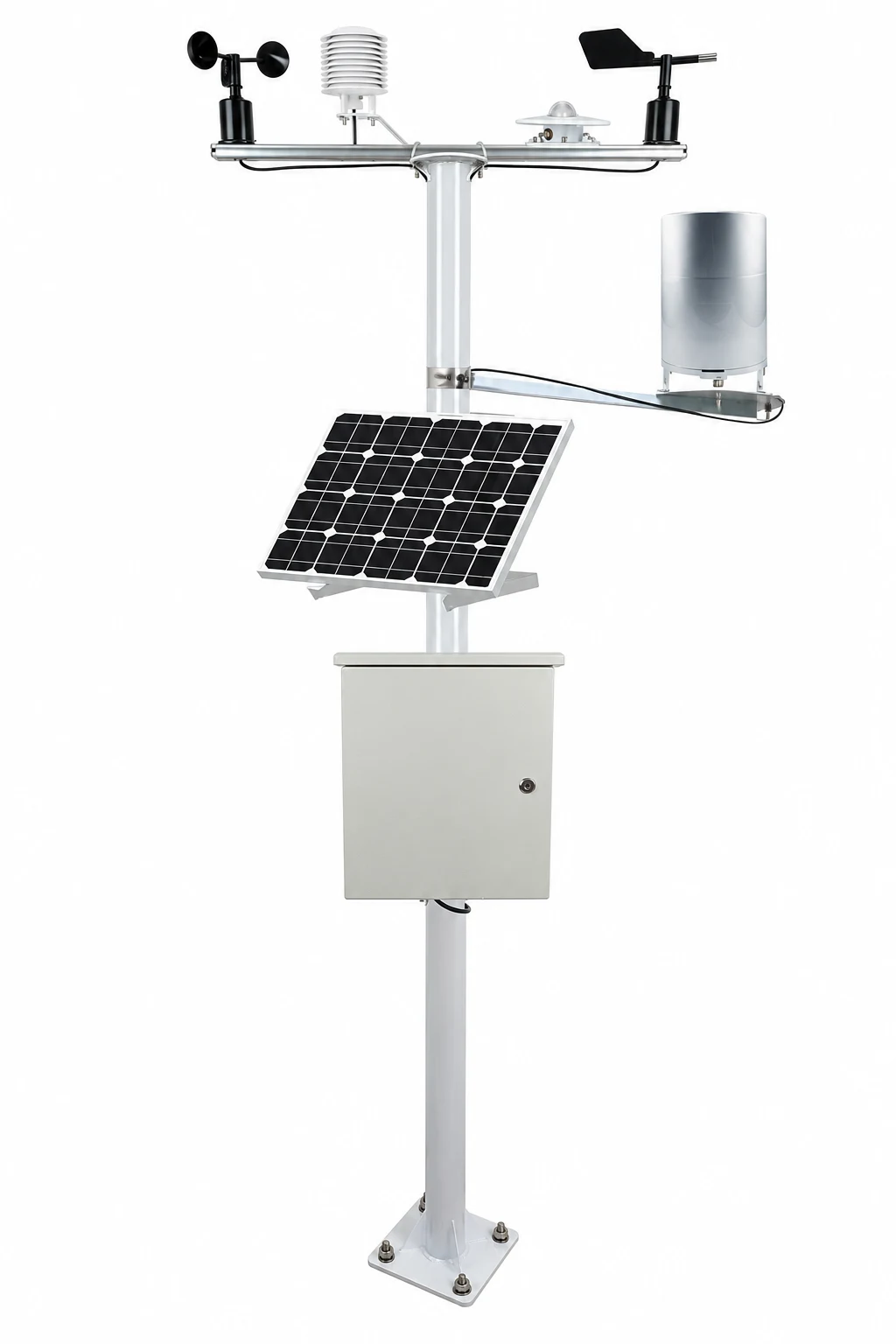
An all-in-one unit combines several measurements in one sensor head. A modular station uses separate instruments connected to a logger. Either can suit commercial agriculture. The important comparison is how the design fits installation, replacement and integration requirements.
| Design | Useful when | Check before ordering |
|---|---|---|
| Compact all-in-one head | Limited mounting space or a repeatable compact installation | Which channels are included, whether a logger is separate and how the head is serviced |
| Modular station | Separate positioning, selectable measurements or component replacement is important | Cable lengths, connector compatibility, logger capacity and mounting scope |
| Existing logger plus additional sensors | The customer already has a compatible acquisition system | Supported inputs, protocol, available channels and sensor power |
Compact does not mean maintenance-free, and modular does not automatically mean better accuracy. A single mounting point can simplify assembly but limit the placement of individual measurements. Separate sensors offer flexibility but introduce more installation and wiring decisions.
When comparing ultrasonic wind measurement with cups and a vane, review the actual specifications and service procedure. The absence of moving wind components does not remove the need to inspect the station, clean other sensors or verify readings.
You can compare Wewin’s modular weather station with a local data logger with the compact weather station. Confirm the current specifications and included accessories for each quotation rather than transferring parameters between models.
3. Read Specifications Beyond the Headline Accuracy
Check the conditions attached to every accuracy statement. A specification may apply only within part of the measurement range or at a stated temperature. Resolution describes the smallest reported step; it is not proof that the instrument is accurate to that amount.
Use the same units and conditions when comparing offers. Ask whether calibration documentation identifies the supplied instrument, which measurements it covers and what traceability is available. A general factory inspection sheet and a traceable calibration certificate answer different questions.
For wind, ask about low-speed starting behavior, reporting intervals and how gusts are calculated. For rain, distinguish accumulated precipitation from intensity and check the measurement method. For temperature and humidity, review the shield and exposure as well as the sensing element. For solar radiation, confirm the measured quantity and units: a light sensor reporting lux should not be treated as a direct substitute for a pyranometer reporting irradiance.
Also separate component ratings from assembled-system limits. A wide-range temperature probe does not make the logger, display, battery or enclosure suitable for the same extremes. Ask about connectors, UV exposure, corrosion, condensation and any heating requirement relevant to the destination. Avoid accepting a single protection rating as a description of every part of the package.
Сайт University of Arizona’s weather-station selection guide provides useful context on balancing data requirements, instrument quality and system costs.
4. Plan Sensor Placement Before Ordering the Mast
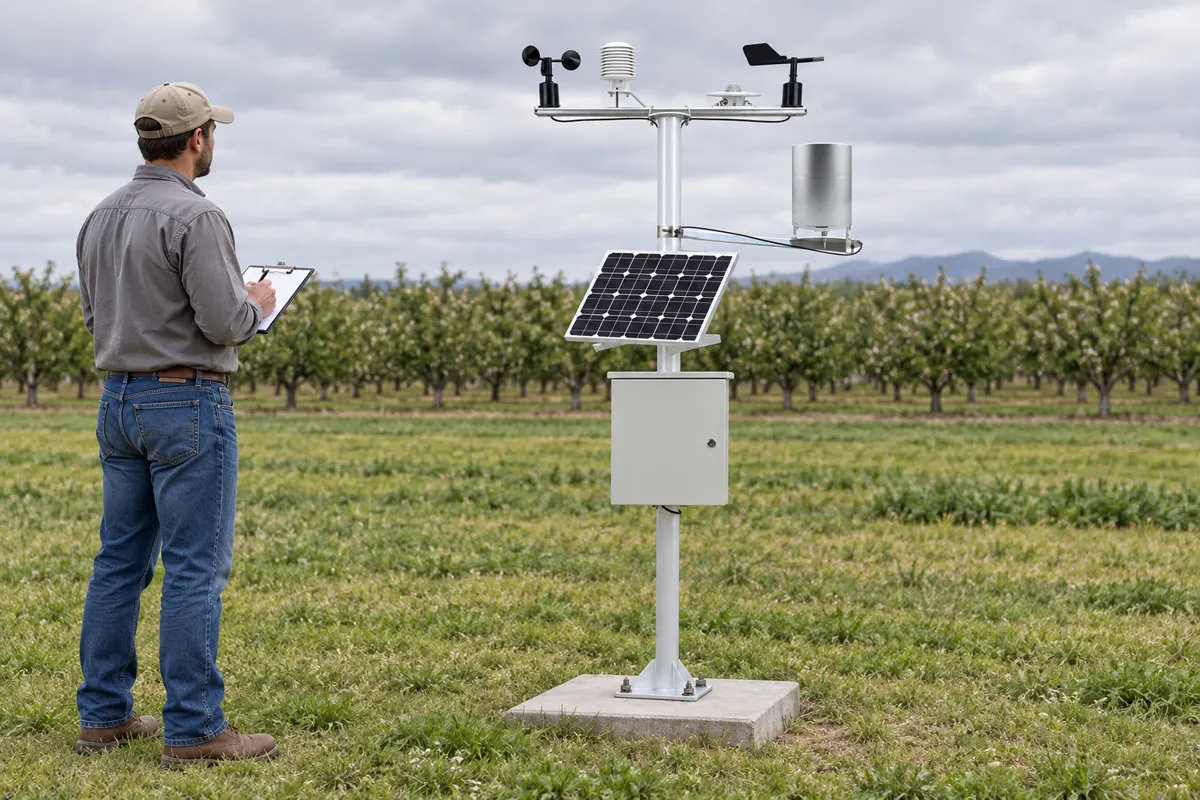
Decide whether the station should represent general field conditions or a particular crop microclimate. These objectives can lead to different locations and measurement heights. A convenient spot beside an office, wall or irrigation sprinkler may be easy to access but poorly matched to the intended observation.
Review nearby buildings, trees, windbreaks, reflective surfaces and changing crop height. Consider access for cleaning, security and the ability to keep the installation level and stable. A tall mast does not solve every exposure problem; it can make a rain gauge or radiation sensor difficult to maintain.
Create a simple site sketch showing proposed sensor positions and obstructions, and ask the supplier to check the mounting arrangement. For a compact head, document any compromises caused by keeping all measurements together. For a modular assembly, check whether the supplied cable lengths allow the planned layout.
There is no single mounting height appropriate for every agricultural measurement or purpose. Apply the requirements of the measurement method and intended use. University of Florida guidance on establishing farm-based stations is a practical starting point; application-specific requirements still need to be agreed.
5. Confirm How Data Leaves the Station
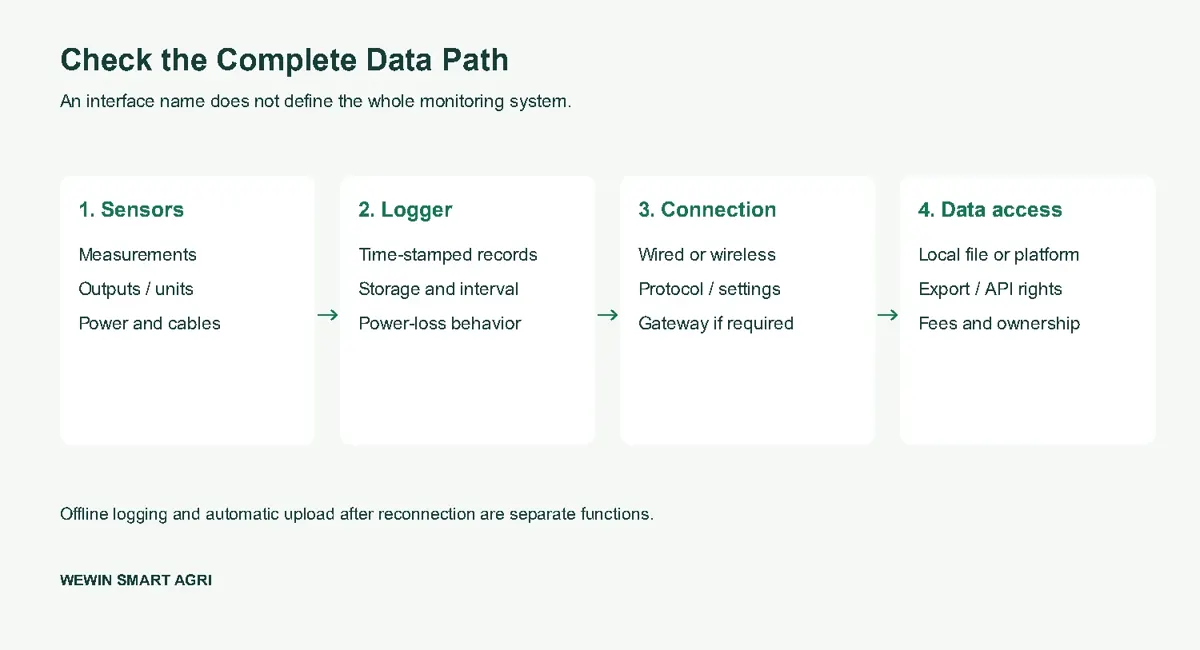
Map the complete path: sensor, logger, communication equipment, software and user. A specification that says “RS485” or “wireless” describes only part of that path. Ask for a sample data file and the documentation needed to reproduce the connection.
Wired connections and Modbus
RS485 is an electrical interface, not a complete application protocol. For a Modbus version, request the register map and confirm supported functions, device address, baud rate, parity, units, scaling and data representation. Check the ordered firmware revision against the documentation. Two devices described as Modbus-compatible still need matching settings and supported data definitions.
Cable routing, grounding, termination and surge protection should be designed for the actual site. For protocol background, consult the Modbus Organization’s specifications and implementation guides. Integration should be verified with the customer’s logger or controller before a batch order.
Wireless links and remote access
Distinguish the local sensor link from the connection that takes data to an office or server. LoRa, LoRaWAN, Wi-Fi and cellular communications are not interchangeable. Confirm whether a gateway is required, who supplies it and whether the customer can use an existing network. Do not assume a stated radio range will be achieved through trees, buildings or uneven terrain.
For cellular equipment, verify the modem technology, supported bands, destination network and SIM arrangement. A manual listing GPRS does not establish 4G compatibility. For cloud access, ask about subscriptions, account ownership, export permissions, API availability and what happens if the service is discontinued.
Offline records
Confirm whether the logger continues recording when the network is unavailable and whether historical records are uploaded automatically after reconnection. Local storage and automatic backfill are separate functions. Also test whether records survive a power interruption and whether full memory overwrites the oldest records or stops logging.
A claimed storage duration needs a record interval and configuration behind it. As an arithmetic illustration, 10,000 records at ten-minute intervals cover about 69 days if one record contains a complete timestamped reading set. This is not a capacity claim for a particular product: storage format, metadata and channel count may change the result.
6. Size Power for the Complete Configuration
List every powered component, including sensors, logger, modem, heater and any display. Separate continuous loads from transmission peaks and startup demand. A low-power sensor specification is not the consumption of the complete station.
For solar installations, ask the supplier to state the assumptions used for panel, battery and charge-controller selection. These should reflect local solar conditions, shading, temperature, communication frequency and the intended reserve. Agree on a low-power response and a method of checking battery condition rather than accepting an unexplained promise of continuous operation.
For mains power, confirm the destination voltage and frequency, adapter ratings, outdoor protection and grounding requirements. Check whether battery shipping requirements and replacement availability affect the order. An apparently inexpensive package can create avoidable cost if the buyer has to replace its power equipment after delivery.
7. Evaluate a Sample Before Buying in Quantity
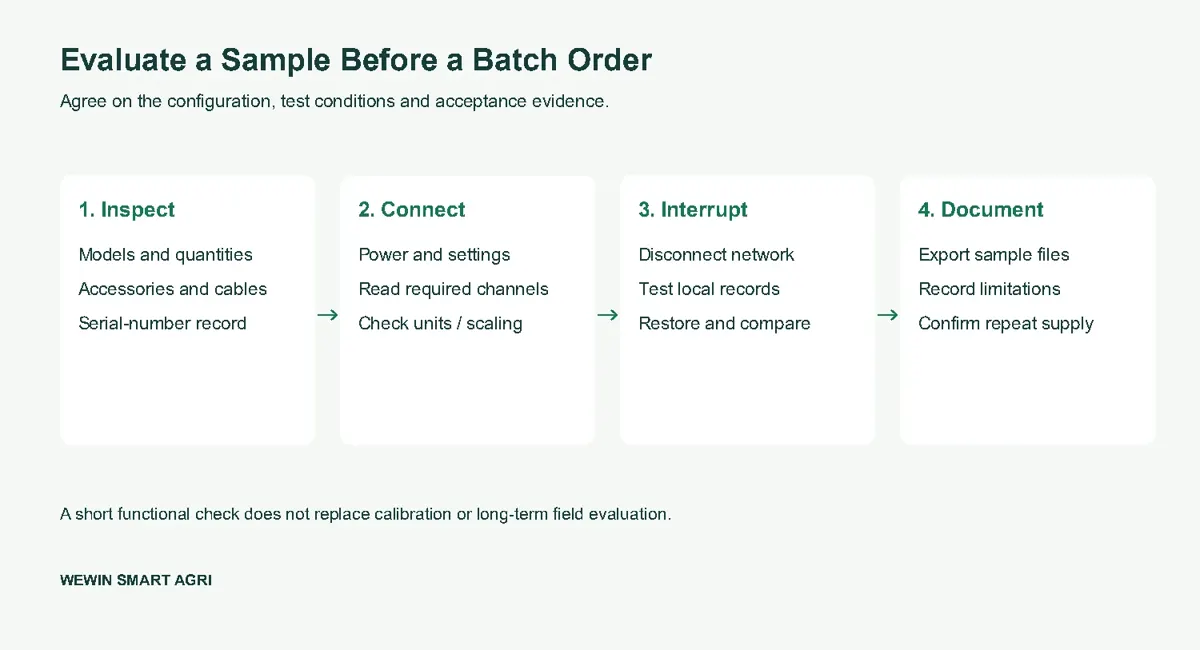
Use a written acceptance plan agreed before the sample ships. The purpose is to prove that the ordered configuration meets the application, not merely that values appear on the display. For distributors, this record becomes a baseline for repeat supply and customer support.
| Проверить | What to verify | Evidence to retain |
|---|---|---|
| Настройка | Sensor models, accessories, labels and cable lengths match the order | Packing list, serial numbers and photos |
| Measurement | Plausible readings and agreed comparison checks under documented conditions | Timestamped observations and reference details |
| Integration | Required channels can be read by the intended system | Settings, protocol version and exported data |
| Network interruption | Local logging and any promised recovery behavior work | Records before, during and after interruption |
| Restart | Configuration and stored records behave as agreed after power restoration | Restart observations and file checks |
| Maintenance | Sensors can be inspected and serviced as documented | Instructions, tools and spare-part references |
A short side-by-side field check can reveal missing channels, scaling errors or installation problems. It does not replace calibration or prove year-round durability. Record the limitations of the test and any issues that require a longer evaluation.
Ask the supplier to explain sensor error indicators and missing values. A frozen value that looks normal can be more difficult to detect than an explicit fault. If readings will influence automated equipment, the controller must have its own tested response to stale or invalid data; the weather station alone is not a complete control-safety design.
8. Compare Ownership Costs and Service Support
Request a complete bill of materials rather than one price for “a weather station.” Separate sensors, logger, mast, foundations, cables, power, communications and software. Then list installation, connectivity charges, calibration, cleaning and replacement parts over a stated comparison period.
Ask how individual sensors are replaced, whether replacements need configuration and whether cables or connectors are proprietary. Establish who handles remote troubleshooting and what information the supplier needs. For repeat orders, request notification of changes to firmware, interfaces or supplied components.
Routine maintenance should be planned around the actual environment. Dust, insects, bird activity, irrigation spray and vegetation can all create inspection needs. The University of Florida’s installation and maintenance guide is a useful reference when preparing a site-specific maintenance schedule. Follow the selected instrument’s instructions for cleaning and calibration.
9. Common Buying Mistakes
- Ordering the longest sensor list without a measurement brief. Start with the decisions and add channels that support them.
- Treating a sensor head as a complete station. Verify the logger, power supply, mounting and software scope.
- Buying by interface name alone. Test the actual protocol, data format and customer system.
- Assuming every wireless version works in every country. Confirm the ordered communications hardware and applicable requirements.
- Accepting cloud access without export and ownership details. Establish how the customer retains usable records.
- Choosing a convenient mounting point before considering exposure. Review the site before fixing cable lengths and mast configuration.
- Treating a weather station as an irrigation controller. Specify any control equipment and commissioning separately.
10. What to Include in an RFQ
Send the supplier enough information to produce a configuration-specific quotation:
- Application, crop environment and destination country.
- Required measurements, ranges, accuracy requirements and reporting units.
- Number of stations, sample quantity and expected repeat-order needs.
- Proposed location, exposure conditions, mounting height and cable lengths.
- Available power and whether solar or battery backup is required.
- Existing logger, controller or platform, with interface and protocol requirements.
- Recording interval, expected network outages and record-retention requirements.
- Local software, cloud, export, API and account-language requirements.
- Accessories, calibration documents, spare parts and acceptance checks.
- Labeling, packaging, delivery destination and required shipping documentation.
Attach a site sketch and a sample of the data format the receiving system expects when possible. Require the quotation to identify standard inclusions, options and exclusions. This makes supplier offers easier to compare and reduces configuration changes after an order is placed.
Часто задаваемые вопросы
Can an agricultural weather station work without internet access?
Yes, a configuration with local logging and a suitable retrieval method can work offline. Verify the storage capacity, export connection and power requirements. Remote viewing and automatic upload after reconnection are separate capabilities that must be specified.
Do I need soil moisture sensors with the station?
It depends on the application. Weather measurements describe atmospheric conditions, while soil sensors provide information from selected root-zone locations. They can complement one another for irrigation assessment. See our guide to choosing soil moisture sensors for irrigation before specifying additional probes.
Is one station enough for an entire farm?
Do not choose station quantity from acreage alone. Review elevation, exposure, crop blocks and the required decisions. A representative field record and monitoring a specific cold pocket are different objectives. Define the locations first and consider additional observations where important differences are expected.
Can I connect the station to my own platform?
Possibly, but check the exact version. Request protocol documents or API details, a sample file and a demonstration with your receiving system. A platform screenshot does not prove third-party integration or unrestricted data access.
Which station is best for distributors?
Prioritize a documented, repeatable configuration with manageable installation, accessible data and available replacements. Evaluate samples, support materials and configuration-change procedures before expanding the range. The most feature-rich package is not necessarily the easiest product to support.
Specify Your Agricultural Weather Station with Wewin
Start with a configuration you can test and support. Wewin can help review measurement, power, mounting and interface requirements, and arrange sample evaluation and a configuration-based quotation. Customization availability and software scope are confirmed for the selected model.
Browse our agricultural weather monitoring equipment, or send your measurement list, destination country and quantity. If you already have a controller or platform, include its model and required protocol so compatibility can be reviewed before ordering.