
Indoor strawberry farming gives commercial growers more control over light, temperature, irrigation and crop scheduling. That control can support consistent fruit quality and production outside the local field season, but it does not automatically deliver higher profits. A workable project must match its growing system, cultivar, energy demand and selling price to the conditions of the intended market.
Strawberries are traditionally grown in open fields and protected structures such as plastic tunnels. Greenhouses and fully enclosed farms extend the options available to growers facing unpredictable weather, limited land or demand for reliable local supply. Improvements in sensors, lighting and environmental controls make these systems easier to monitor, while skilled crop management remains essential.
Before selecting equipment, consider five connected factors: root-zone management, facility layout, lighting, crop protection, and the coordination of cultivar, pollination and climate. This guide focuses on those practical decisions for commercial growers and project partners.
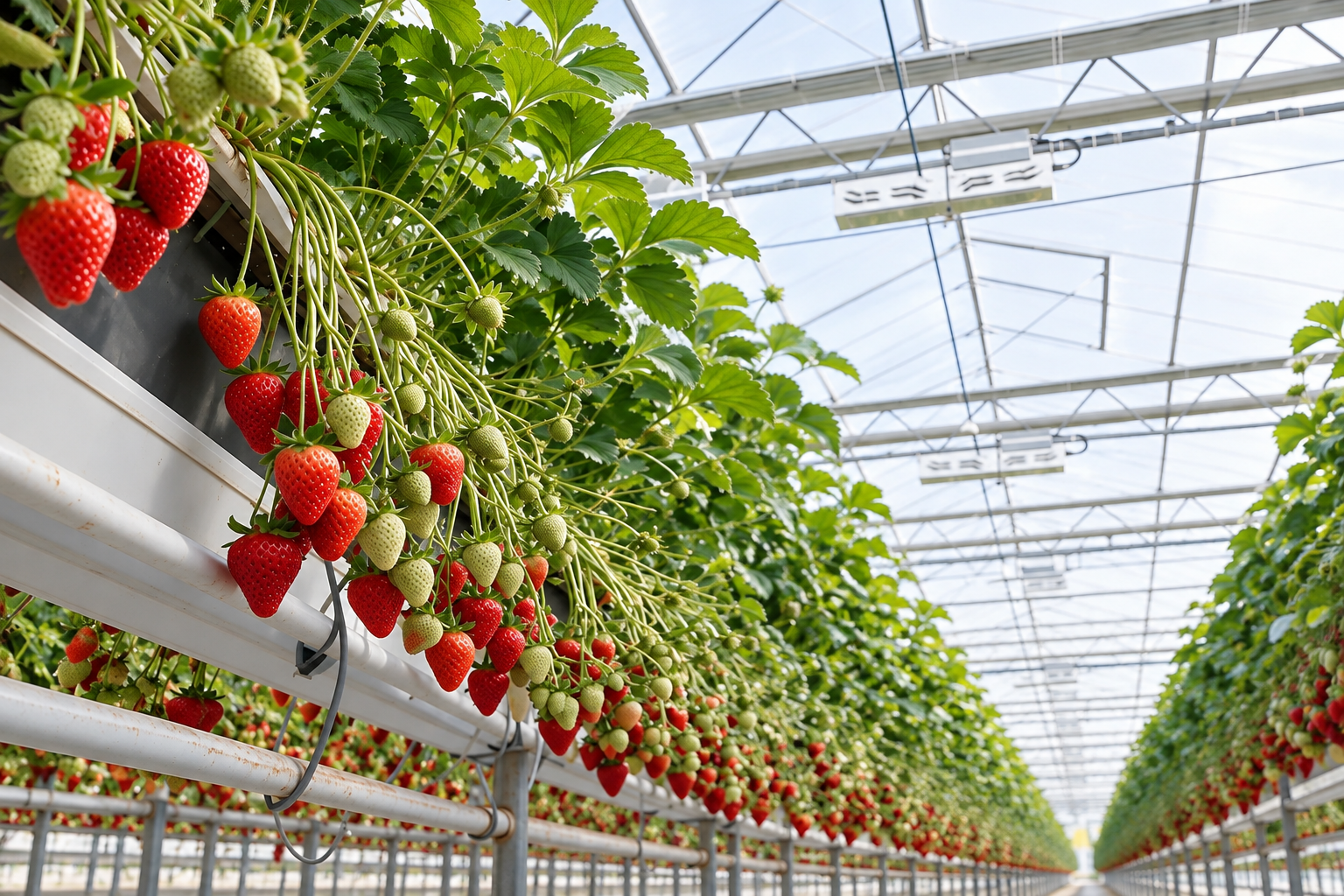
1. Choose a Root-Zone System for Hydroponic Strawberries
Hydroponic and aeroponic systems both deliver nutrients without relying on field soil. In hydroponic production, roots receive a nutrient solution directly or through an irrigated substrate. In aeroponics, roots hang in an enclosed space and receive a fine nutrient mist. The distinction matters because it changes irrigation reliability, maintenance needs and the consequences of a pump failure.
For hydroponic strawberries, elevated gutters containing substrate bags are one practical configuration. They give the root system physical support and allow drip irrigation to be adjusted to crop demand. A greenhouse cultivar trial from NC State Extension, for example, used raised gutters, coir bags and drip fertigation. This is a specific production approach rather than evidence that every hydroponic system performs equally well.
Compare water quality, drainage, root-zone aeration, nutrient dosing and access for cleaning before choosing a design. Aeroponic equipment also needs dependable mist delivery, filtration and a response plan for interruptions. Ask how operators will detect blocked emitters, low reservoir levels or changes in nutrient concentration before plants show visible stress.
Recirculation can reduce water discharge, but water-saving percentages depend on the comparison system and what is included in the calculation. Measure water use per kilogram of marketable fruit, including cleaning and replacement solution. Similarly, faster growth and higher yields should be demonstrated with the chosen cultivar and operating conditions rather than assumed from a general hydroponics claim.
2. Match the Growing Facility to the Production Plan
Plastic tunnels, controlled greenhouses and fully enclosed vertical farms offer different levels of protection and environmental control. Choosing between them starts with the local climate and target harvest window. A structure that extends the season successfully in one region may require substantial cooling or heating in another.
Plastic tunnels: Rain protection helps keep fruit dry and can reduce exposure to rain-splashed pathogens. Tunnels may also extend the harvest period when combined with appropriate crop timing and frost protection. Their performance still depends on ventilation, irrigation and pest management; a covered crop is not automatically disease-free.
Greenhouses: A greenhouse uses sunlight while allowing growers to add climate controls and supplemental lighting. Elevated gutters can improve access for picking and crop inspection. Evaluate shading, ventilation, cooling, heating and moisture removal together, because a change in one part of the environment affects the others. Our separate guide to greenhouse strawberry cultivation covers related production challenges.
Vertical farms: Multiple growing levels can increase the cultivated area within a building footprint. However, additional tiers also introduce challenges in light distribution, airflow, irrigation, access and harvesting. A multi-tier installation inside a glasshouse is different from a fully enclosed facility that depends on artificial lighting for photosynthesis.
Compare layouts using annual marketable yield per square metre of building floor, electricity per kilogram, picking labour and rejected fruit. Do not compare a single growing layer in one system with the entire building footprint in another. More planting positions do not, by themselves, establish lower production costs or a smaller carbon footprint.
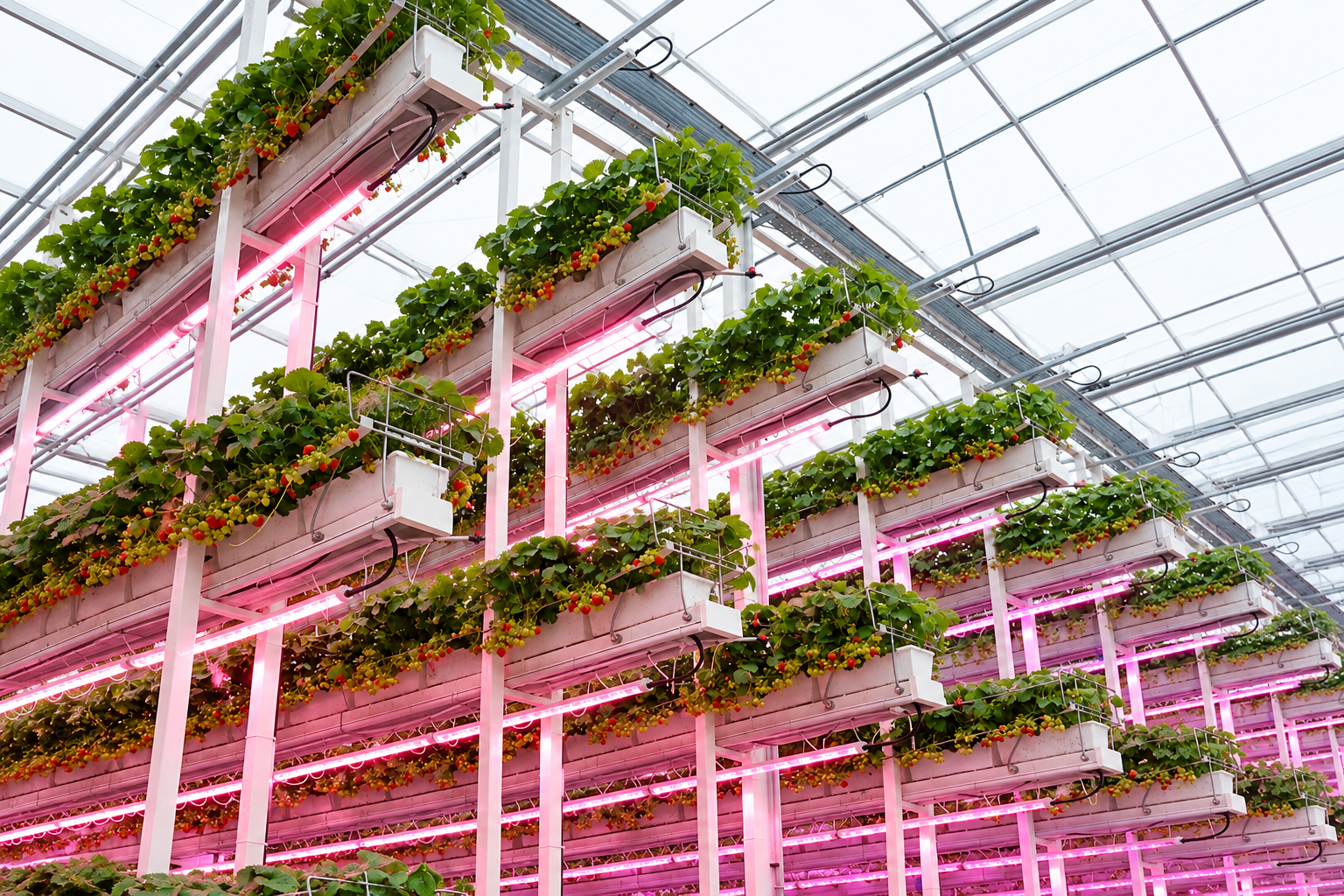
3. Design LED Grow Lights for Strawberries Around Crop Demand
LED grow lights for strawberries can provide supplemental light during short days or cloudy weather, or act as the main photosynthetic light source in a fully enclosed farm. These are different design tasks. In a greenhouse, the lighting plan should account for available sunlight; in an indoor room, the electrical system must support the full crop-lighting requirement.
Start with the amount of light reaching the canopy, its distribution across the crop and the total received over a day. Fixture wattage alone cannot show whether plants on the edges or lower tiers receive enough light. Consider mounting height, spacing, dimming, canopy development and shading from the structure.
Photoperiod and spectrum also need to match the cultivar and growth stage. Extending the lighting period is not a universal way to improve flowering or fruit yield. A suitable program must balance plant development, fruit quality and electricity use while maintaining the required dark period for the selected production strategy.
Research from JIRCAS on integrated environmental control and supplemental lighting illustrates why these factors belong together. In that trial, cooling and other environmental controls were combined with daytime LED supplementation. Lighting benefits varied with solar conditions, so the results should not be read as a fixed yield increase for every location.
Efficient fixtures can reduce electricity demand for a given light output, but they still add heat to the facility. Include cooling and dehumidification in the operating-cost calculation. When comparing grow-light equipment, request canopy-level light calculations, fixture efficacy, dimming compatibility and suitability for the intended humid environment.
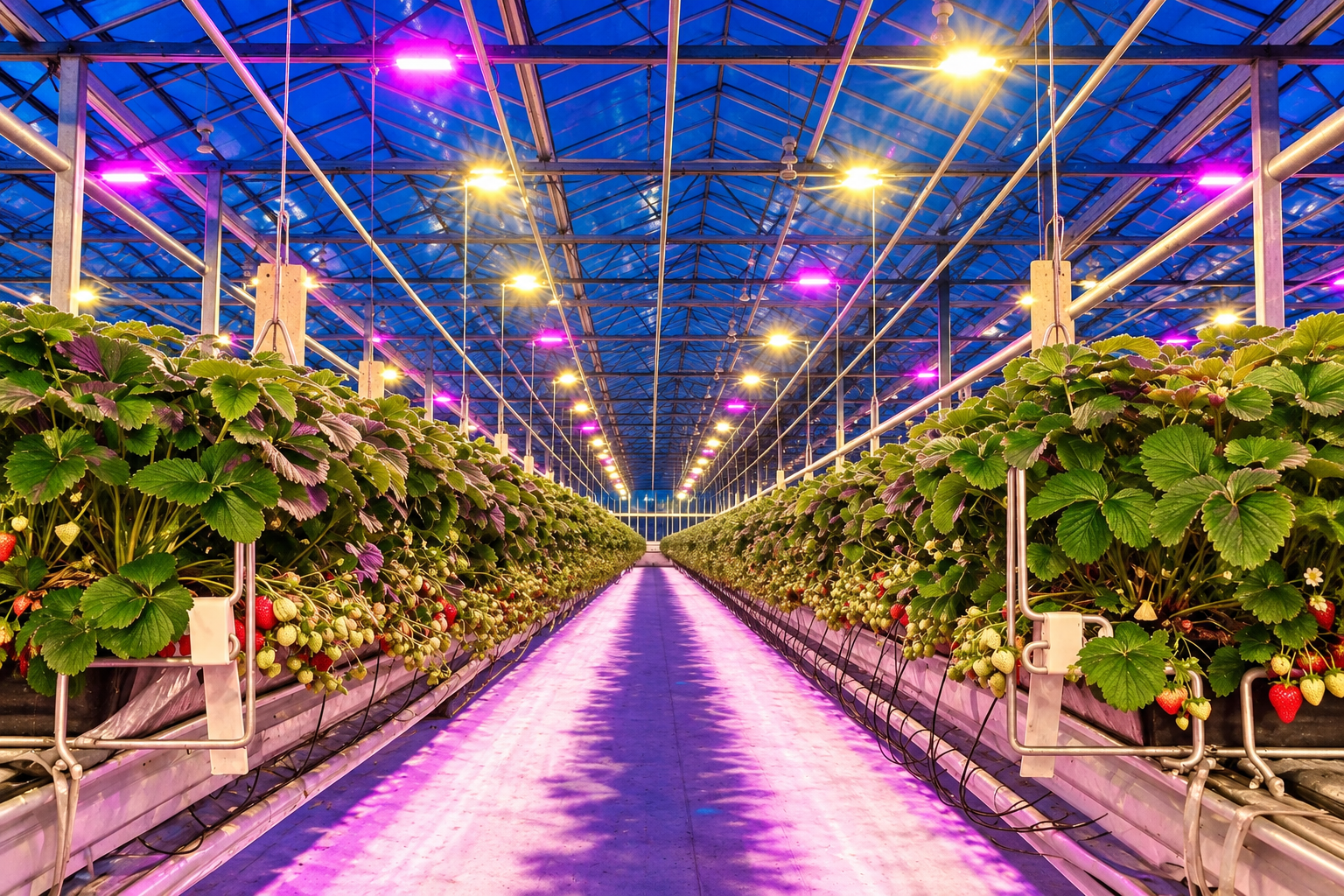
4. Separate Growth Lighting from Disease-Control Treatments
Ordinary LED grow lights should not be described as a general-purpose method for killing bacteria, fungi and mould. Photosynthetic lighting supports crop growth. A disease-control treatment requires evidence for the particular pathogen, wavelength, exposure and operating conditions.
Cornell research on ultraviolet treatment reported suppression of powdery mildew in strawberry trials using a specifically developed UV approach. That work concerns controlled UV treatment, not proof that standard red, blue or white grow lights sterilize a strawberry crop. Any specialist treatment needs validated procedures and appropriate protection for workers and plants.
Day-to-day prevention remains central to indoor strawberry farming. Inspect incoming plants, remove diseased material, keep tools and contact surfaces clean, and maintain access for scouting. Check leaves, flowers and fruit routinely rather than relying only on environmental dashboards.
Moisture management also matters. Condensation, wet plant surfaces and dense canopies can create disease-management problems even inside a modern facility. Coordinate airflow, irrigation timing and moisture removal, and use an integrated pest-management program suited to the local situation. A greenhouse or indoor farm may reduce some outside pressures while still allowing pests and pathogens to enter.
5. Coordinate Cultivar Choice, Pollination and Climate
The fifth factor connects the growing system to the biology of the crop. Cultivars differ in flowering response, harvest timing, fruit characteristics and suitability for the planned environment. Choose planting material for the intended season and sales channel, then validate performance before committing the entire facility.
The NC State greenhouse trial found differences in early harvest patterns among the cultivars tested. For a commercial grower, the practical lesson is to examine when saleable fruit becomes available, not only the final season total. Fruit firmness, flavour, shelf life and picking efficiency also influence whether a production schedule fits the buyer’s needs.
Include pollination in the operating plan. An enclosed growing space changes access for natural pollinators, and flowers still need effective pollen transfer for well-formed fruit. Select an appropriate managed approach with local horticultural advice, then inspect fruit set and shape to check whether it works across all growing levels.
Temperature, humidity, root-zone conditions and irrigation must support both plant health and fruit development. Use representative sensor positions rather than assuming one reading describes the whole facility. Upper tiers, crop edges and areas near air outlets may behave differently. Check sensor calibration and compare recorded values with direct crop observations.
For year-round indoor strawberry farming, plan successive planting batches and replacement periods alongside the harvest calendar. Continuous supply depends on healthy planting material, cultivar response, labour and environmental capacity. It does not follow automatically from growing without soil.
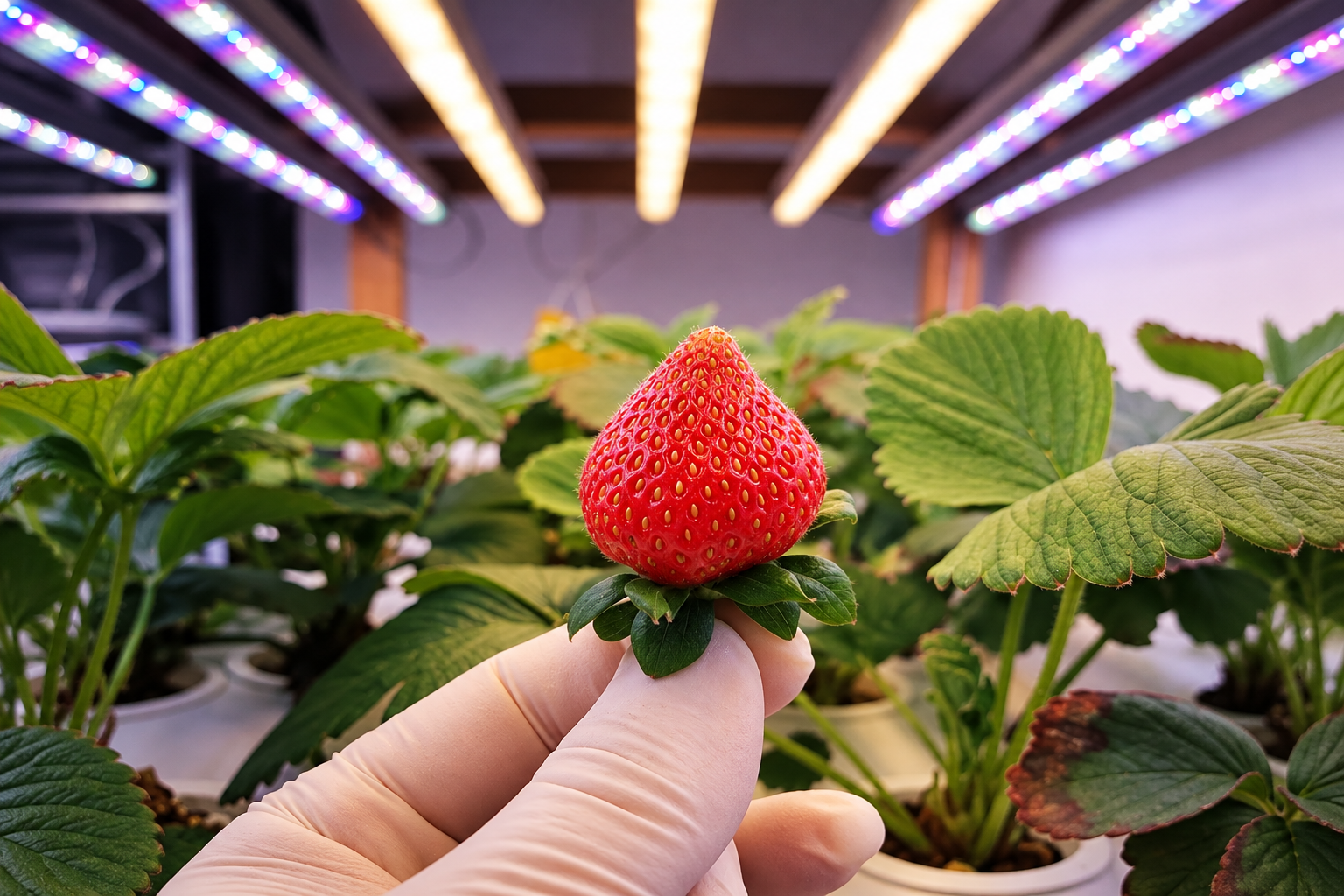
Evaluate Indoor Strawberry Farming Before Scaling Up
A pilot should test the complete production process, including propagation or plant sourcing, establishment, flowering, pollination, harvesting, grading and packing. Record marketable yield, labour, energy, water, crop losses and selling prices over a representative period. Separate measured results from expected improvements.
Calculate cost per kilogram of saleable fruit with heating or cooling, lighting, dehumidification, nutrients, planting material, maintenance, packaging and labour included. Allow for crop changeovers and equipment downtime. A profitable harvest at a premium price does not prove the same system will work at a lower wholesale price or in a different electricity market.
When discussing an equipment package, prepare the facility dimensions, location, available power, source-water information, intended cultivar, production targets and local installation requirements. These details make it easier to coordinate growing structures, irrigation, lighting, sensors and controls as one system.
Wewin Smart Agri supports equipment selection and custom configurations for indoor-growing and greenhouse projects. Share your project requirements to discuss a tailored equipment proposal with your local growing and installation team.