Agricultural Sensor Series · Part 1
This article examines what prevents agricultural monitoring from becoming useful in daily operations. The next installment explores edge computing, power technology, sensing hardware and data interoperability.
Agricultural sensor adoption is often discussed as a hardware challenge. In practice, the harder question is whether the measurements help someone make a better decision. Autonomous tractors, spraying drones and automated fertigation all depend on reliable sensing, but the same principle applies to a single greenhouse: useful data must connect to a practical action.
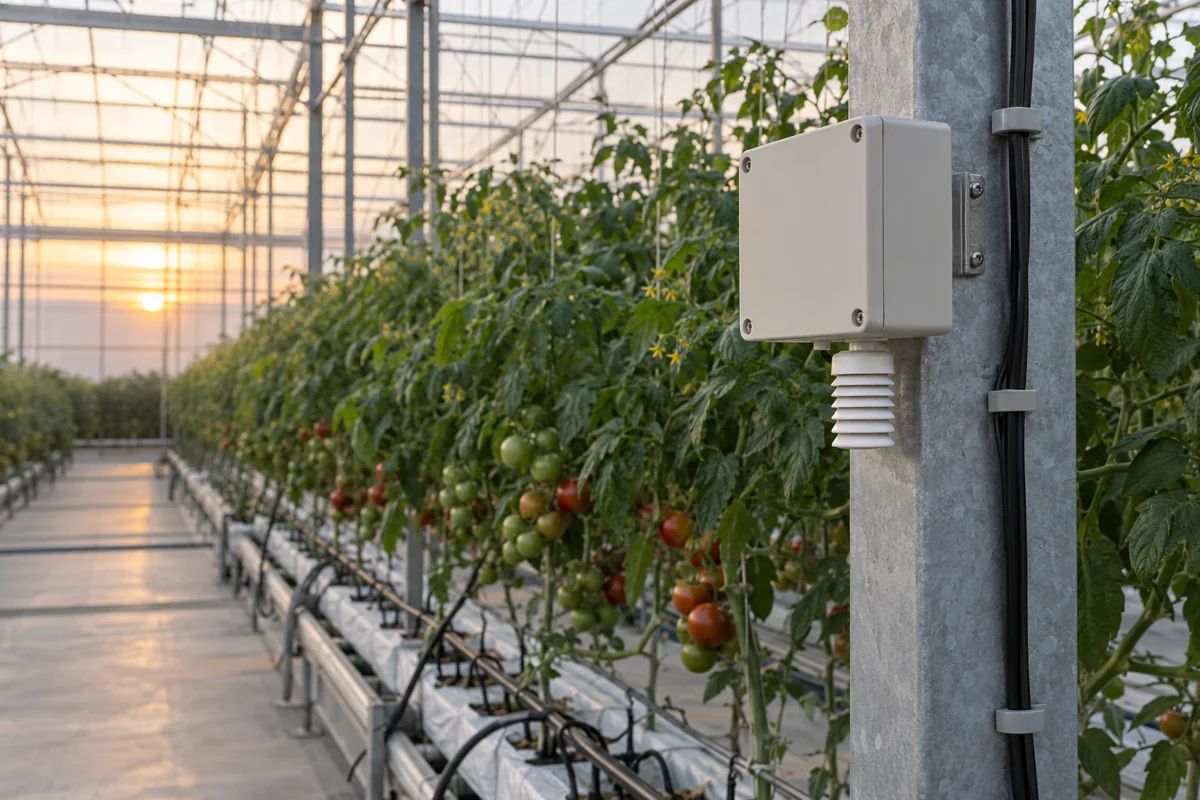
Imagine 4:30 a.m. in Shouguang, a vegetable-growing area in Shandong, China. Zhang steps into his greenhouse in the dark. For years, his first routine has been to look at the plants, feel the soil and judge the air. This morning, he first checks his phone. Air temperature, humidity, root-zone moisture and other readings give him an early picture of conditions before he walks between the rows.
A small environmental sensor on a nearby post is part of that picture. It does not replace his knowledge of the crop. It helps him decide where to look more closely.
This opening and the closing scene are illustrative, adapted from the supplied narrative; they are not a verified Wewin customer case or a reported interview.
1. Agricultural Sensors: The Often Overlooked Foundation
Think of a digital farm as a living body. The software platform acts as the brain, communication networks carry signals, and pumps, valves and ventilation equipment carry out instructions. Sensors provide the observations that make those instructions meaningful.
An attractive dashboard cannot compensate for an incorrectly positioned probe. A sophisticated irrigation algorithm cannot correct an undetected wiring fault or interpret a measurement whose units are unknown. Reliable sensing starts before the data reaches the platform.
For distributors, installers and commercial growers, this changes the first procurement question. Instead of asking how many parameters a device measures, ask which decisions those measurements will support, who will act on them and how their reliability will be checked.
2. The Opportunity Extends Beyond Greenhouses
The original article highlights the breadth of agricultural sensing, from protected cultivation and open fields to livestock and aquaculture. That breadth is worth retaining. A single national adoption percentage or a fixed number of sensors per hectare, however, cannot describe these very different applications.
A greenhouse may need measurements across several climate and irrigation zones. An open field may need strategically placed weather and root-zone monitoring points. A fish farm may prioritize dissolved oxygen and water temperature. The useful deployment density depends on variability, management objectives and the consequences of missing a problem.
The opportunity is therefore more specific than “put sensors everywhere.” It is to build monitoring that operators can maintain, interpret and use throughout a growing cycle.
3. What Holds Back Agricultural Sensor Adoption?
Unclear links between measurements and decisions
A farm can collect thousands of readings without changing a single operation. Before installation, define a question: Is the active root zone drying between irrigations? Is condensation persisting overnight? Is dissolved oxygen falling before dawn? Each question should lead to a responsible person, a check or an agreed response.
Judge a pilot by whether it answers those questions consistently. Do not attribute a change in crop performance to sensors alone without considering weather, crop stage, irrigation management and other changes during the trial.
Incompatible equipment and isolated data
A sensor, gateway and platform can each work correctly on their own and still fail to work together. Sharing an RS485 connection does not establish application compatibility. Buyers also need the protocol, register map, units, scaling, data format and communication settings.
For Modbus devices, obtain the current device register documentation alongside the Modbus Organization’s protocol specifications. Confirm how data can be exported, what happens when connectivity is lost and whether a replacement device can be configured without rebuilding the installation.
Wireless compatibility needs equal attention. LoRa and LoRaWAN are not interchangeable descriptions of a complete system. Confirm the gateway architecture, regional radio configuration and destination-country network availability before selecting equipment.
Reliability and maintenance gaps
Agricultural equipment faces condensation, dust, sunlight, irrigation water, chemical exposure and accidental damage. A laboratory accuracy figure says little about whether an installation will remain useful through these conditions.
Check enclosure protection, connectors, cable entry, mounting and the stated operating environment together. IP ratings describe particular ingress tests; they do not establish resistance to every chemical, prolonged immersion or condensation inside an enclosure. Air sensors also need appropriate exposure and shielding, rather than simply a sealed housing.
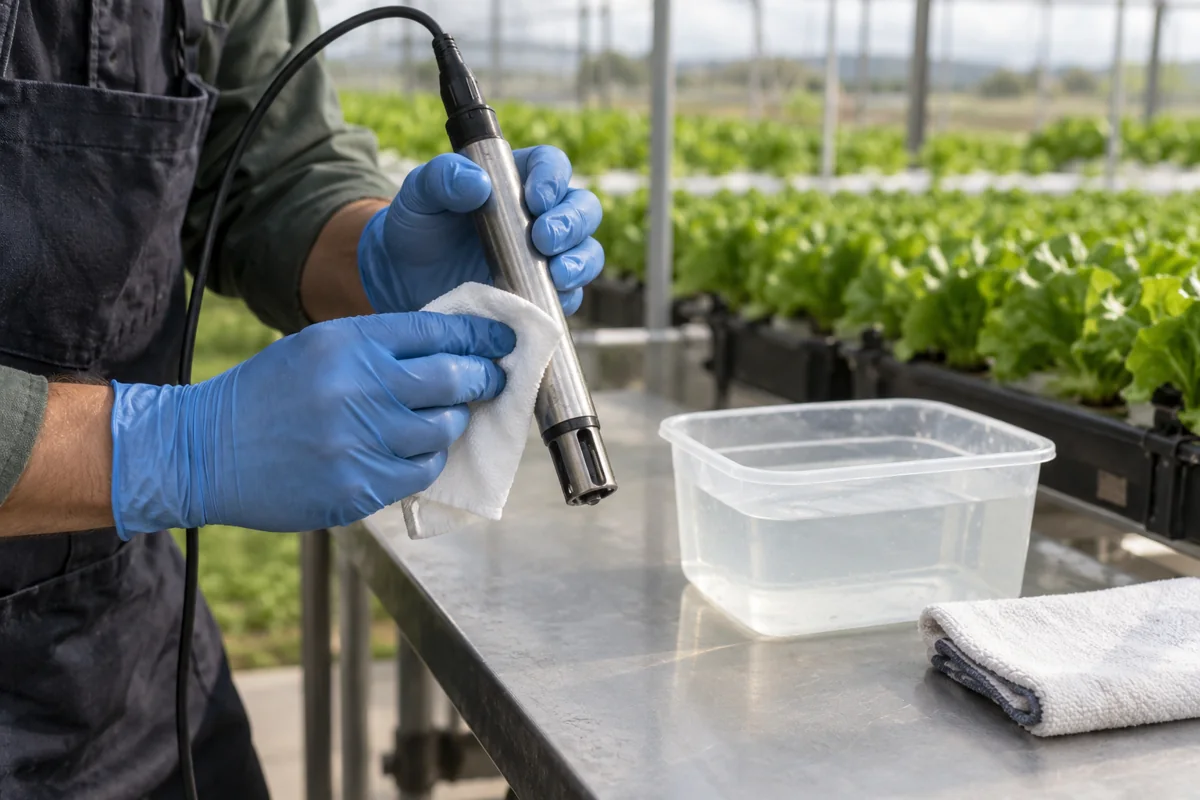
Maintenance should be assigned before delivery. Depending on the measurement technology, tasks may include cleaning, calibration checks, replacing consumables and inspecting power connections. Solar panels need inspection and cleaning as conditions require; replacement should follow their condition, not a blanket schedule.
A reading that continues to arrive is not automatically a reliable reading. For practical fault checks, see our agricultural sensor troubleshooting guide.
Data that operators cannot confidently interpret
Suppose a phone displays “soil moisture: 35%,” while the soil still feels wet. That is not enough evidence to declare the sensor faulty or the operator mistaken. First confirm what the percentage means. Volumetric water content, relative moisture and percentage of available water are different quantities.
Interpretation also depends on soil texture, installation contact, rooting depth and calibration. The University of Minnesota’s irrigation scheduling guidance explains the role of soil water measurements in irrigation decisions. Use such guidance with local crop and soil knowledge.
Training should explain what a reading means, when to question it and what to do next. A clear trend and a practical instruction can be more useful than a screen crowded with unexplained numbers. FAO’s digital agriculture report overview also identifies connectivity and digital skills as enabling conditions for adoption.
4. From Installed Hardware to a Working Monitoring System
Support actual use, not device counts
For project owners and public programs, a useful acceptance process should go beyond counting installed devices. Check continuity, plausible readings, maintenance records and whether staff can explain how the information informs operations. Data volume alone is insufficient: a faulty sensor can produce a continuous stream of poor measurements.
Define service responsibilities
Hardware supply, installation, commissioning, calibration and ongoing support are different responsibilities. A distributor or integrator should state who provides each service, the documentation available and how faults will be handled. A monitoring service may suit some users, while others prefer local data ownership and their own maintenance team.
There is no single model that fits every farm. Agree on data access, export, support scope and the consequences of ending a platform service before choosing the arrangement.
Match the design to the application
A sheltered greenhouse installation and an unattended outdoor station have different needs. Specify environmental exposure, measurement range, power availability and communication conditions for the actual site. Determine battery and solar requirements from the whole system, including transmission intervals, network conditions and any connected actuators.
Self-diagnostics can help identify faults, but should not be confused with automatic calibration. Confirm which checks a device actually performs and which measurements still require a reference procedure.
Combine data with context
Temperature, humidity, radiation and root-zone moisture become more useful when considered with crop stage and recent management. Weather records can support an assessment of spraying conditions; disease-risk models may use leaf wetness and temperature. Neither application should be treated as a universal automatic recommendation without local validation.
Preserve timestamps, units, sensor locations and maintenance history. Without that context, combining datasets can create a misleading picture rather than a clearer one.
5. Different Agricultural Applications Need Different Sensors
| Solicitud | Common monitoring priorities | Important deployment checks |
|---|---|---|
| Greenhouses | Air temperature, humidity, CO₂, PAR, substrate moisture and EC | Climate zones, shielding, root-zone placement and controller compatibility |
| Open fields and orchards | Rainfall, wind, temperature, humidity, solar radiation and soil moisture | Representative locations, root depth, power, radio coverage and maintenance access |
| Livestock housing | Temperature, humidity and application-specific gas monitoring | Animal-level exposure, ventilation patterns, dust and sensor suitability |
| Aquaculture | Dissolved oxygen, water temperature, pH and other water-quality indicators as required | Representative depths, fouling, calibration and tested alarm responses |
Protected cultivation: monitor meaningful zones
Greenhouse monitoring can cover climate, soil or substrate, crop condition and equipment operation. A larger installation may also measure irrigation pressure and flow or confirm actuator position. Each added measurement should answer a management question.
PAR and illuminance are different measurements: lux readings should not be presented as an equivalent measurement of photosynthetically active radiation. Likewise, EC indicates conductivity, not the concentration of each individual nutrient. Soil and substrate pH measurements need an appropriate method and should be checked against suitable reference testing.
Use our agricultural sensor types and selection guide for the broader product comparison.
Open fields: cover variability with representative points
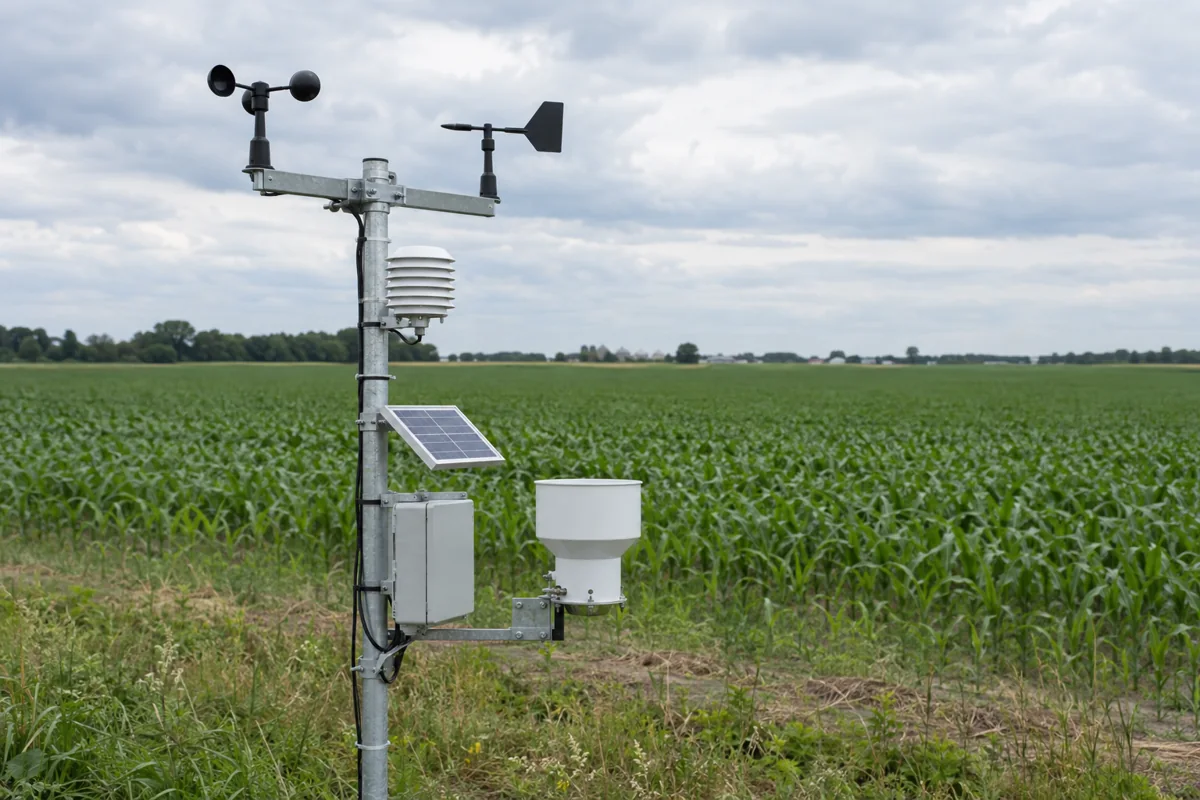
Field deployment requires attention to soil zones, topography, irrigation patterns and access. Select monitoring depths for the crop’s active root zone rather than copying a universal depth or spacing. Weather-station siting also affects whether a reading represents the conditions being managed.
Pest traps and spore-monitoring equipment can complement environmental measurements. Satellite and drone imagery also belong to the wider sensing system: they use optical or other sensors to observe larger areas. Compare weather-station requirements in our agricultural weather station selection guide.
Livestock: separate environmental and individual monitoring
Housing sensors monitor the shared environment. Animal-worn devices may track activity or other indicators depending on their design. Do not assume a collar measures internal conditions such as rumen pH; specialized internal devices use a different measurement approach. Health alerts require appropriate interpretation and do not replace veterinary assessment.
Aquaculture: connect alarms to a tested response
Dissolved oxygen is a critical monitoring priority in many aquaculture operations. Measurement location, depth, cleaning and calibration influence the usefulness of an online probe. The SRAC guidance on dissolved oxygen measurement provides technical background on measurement and instrument care.
If an alarm is intended to start aeration, confirm the complete control arrangement. Test the alarm, operator notification and response to a failed sensor or lost connection. A dashboard alone does not establish that protective action will occur.
6. Sensors Support Experience; They Do Not Replace It
A sensor produces a measurement. Interpretation turns that measurement into information. A suitable response gives the information practical value. The chain can fail at any point.
One soil probe does not describe every part of a field. A temperature sensor near an entrance may not represent the crop canopy. A steady number may reflect stable conditions, a misplaced device or a fault. Field observations and independent checks remain part of sound monitoring.
The most useful approach combines measurements with the grower’s knowledge of the site. If the two disagree, investigate the cause before changing the management plan. Use automation only with defined limits, manual intervention and an agreed response to missing or implausible data.
7. What Could Make Agricultural Sensor Adoption More Practical?
Several development directions deserve attention without treating them as guaranteed outcomes.
Local processing: Some systems can check readings, store data or carry out configured control rules near the equipment. These functions may reduce dependence on an uninterrupted cloud connection, but they must be confirmed for the selected product.
Multiple measurements with clear purposes: Combining parameters can simplify deployment, provided placement suits every measurement and individual sensing elements remain serviceable. More parameters do not automatically mean more useful information.
Better documentation and data access: Clear interface specifications, export options and maintenance records make installations easier to support and extend.
Support throughout use: Installation guidance, commissioning checks and understandable operating instructions help turn a device purchase into a functioning monitoring routine.
Before selecting equipment: a practical project checklist
Prepare the crop or livestock application, site conditions, required measurements and ranges, proposed locations, power supply, communication method, existing gateway or controller, data-access requirements and intended alarm or control actions. Include your sample quantity, expected deployment quantity and maintenance arrangements.
Wewin Smart Agri can help review those requirements for sensor selection and sample evaluation. Send your monitoring requirements to Wewin so the proposed configuration can be checked against your application before a wider rollout.
Back to the Greenhouse: Better Sensing, Better Judgment
Return to Zhang’s greenhouse before sunrise. He has checked the readings on his phone, but he still walks between the rows. He looks at the leaves, checks the irrigation lines and feels the soil.
The screen gives him a starting point. The greenhouse gives him the context. Together, they help him decide whether to irrigate, ventilate or investigate further.
That is the real purpose of agricultural sensor adoption: to strengthen experience with observations that are consistent, understandable and useful. A monitoring system should leave growers with more than hardware. It should leave a dependable record of conditions and decisions that helps them understand the next growing cycle.
Further Thoughts
What do you think is the biggest barrier to wider agricultural sensor adoption: cost, technical challenges, or growers’ willingness to use the technology? Share your thoughts in the comments. If you know a grower or a farm using agricultural sensors, we would also welcome their story: what worked, what proved difficult, and what helped them put the data into practice.