Sensors, often called the “nerve endings of the information age,” have become part of many essential industries. In agriculture, sensing technology provides the data window through which growers can observe changes in their fields, greenhouses and crops.
Agriculture is moving from experience-led production toward a more measurable, traceable and controllable form of management. Pressure on water and land, changing labor availability and uneven production efficiency make this transition increasingly important. Smart agriculture connects measurements with decisions about the growing environment, irrigation and crop management.
But different facilities, crop varieties and geographical environments do not need the same sensing system. Their requirements for accuracy, collection frequency and the types of data collected can be very different.
The selection of precision agriculture sensors therefore needs to consider three dimensions together: facility type, crop category and geographical environment. This article follows that approach, examining how sensing technologies can be matched to agricultural applications, how data support management models, and where the technology is heading.
1. Sensing Technologies for Different Agricultural Facilities
The growing facility provides the physical setting for a sensing system and determines which environmental conditions can be monitored and controlled. Plant factories, greenhouses and open-field farms each require a different approach.
Plant Factories: Sensing Throughout the Production Process
Plant factories use controlled indoor environments to manage light, temperature, water, gases and nutrients. Their sensing systems support the connection between crop measurements and lighting, climate equipment and irrigation.
Monitoring objectives. The main areas are the light environment, air and root-zone temperature, water supply, CO₂, nutrient-solution conditions and crop health. Collection intervals and control response should reflect how quickly each variable changes and what equipment can respond.
Sensor configuration. The original framework identifies several complementary technologies:
- Multispectral and hyperspectral imaging can help assess crop condition, including changes associated with chlorophyll, water status and stress. The band arrangement, resolution and interpretation method depend on the application.
- Sap-flow instruments can provide information about plant water movement. Their suitability depends on stem size, crop type and the measurement technique.
- CO₂ sensors, commonly using infrared measurement, support observation of the atmosphere around the crop and can provide input to a suitable enrichment or ventilation system.
- Water EC and pH sensors monitor nutrient-solution conductivity and acidity. Temperature compensation, calibration and cleaning are part of the measurement process.
- Air temperature, humidity and light sensors provide the environmental record needed to assess growing conditions. Plant-light management should distinguish illuminance in lux from PAR measurements such as PPFD.
Application characteristics. Indoor production places particular emphasis on continuous records, stable environmental control and traceability. A leafy-green growing cycle, for example, may use different lighting and irrigation settings during propagation and active growth. These settings need to match the cultivar, cultivation method and actual growing conditions.
Crop-light assessment also benefits from accumulated daily measurements. Purdue Extension’s guidance on daily light integral explains how light reaching the canopy can be measured for plant production. An ordinary lux reading should not be treated as interchangeable with a quantum-sensor measurement.
Greenhouses: Dynamic Monitoring of the Growing Environment
Greenhouses are a widely used form of protected agriculture. Greenhouse IoT sensors are commonly configured around the environmental measurements most closely connected to ventilation, shading and irrigation.
Monitoring objectives. Air temperature and humidity, light, soil or substrate-water status, and pest or disease observations form the core of many installations. The goal is to connect monitoring, alerts and suitable control actions while reducing the effects of unwanted environmental fluctuations.
Sensor configuration. A greenhouse temperature and humidity sensor should be selected for the expected humidity, condensation and exposure conditions. Light measurement supports assessment of sunlight and shade. Soil-water sensors help track the root environment, while insect-monitoring equipment can provide images or counts where the selected system supports those functions.
Where irrigation also supplies nutrients, flow, pressure, water EC and pH can provide additional information. These are separate measurements and do not have to be packaged as one instrument.
Application characteristics. Readings can be connected to fans, vents, shade systems or irrigation equipment through compatible controllers. For a strawberry greenhouse, for example, the monitoring priorities may include changes in humidity, root-zone water status and disease-favorable conditions. Thresholds should be set for the crop stage and site rather than copied from a universal recipe.
See the Wewin greenhouse monitoring and automation solution for the equipment configuration context.
Open Fields: Monitoring Networks for Larger Agricultural Areas
Open-field production must work with variable weather, soil and terrain. The important questions often involve soil-water availability, pest pressure, weather events and crop condition. A combination of fixed stations and wider-area observation can provide a more complete picture.
Monitoring objectives. Soil and weather observations provide continuous records at selected locations. Pest observations, imagery and field inspection add information at intervals appropriate to the crop and management task.
- Fixed soil-water sensors can measure volumetric water content or soil-water tension. These are different quantities, so their readings and thresholds need different interpretation.
- Agricultural weather stations record selected combinations of air temperature, humidity, wind, rainfall and radiation. Measurements describe conditions at the station; wider-area alerts need suitable interpretation and additional information.
- Insect-monitoring stations can combine traps, cameras and communications. The target species, detection method and recognition performance require verification.
- Drone imagery can add spatial detail to ground measurements, helping identify areas that need inspection.
- Satellite observations can provide broader crop-condition information, with useful coverage depending on the dataset, revisit timing and cloud conditions.
Application characteristics. The original article describes a three-level structure: fixed ground stations, mobile inspection and satellite remote sensing. Ground instruments provide local time-series data; drone surveys help investigate variation within the site; satellite data add a broader view.
In a wheat or maize project, these layers can help identify where to inspect irrigation performance or crop stress. Station quantity should follow management zones, soil variation and the decisions required, rather than a fixed spacing applied to every farm.
2. Matching Precision Agriculture Sensors to Crops and Growth Stages
Crop biology, growing duration and the harvested part of the plant change the purpose of monitoring. Root and tuber crops, leafy vegetables and fruit crops do not place equal weight on every measurement.
Root and Tuber Crops: The Root Environment Comes First
For crops such as yam, radish and potato, root development is closely connected to soil conditions. Monitoring may cover soil moisture, temperature, soil condition and nutrient assessment.
A soil moisture and temperature sensor provides information about the root environment. Soil-compaction measurements can help investigate physical restrictions, while specialist root-observation methods can support research or detailed crop assessment.
The original article also discusses soil fertility and root-growth instruments. These require particular attention to the measurement method. EC is an indicator of conductivity, not a direct measurement of every nutrient. Claims to measure plant-available nitrogen, phosphorus or potassium should be evaluated against reference testing and the actual soil conditions.
For yam production, the practical question is how changes in root-zone water, temperature or physical condition affect development. The same approach can be adapted to cassava or potatoes, with installation depth and interpretation adjusted to the crop.
Leafy Vegetables: Water, Light and Leaf Health
Cabbage, lettuce, spinach and other leafy vegetables respond to changes in water supply, light and the growing environment. Relevant measurements include air conditions, crop-level light, leaf wetness and indicators of plant condition.
Multispectral or chlorophyll measurements can support crop assessment when a suitable interpretation is available. Leaf-wetness sensors track water on a sensing surface and the duration of wet conditions; they should not be described as ordinary relative-humidity sensors attached to a leaf.
Spore sampling and insect monitoring may contribute to an early-warning program, but the observations need a crop-specific disease or pest interpretation. A reading by itself is not a complete diagnosis or treatment recommendation.
For leafy greens in a greenhouse or plant factory, temperature, humidity, root-zone water and light records help explain changing conditions. Disease-risk assessment becomes more useful when environmental records are reviewed alongside crop inspection.
Fruit Crops: Growth, Quality and Harvest Timing
For tomatoes, lychees and apples, monitoring can extend beyond the growing environment to fruit development and quality. The original framework includes fruit-diameter measurement, near-infrared assessment of soluble solids, maturity assessment and firmness testing.
These measurements serve different purposes. A fruit-growth instrument follows changes in size; optical quality methods need crop-specific calibration; firmness testing may require sampling. They should not all be represented as continuously installed, interchangeable sensors.
For a tomato crop, environmental and root-zone measurements can be reviewed alongside growth and quality observations. For date palms or tropical fruit, the same principle applies, but the indicators and interpretation must reflect the crop and production system.
Change the Monitoring Priorities Through the Growing Cycle
Propagation: focus on the nursery environment, growing-medium moisture, light and temperature history. Accumulated temperature can help describe development, but growing degree days are calculated from temperature records rather than measured by a dedicated “accumulated-temperature sensor.”
Active growth: follow water and nutrient management, crop development, environmental variation and pest or disease observations. Measurements should help identify a condition that can be checked or managed.
Harvest: focus on the quality indicators relevant to the product, alongside field conditions and harvest planning. Maturity, soluble solids and firmness need crop-appropriate assessment methods.
The main lesson is to change the monitoring emphasis as the crop develops, while maintaining a consistent data record.
3. Adapting Sensing Systems to Geography and Climate
Climate and geography affect protection, communications, power and installation. The original article compares rainy southern regions, dry or cold northern regions, plains, hillsides and saline soils. These are useful operating-condition categories beyond China as well.
Rainy and Humid Regions
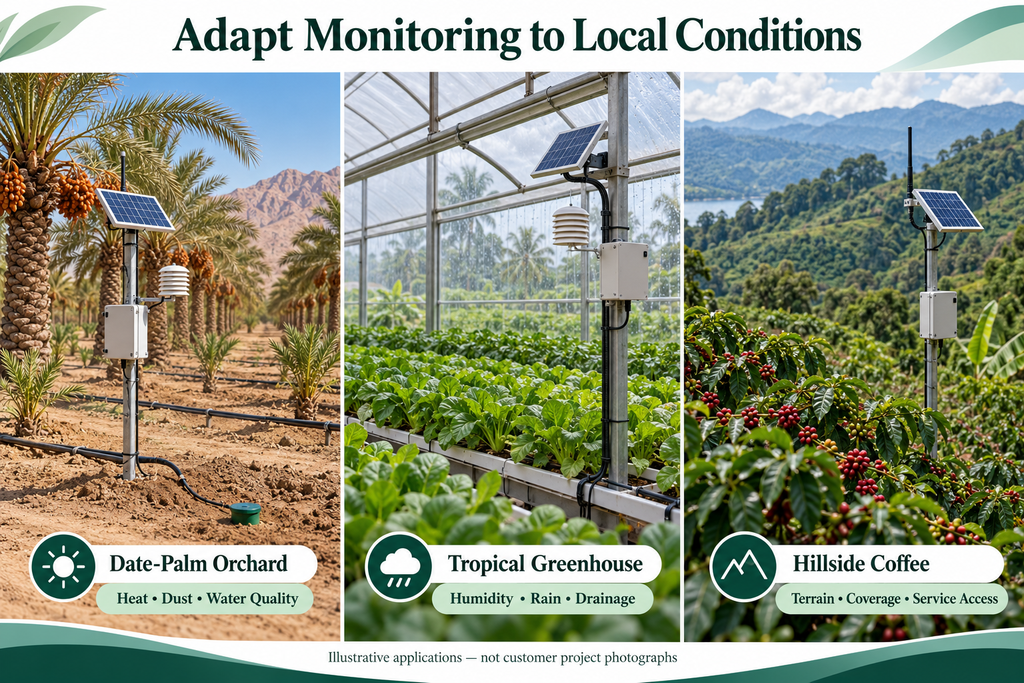
In humid growing regions, rain exposure, condensation, corrosion and drainage deserve particular attention. Relevant equipment may include protected air sensors, rainfall measurement, root-zone monitoring and, where needed, water-level or drainage observations.
Enclosure ratings must suit each component’s exposure. Electronics, exposed sensing elements, buried probes and submerged equipment do not have identical requirements. Connector sealing, mounting and maintenance access matter alongside the rating.
Wireless performance should be checked on site rather than assuming a particular protocol always overcomes rain-related or terrain-related signal problems. Solar and battery arrangements must also account for extended low-sun periods.
A lychee orchard in a rainy region illustrates the relationship between weather, root-zone conditions and drainage. Similar configuration questions can arise in Southeast Asian fruit plantations.
Dry, Hot or Cold Regions
Dry agricultural areas place more emphasis on water availability, irrigation performance, dust and temperature exposure. Soil-water measurements, a local weather station and flow monitoring can provide complementary information.
Cold conditions add requirements for rated operating temperatures, battery performance, freeze exposure and servicing. Hot sites require attention to direct solar heating, radiation shielding and enclosure conditions.
NB-IoT and other cellular connections depend on the local network, supported bands and service availability. Solar-panel and battery capacity should be calculated for the complete system, rather than copied from a generic equipment list.
For a Middle Eastern date-palm orchard, the configuration review might examine heat, dust, irrigation zones and water salinity. This is an illustrative adaptation of the original regional framework, not a report of a completed project.
Plains, Hillsides and Saline Soils
Plains and larger fields: combine representative soil-water measurements, weather observations and irrigation-flow information. Wider-area imagery may help investigate variability. An effective soil moisture monitoring system uses the crop root zone and soil-water behavior to interpret readings.
Hills and fragmented land: consider elevation, slope, shade, access and the location of gateways. Compact, low-power nodes may help, but coverage and maintenance routes need checking in the actual terrain. Hillside coffee plantations in Africa are one example where this planning is relevant.
Saline soils: evaluate salinity, water quality, crop tolerance and material durability together. In-situ soil EC, irrigation-water EC and laboratory soil-extract EC are not interchangeable measurements. Soil pH provides another piece of information and does not by itself establish a soil-amendment prescription.
FAO’s Water Quality for Agriculture explains the role of irrigation-water conductivity in assessing salinity. Interpretation still needs the crop and site context.
Three Principles for Regional Adaptation
- Match environmental durability to the installation: temperature, water exposure, corrosion, dust and electrical conditions.
- Specify the measurement quality and collection interval needed for the agricultural decision.
- Keep deployment practical: representative placement, manageable power requirements and realistic access for servicing.
4. The Data and Model Logic Behind Smart Agriculture
Facility type, crop category and geographical environment are connected. Crop requirements provide the starting point, facility capabilities define what can be controlled, and local conditions create the operating constraints.
A Crop-Centered Model
Consider the original example of greenhouse tomatoes in a dry northern region. The crop has changing requirements through its growing cycle. The greenhouse may provide ventilation, heating, cooling and irrigation. The region adds water constraints, dry air and seasonal temperature exposure.
The sensing system connects those three dimensions. Air and root-zone measurements describe current conditions; control equipment provides the means to respond; regional information helps interpret what is happening.
The original article expresses irrigation and fertilization as functions of multiple inputs. In practical terms, irrigation decisions may use crop stage, root-zone water, rainfall or weather information, and irrigation-system behavior. Nutrient decisions also need crop requirements, water and soil assessment, and the cultivation method.
These relationships describe a decision framework, not a universal mathematical formula or a ready-to-use agronomic recipe.
Solving the Problem of One Configuration for Every Farm
Using the same sensor arrangement everywhere can produce data that are difficult to interpret or act on. Matching the system to the site improves the relevance of the measurements and avoids unnecessary instruments.
Soil-water monitoring illustrates this well. Volumetric water content and soil-water tension describe different aspects of water availability. Installation, representative soil types and appropriate calibration affect the usefulness of the results. University of Minnesota Extension’s guidance discusses these distinctions and their role in irrigation scheduling.
From Data Collection to Decisions and Actions
The next step is to connect collection, analysis, decisions and execution. Integrated sensors, local processing and crop models can support this progression when they are validated for the intended task.
A complete data chain also needs clear units, timestamps, sensor identities, zone labels and access to recorded measurements. For automation, define what happens if a reading becomes implausible, a sensor disconnects or the internet connection fails.
Traceability can be supported by controlled records and data-access procedures. Blockchain may be used in some systems, but it does not prove that the original sensor measurement was correct.
5. Agricultural Sensor Technology Trends and Market Development
Smaller Devices and Lower Power Requirements
Miniaturization and low-power electronics can make monitoring easier to deploy in scattered or difficult locations. Sleep modes and suitable reporting schedules can reduce energy use.
Solar power and other energy-harvesting approaches are also being explored. Their usefulness depends on the available energy and complete system demand. An instrument’s sensing element may be very small, while the field-ready assembly still requires a housing, power source, antenna or connectors.
Multi-Parameter Integration
Combining temperature, humidity, CO₂ and light, or combining selected root-zone measurements, can simplify equipment arrangements and data collection.
Integration works best when a single installation point is appropriate for all the measurements. A combined housing cannot resolve unsuitable probe placement or replace calibration. The measurement method for every parameter should remain clear.
Intelligent Processing, Diagnostics and Calibration
AI and edge computing can support image analysis, local filtering and selected control functions. Instead of sending every raw observation to a remote platform, a system may process information locally and upload a result.
Self-diagnostics can help identify faults or unusual readings. Calibration features may help maintain performance, but their scope and reference method need to be understood. They do not make every sensor maintenance-free.
Development of China’s Agricultural Sensor Supply Chain
The original article describes progress in domestic sensor chips, sensing materials, algorithms and equipment integration. It also discusses collaboration between manufacturers, research institutions and agricultural users.
For international buyers, the practical significance is a broader supply of sensor modules, monitoring instruments and configurable systems. However, manufacturing origin does not establish the performance of an individual model. Accuracy, field durability, protocol documentation, calibration and sample results still need to be assessed.
Policy support, pilot projects and cooperation across the supply chain can help move technology from development into field use. Claims about market shares, subsidies or application results should be tied to their specific place, program and reporting period.
A Path Toward Wider Adoption
The original article identifies three connected approaches: technical improvement, industry collaboration and support for practical deployment. Integrated equipment, dependable data access and clearly defined support can help different sizes of agricultural businesses use monitoring more effectively.
For distributors and installers, a repeatable configuration provides a practical starting point. Begin with the measurements the customer needs, confirm the interfaces and evaluate a representative sample setup before wider deployment.
Wewin’s agricultural monitoring solutions bring together greenhouse, soil and weather-monitoring configurations. Model information is available under أجهزة الاستشعار الزراعية 和 agricultural weather monitoring equipment.
Conclusion: Sensing Is the Foundation of Agricultural Data
Agricultural digitalization depends on data, and sensing technology provides its foundation. The central issue is how to connect the crop’s requirements, the facility’s capabilities and the local environment in one workable monitoring system.
As sensing develops alongside AI, connected platforms and remote observation, agricultural monitoring can bring together information from the ground, the crop canopy and wider-area imagery. Its value remains rooted in reliable measurements and useful decisions.
The “nerve endings” of smart agriculture become meaningful when the information they collect helps people understand and manage real growing conditions. Share your crop, country, growing environment and required measurements with Wewin Smart Agri to discuss a suitable sensor and weather-monitoring configuration.
Source acknowledgment: adapted from the Chinese article supplied by the reader, attributed to Guo Yuansheng’s sensor column in China Electronics News. The original facility–crop–geography framework appears in the January 20, 2026 edition. The structure and main discussion are retained; technical terminology and unsupported universal performance claims have been edited for this English adaptation.