
Agricultural sensors measure the conditions that influence irrigation, crop growth and water quality. But a soil probe, a greenhouse CO₂ sensor and a weather station answer different questions. Choosing the right equipment starts with the decision you need to make, rather than the number of measurements on a product label.
I’m Jing from Wewin Smart Agri. This guide explains the four main groups used in agricultural monitoring: soil sensors, air and gas sensors, weather sensors, and fertigation and water-quality sensors. It is designed to help equipment distributors, irrigation installers, system integrators and commercial growers compare products and prepare a clearer specification.
What are agricultural sensors?
An agricultural sensor detects a physical or chemical variable and converts it into a signal or digital reading. Depending on the instrument, that variable may be soil water content, temperature, humidity, electrical conductivity, gas concentration, rainfall or dissolved oxygen.
Think of sensors as a system’s senses. A logger or controller collects their measurements. A gateway may transfer data to a remote platform, while control equipment operates pumps, valves, fans or dosing devices. These are separate functions: a sensor does not automatically provide wireless communication, cloud access or equipment control.
Agricultural installations also expose instruments to very different conditions. A ventilated greenhouse enclosure, a buried soil probe and an immersed water electrode require different protection. Confirm suitability for the actual environment instead of assuming every agricultural sensor is equally rugged.
Agricultural sensor types at a glance
| Sensor group | Typical measurements | Main applications | First selection question |
|---|---|---|---|
| Soil | Moisture, temperature, pH, EC | Irrigation and root-zone monitoring | What soil or substrate will be measured? |
| Air and gas | Air temperature, humidity, CO₂; selected livestock gases | Greenhouses and livestock buildings | Where will the reading represent crop or animal conditions? |
| Weather | Rainfall, wind, solar radiation, temperature, humidity | Fields, orchards and agricultural weather stations | Which management decision needs local weather data? |
| Fertigation and water quality | Water pH, EC, temperature, dissolved oxygen; flow and pressure | Nutrient delivery, irrigation and aquaculture | What medium, installation and maintenance are required? |
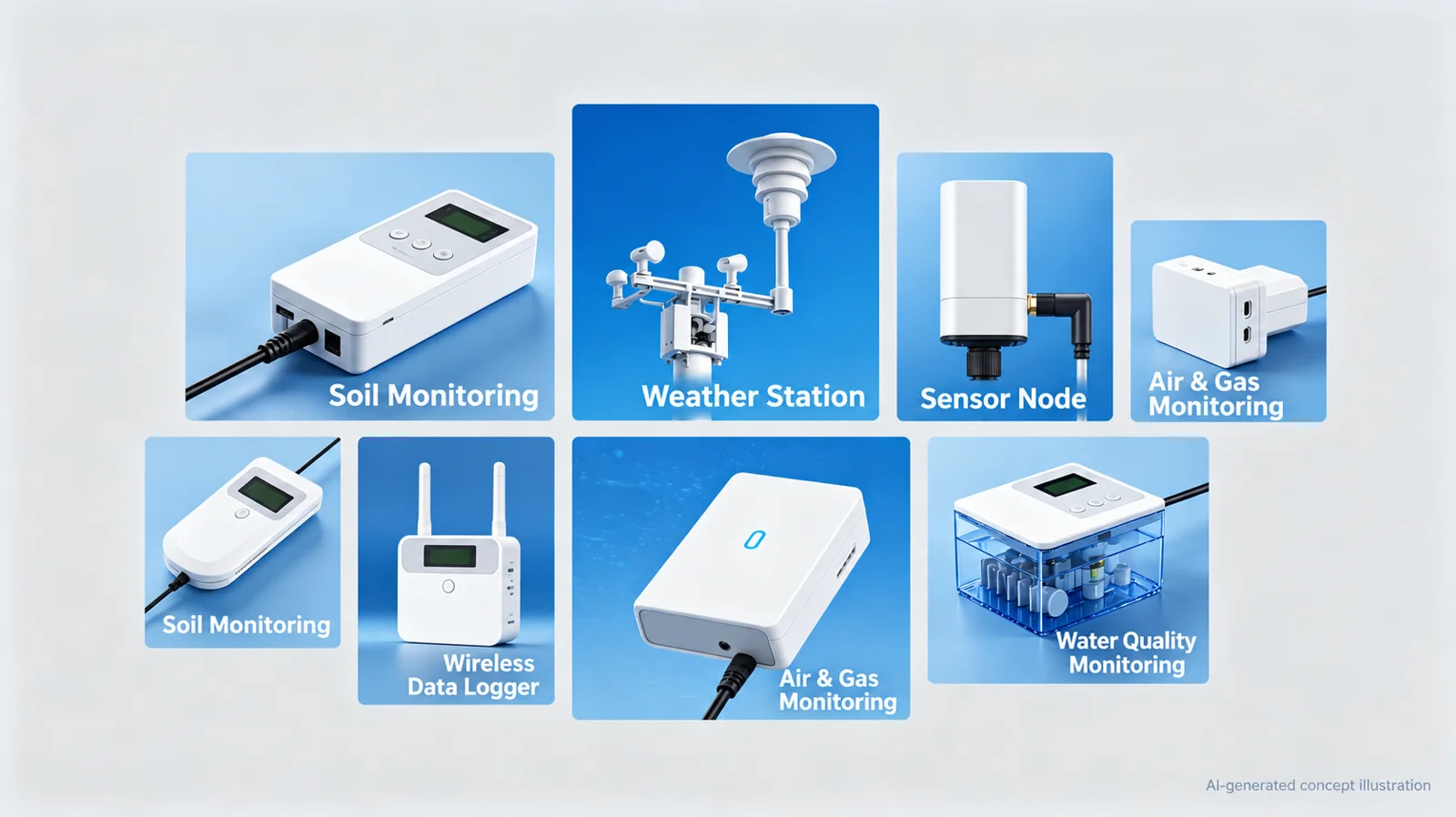
1. Soil sensors: understanding the root zone
Soil sensors help explain what is happening below the surface. Their usefulness depends on representative placement and knowing what each output actually measures. One probe cannot automatically represent every soil type or irrigation zone in a field.
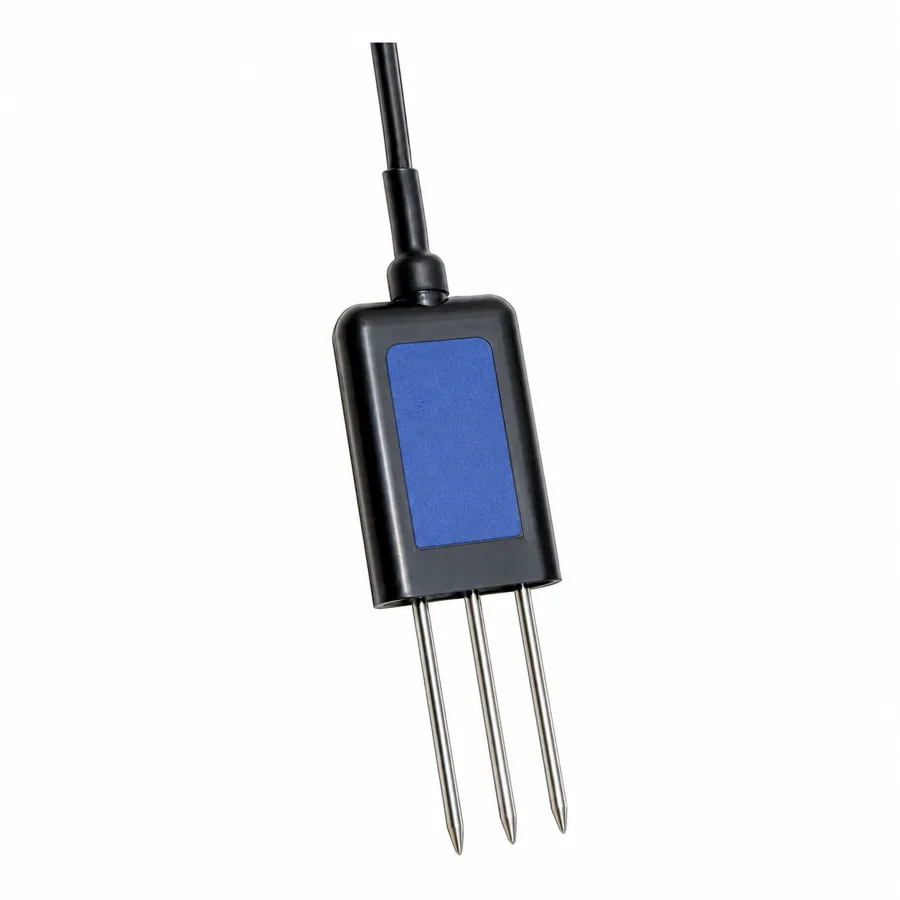
Soil moisture and temperature sensors
Soil moisture sensors support irrigation decisions by measuring or estimating water conditions around roots. Some report volumetric water content, usually expressed as a percentage; others measure soil water tension or matric potential. These values are related, but they are not interchangeable.
A combined moisture and temperature probe can also track root-zone temperature. Check the measurement method, intended soil or growing medium, calibration options and sensitivity to salinity. A specification obtained under one test condition does not guarantee identical performance in clay, sandy soil and a greenhouse substrate.
Installation depth follows the crop’s active roots, growth stage, irrigation method and monitoring objective. There is no universal 10–20 cm depth. The University of Minnesota’s irrigation guidance discusses monitoring at multiple root-zone depths and representative locations. Follow the probe’s installation instructions and maintain good soil contact without air gaps.
For automated irrigation, establish site-specific trigger values and confirm how the controller handles missing or implausible readings. Our soil moisture sensor selection guide covers this application in more detail.
Soil pH and electrical conductivity sensors
Soil pH describes acidity or alkalinity, which influences nutrient availability and crop suitability. Confirm whether a device is intended for direct insertion, a prepared soil sample or another measurement method. Comparing values from different preparation methods without a reference procedure can be misleading.
Electrical conductivity, or EC, indicates how readily electricity passes through the measured medium. Dissolved salts contribute to conductivity, but soil water content, temperature, texture and measurement method also affect the result. Bulk-soil EC, pore-water EC and laboratory extract EC should not be treated as the same value.
智能水肥机 USDA NRCS explanation of soil EC makes an important distinction: conductivity does not directly identify individual ions. High EC may indicate a salinity concern; it does not prove that a particular fertilizer has been over-applied. Interpret it alongside irrigation-water quality, fertilizer records and appropriate soil testing.
Soil NPK sensors: verify the measurement before relying on it
Nitrogen, phosphorus and potassium are essential plant nutrients, but a product displaying three NPK values is not automatically equivalent to a laboratory soil analysis. Ask what the instrument measures, which nutrient forms its outputs represent and how those values were calibrated and validated.
For procurement, request the measurement principle, units, soil preparation requirements, interference information and comparison results against a suitable reference method. Evaluate samples in representative local soils. Do not assume an EC-based estimate can separately quantify available nitrogen, phosphorus and potassium.
Nutrient measurements may support fertilizer decisions when properly validated. They should not be presented as a universal replacement for soil testing or as a stand-alone prescription for variable-rate fertilization.
2. Air and gas sensors: greenhouse and livestock monitoring
Greenhouses and livestock buildings need measurements that represent the conditions experienced by plants or animals. A convenient mounting point beside a door, heater or water outlet may produce an unrepresentative reading.
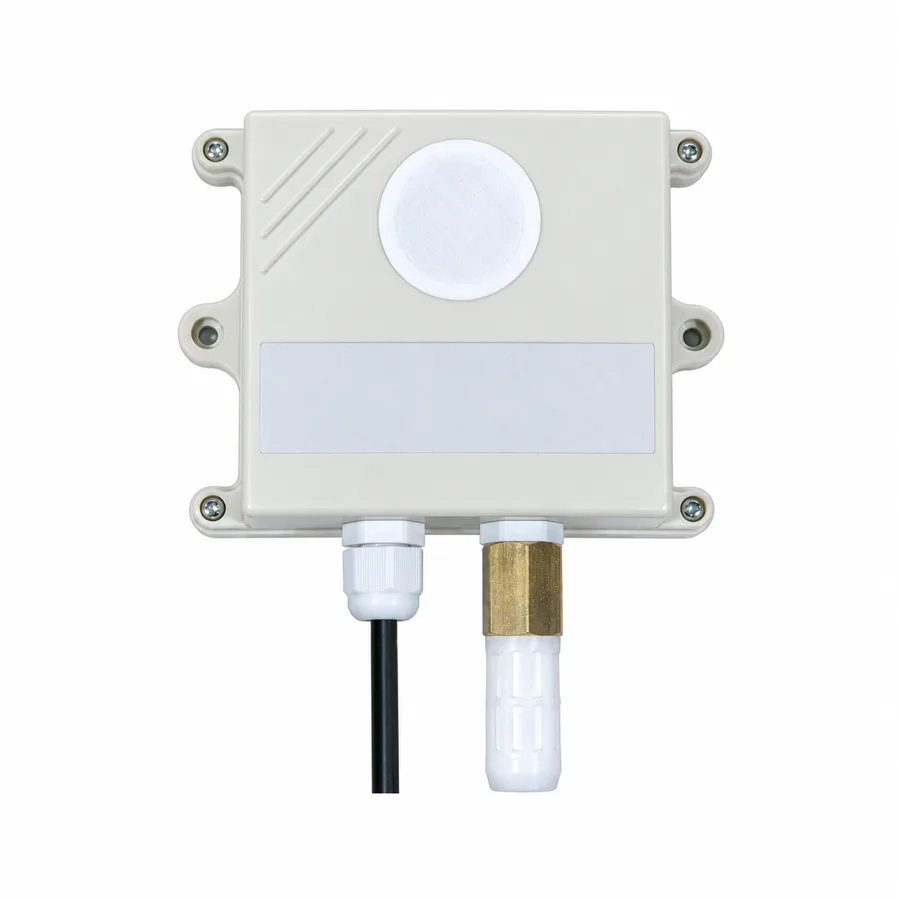
درجة حرارة الهواء والرطوبة النسبية
Temperature and relative humidity help operators manage greenhouse climate, ventilation and condensation risk. In livestock buildings, they also contribute to environmental management. Their interpretation depends on the crop or animal, growth stage, air movement and operating conditions.
Protect the sensing element from direct solar heating, spray and unsuitable condensation exposure. Check whether a radiation shield, airflow arrangement or replaceable filter is required. A waterproof electronics box does not mean its humidity-sensing element can be submerged or continuously wetted.
Combined instruments can simplify installation, but compare the performance of each channel. Sensor response time, recovery after condensation and access for maintenance matter alongside nominal accuracy. A combined greenhouse CO₂, temperature and humidity sensor is one configuration to evaluate when these measurements are needed at the same location.
Carbon dioxide sensors
Plants use CO₂ during photosynthesis, and greenhouse concentrations can change with plant activity, ventilation and enrichment. A CO₂ sensor helps a controller or operator understand these changes; it does not determine the correct enrichment strategy by itself.
Check the sensing technology, range, compensation requirements and calibration procedure. Ask whether automatic baseline correction is suitable for the greenhouse’s actual concentration pattern. Place instruments where they represent the crop zone, away from a concentrated CO₂ outlet unless that is the intended measurement point.
Low CO₂ is not a universal instruction to open vents. Ventilation exchanges air with outdoors and also affects heat, humidity and any supplied CO₂. Enrichment and ventilation decisions must be coordinated with light conditions, climate targets and the installed control system. See Ontario’s greenhouse CO₂ guidance for the relationship between enrichment and greenhouse operation.
Ammonia and hydrogen sulfide sensors
Livestock applications may require ammonia or hydrogen sulfide monitoring, depending on housing, manure handling and the monitoring objective. Select the target gas and range explicitly; a general air-quality sensor is not a substitute for a gas-specific instrument.
Check cross-sensitivity, humidity limits, expected sensing-element life and calibration requirements. Environmental monitoring equipment should not be assumed suitable for worker protection, confined-space entry or other safety-critical use. Those applications need instruments and procedures qualified for that purpose. Any ventilation response also requires correctly designed control equipment and a tested operating procedure.
3. Weather sensors: local measurements for fields and orchards
An agricultural weather station combines selected instruments with a logger, mounting structure and power arrangement. Its sensor list is configurable: rainfall, wind, radiation, leaf wetness and pressure are not necessarily included in every package.
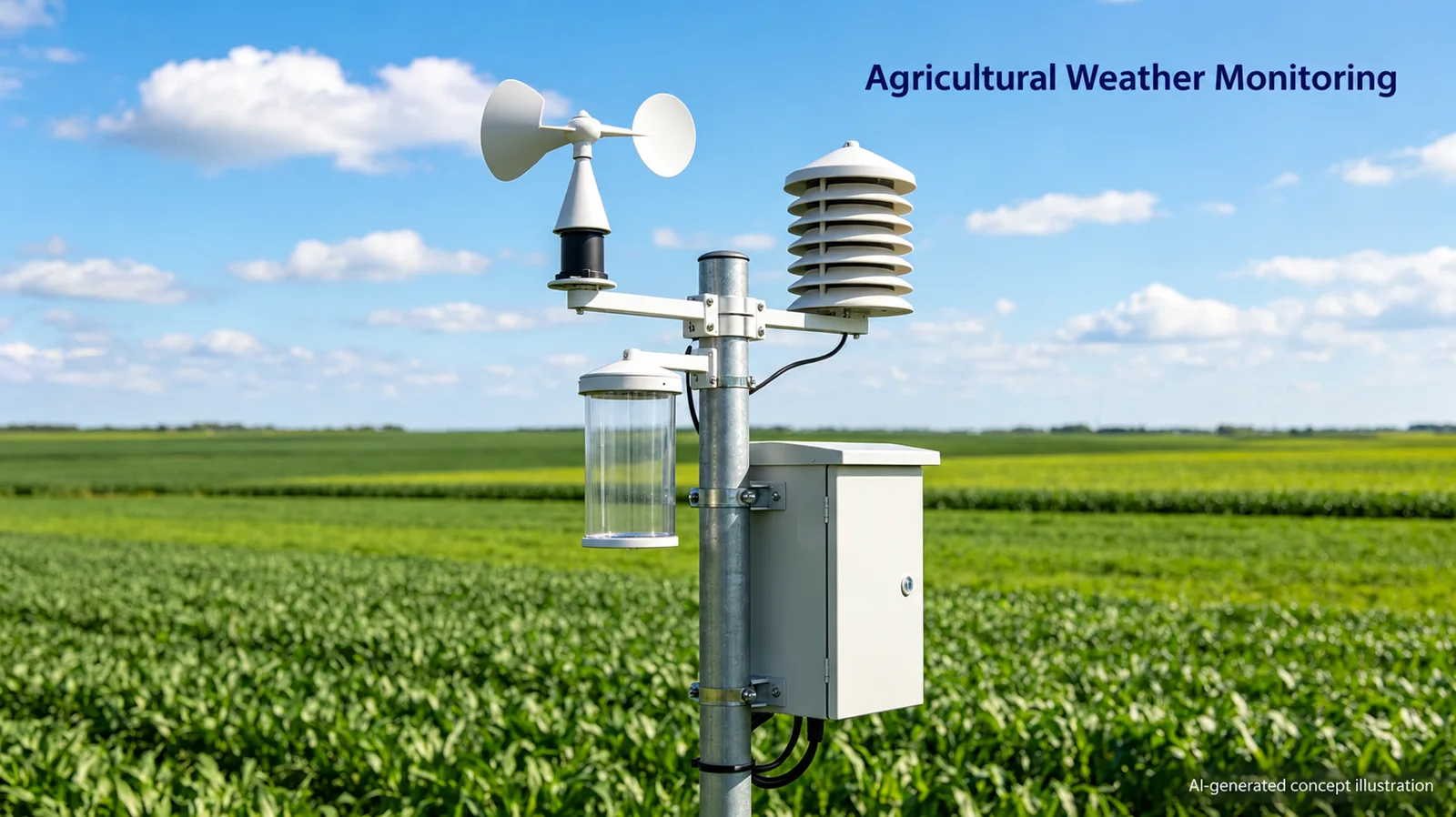
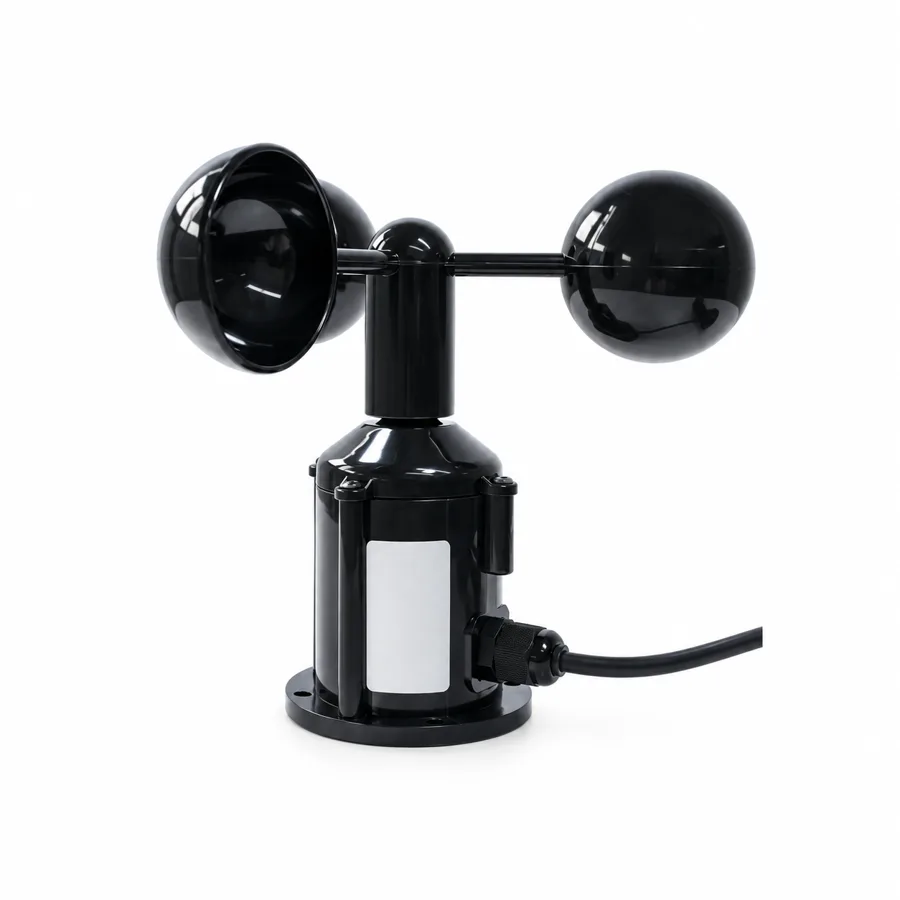
Rainfall, wind and solar measurements
Rain gauges record precipitation and can help assess irrigation needs. Their readings still need interpretation alongside root-zone moisture, rainfall distribution and the irrigation plan. Tipping-bucket gauges require level installation and maintenance; optical instruments have different operating principles and limitations.
Wind speed and direction measurements support operational planning, including assessment of conditions before spraying. They do not replace local application rules, equipment limits or the pesticide label. Mounting height and obstructions influence readings, so document the installation rather than comparing stations solely by their sensor specifications.
Light measurements also need careful naming. Illuminance in lux, solar irradiance in W/m² and photosynthetic photon flux density in µmol/m²/s are different quantities. For crop-light monitoring, confirm whether a PAR/quantum sensor is required instead of assuming a general light sensor provides the same information.
Leaf wetness and disease-risk information
A leaf-wetness sensor detects wetness on its sensing surface. With representative positioning and a suitable model, the recorded wetness duration, temperature and other observations can support disease-risk assessment. It does not directly identify a pathogen or guarantee disease prediction.
For weather-based irrigation calculations, verify the required measurements, siting and software method. The FAO crop evapotranspiration reference explains the meteorological basis; a basic temperature-and-humidity station alone does not automatically provide all inputs for a full reference-evapotranspiration calculation.
Our agricultural weather station selection guide explains how to compare sensor packages, logging, connectivity and installation.
4. Fertigation and water-quality sensors
These instruments monitor the water or nutrient solution delivered to crops, or the water supporting aquaculture. Select them for the actual liquid, temperature, pressure, chemistry and installation arrangement.
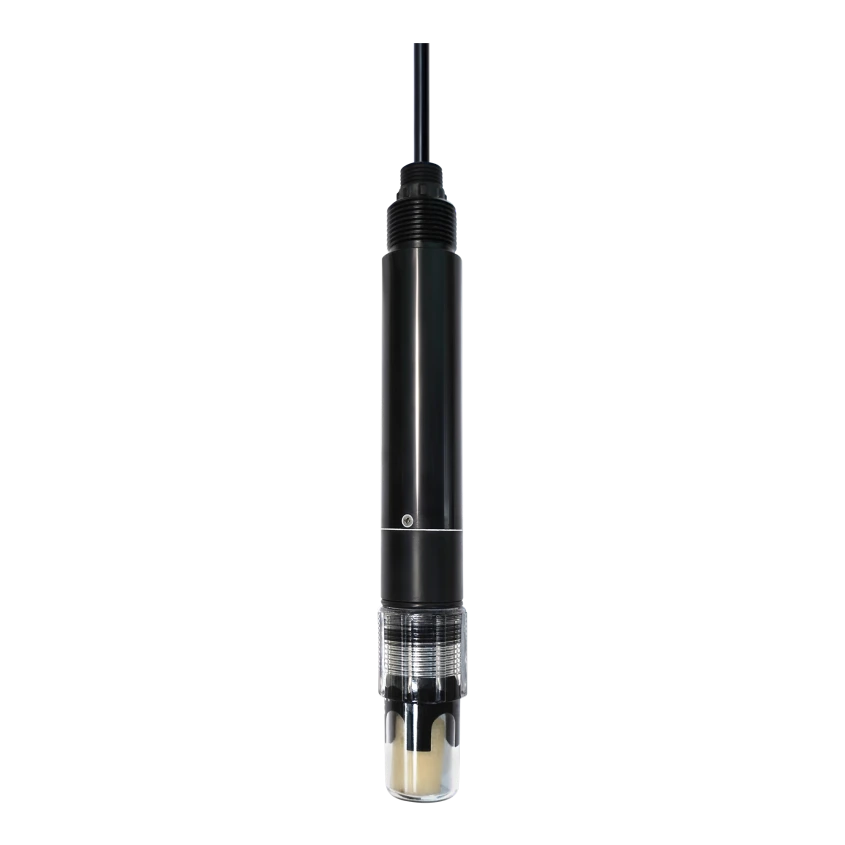
Water pH, EC, flow and pressure
Water pH and EC are commonly used in fertigation and hydroponic monitoring. pH measures acidity or alkalinity; EC reflects overall ionic conductivity. EC can help track a known nutrient solution, but it does not reveal the concentration of each fertilizer ingredient or prove that nutrient ratios are balanced.
Confirm whether the electrode is suitable for immersion, a flow cell or direct pipe installation. Check thread dimensions, pressure limits, wetted materials, installation orientation and access for cleaning. A protective cap shown in a product photograph is not necessarily part of the operating installation.
Provide suitable mixing and a representative sampling point. Calibration fluids, temperature compensation, electrode storage and replacement requirements should be included in the maintenance plan. A water pH sensor for fertigation must be matched to that installation rather than selected on its communication interface alone.
Flow and pressure sensors answer different questions: how much water is moving and what hydraulic conditions exist. Used with a correctly configured controller, they can help identify abnormal delivery conditions. Alarm thresholds and responses still need commissioning against the actual system.
Dissolved oxygen and other aquaculture measurements
Dissolved oxygen, water temperature and pH are useful measurements in many aquaculture applications. Optical and membrane-based dissolved oxygen instruments have different consumables, maintenance and operating requirements. Compare total upkeep as well as the purchase price.
Temperature and salinity affect dissolved oxygen interpretation. Monitoring one convenient point may miss conditions elsewhere or at another depth. The US EPA dissolved oxygen factsheet describes important measurement considerations and the value of continuous records.
If ammonia monitoring is needed, clarify whether the output is total ammonia nitrogen or another quantity. The toxic un-ionized ammonia fraction depends on pH and temperature. Sensor readings, aeration control, backup arrangements and manual checks should form part of an operating plan; installing a probe alone does not guarantee stock protection.
How to select agricultural sensors for your application
Start with the smallest useful monitoring package
For irrigation scheduling, begin by assessing representative soil-moisture measurements and the controller’s data requirements. For greenhouse climate, prioritize air temperature and humidity, then add CO₂ or crop-light measurements when the management objective requires them. For an orchard weather project, define the weather decisions before selecting the station’s channels.
These are starting points, not fixed packages. Add measurements when they support a defined decision and someone can maintain and interpret them. More channels increase installation work, calibration needs and the risk of buying data that will not be used.
Check protection, power and communications together
| العنصر | What to confirm before ordering |
|---|---|
| Environmental protection | Ratings for each enclosure, probe, connector and cable joint; burial or immersion conditions; UV, corrosion and condensation exposure |
| الطاقة | Actual voltage range, peak current, warm-up time and complete logger/gateway demand |
| Wired connection | RS485 or analogue output, wiring, isolation needs, cable arrangement and controller support |
| Digital protocol | Modbus register map, address, baud rate, parity, units, scaling and data format |
| Wireless connection | Radio technology, permitted regional band, gateway/network requirements, coverage and recurring costs |
| Data access | Local display, logging interval, export format, platform access and behavior during disconnection |
| Maintenance | Calibration method, consumables, cleaning, replacement parts and accessible installation |
Do not make IP67 a blanket requirement for every sensor. Select protection appropriate to the exposure, and verify the manufacturer’s stated conditions. Temporary-immersion protection is not the same as suitability for indefinite submersion, chemical exposure or pressure washing. Sensing surfaces may require a different arrangement from the electronics enclosure.
Solar power must be sized for the complete installation and local conditions. A low-power probe does not establish the battery life of a station with a cellular modem. Include transmission frequency, seasonal sunlight, battery capacity and the required autonomy in the specification.
RS485 is an electrical interface, not a guarantee of protocol compatibility. Likewise, proprietary LoRa and LoRaWAN are not automatically interchangeable. NB-IoT depends on compatible local network service, and Wi-Fi requires practical coverage. Confirm the full route from sensor output to usable data before placing a batch order.
Test a sample before standardizing a product
Agree on acceptance criteria before testing. Record the model, firmware or protocol version, wiring and configuration. Compare readings against an appropriate reference under representative conditions, and distinguish resolution, repeatability and accuracy rather than treating them as the same specification.
Test the complete system through a normal operating cycle. Check timestamps, units, data export, power recovery and loss of communication. For control applications, verify safe behavior when readings are unavailable or outside plausible limits. Our agricultural sensor troubleshooting guide covers common power, communication and reading problems.
Frequently asked questions
Can one multi-parameter sensor replace several separate sensors?
Sometimes, when all measurements are needed at the same location and the individual channels meet the requirements. Separate devices may be preferable when mounting positions, maintenance intervals or replacement needs differ. Compare each measurement channel, not only the advertised channel count.
Do agricultural sensors need an online platform?
Not necessarily. A compatible local logger, display or controller can use many wired sensors without an internet connection. Remote access requires additional equipment or network services unless already included. Ask what works offline and what requires a subscription.
Can soil EC readings control fertilizer dosing directly?
Not as a universal rule. Soil EC is influenced by several soil and water conditions and does not identify individual nutrients. Dosing requires an appropriate control design, defined measurement points and agronomic targets. Water-solution EC and bulk-soil EC should not be used interchangeably.
What should a distributor request for repeat orders?
Request stable model identification, current datasheets, protocol documents, wiring diagrams, agreed labeling and packaging, sample acceptance criteria and notification of relevant product changes. Confirm spare parts, calibration supplies and support arrangements for the destination market.
Discuss your sensor requirements with Wewin Smart Agri
The most useful agricultural sensors are the ones that provide reliable information for a specific decision. Soil, air, weather and water measurements work together, but each needs an appropriate instrument, installation and data path.
To request a sensor recommendation and quotation, send the following information:
- Application, crop or monitored process, and destination country.
- Required measurements, expected ranges and acceptance criteria.
- Soil, substrate, water or gas conditions, including temperature and exposure.
- Existing controller or logger, supply voltage and communication protocol.
- Number of monitoring points, cable lengths and intended mounting locations.
- Local or remote data requirements and available connectivity.
- Sample quantity, expected order quantity, and labeling or packaging requirements.
Wewin Smart Agri can help review product fit, available configuration options and sample-testing requirements before preparing a quotation. Share your actual application first so that the proposed equipment matches the job.